POINTCAST COLLEGE FOOTBALL · SOUND DESK 001

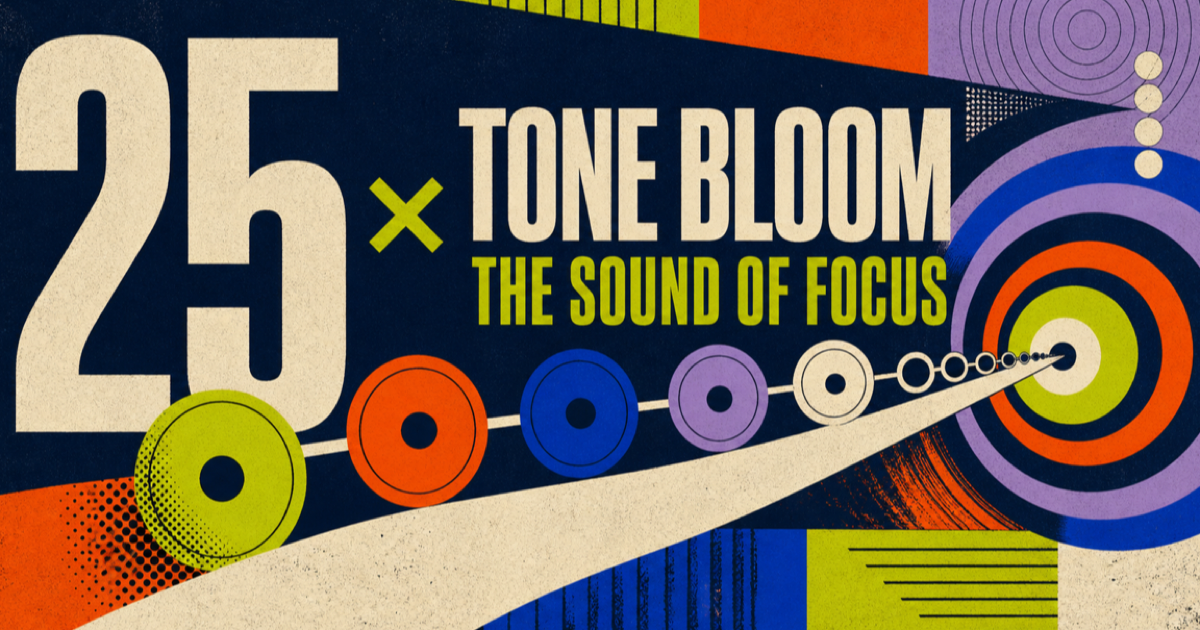
POINTCAST 25 × TONE BLOOM · MICHAEL HOYDICH

THE SOUND
OF FOCUS

What the work sounds like before the stadium arrives.

The game is loud.
The work is not.

College football is usually described at stadium volume. Most of its decisive attention happens earlier and quieter: the film room, the playbook, the belief board, the operation, and the walk that lets the mind widen again.

A quarterback does not focus by staring harder at one defender. The useful sequence is wider: hold the whole shell, notice the conflict, narrow to the answer, execute, and then release enough of the last play to see the next one.

The same aperture moves through the rest of college football. Film study is sustained attention. A playbook protects language. A belief board needs generative attention. Saturday operations need tempo. The walk home needs no new assignment.

Wide. Conflict. Narrow. Go.

A tiny attention model, not a quarterback simulator. Run the clock and watch the field ask for four different shapes of focus.

READY 25 SECONDS
See the whole shell.

Start wide. The first job is not to pick an answer; it is to preserve enough field to notice what changes.

The task changes
the soundtrack.

01

Deep Field / Narrow and hold

The Film Room

Find the repeatable truth inside too much footage.

Opponent film, protection structure, coverage tendencies, self-scout, and the moment the first theory stops surviving the tape.

“What is the one pattern that changes the call?”
THE SOUND

Low brown field, very sparse glass, and an optional split beat. No lyrics. No dramatic drop asking to become the work.

SPOTIFY / Deep Coding Mix ↗
25 × Tone Bloom graphic field of colored chimes and stereo waves

Do not ask what works.
Run the study.

Tone Bloom turns these five states into filtered noise, sparse chimes, optional split-ear beats, and a private 25-minute N-of-1 study. Rotate Tone Bloom, Spotify, and silence. Rate focus before and after. Count distractions. Name the actual output.

  • No account and no uploaded study data.
  • Five Spotify playlists created for the feature.
  • Twenty-five practical focus moves.
  • An evidence cabinet for caffeine, adaptogens, nootropics, prescriptions, and cannabis.
OPEN 25 × TONE BLOOM ↗

Five things the scoreboard cannot tell you.

  1. 01

    Attention changes shape

    Sustained film study, verbal learning, strategic invention, operations, and recovery do not ask the nervous system for the same thing.

  2. 02

    The crowd is not the model

    Stadium music is designed for shared arousal. Work sound is often better when it masks, paces, or gets out of the way.

  3. 03

    Silence is a condition

    The study rotates Tone Bloom, Spotify, and silence. A soundtrack has to beat the quiet result, not only the annoying room.

  4. 04

    Feeling focused is one measure

    Completion, accuracy, recall, and distraction count can disagree with how compelling a session felt.

  5. 05

    Recovery belongs on the board

    The walk home is not empty time. It is the wide state that makes another narrow state possible.

Potential
is not proof.

College football is full of performance language. That makes clean boundaries more important, not less. This is education, not medical advice or a protocol.

01

Caffeine

Useful for some, with real tradeoffs

A familiar amount may support alertness. More can produce anxiety, palpitations, and damaged sleep. The FDA 400 mg/day reference is not a target.

02

Binaural beats

A sound condition, not a treatment

Two nearby tones sent to opposite ears create a perceived beat. Attention findings and brain-entrainment claims remain inconsistent.

03

Adaptogens + nootropics

Product-specific and often overmarketed

“Natural,” “adaptogen,” and “nootropic” are not evidence grades. Ingredients, purity, interactions, task, and repeated observation all matter.

04

Prescription stimulants

Clinical treatment, not shared equipment

They can be effective when appropriately prescribed and also carry misuse, addiction, and overdose risks. Never borrow or share them.

05

Cannabis

Felt focus can disagree with measured focus

THC can impair attention, memory, learning, decisions, coordination, and reaction time. Tone Bloom logs cannabis only as an observational context tag.
Read past
the promise.

The useful finding is usually narrower than the marketing sentence. These are the primary research and public-health sources carried into the interactive companion.

  1. 01 PLOS One systematic review · binaural-beat entrainment evidence
  2. 02 Memory & Cognition · music with lyrics and cognitive tasks
  3. 03 Scientific Reports · preferred background music and task-focus
  4. 04 U.S. FDA · caffeine amount, sensitivity, and safety
  5. 05 NIH NCCIH · Rhodiola usefulness and safety
  6. 06 NIH NCCIH · Ashwagandha usefulness and safety
  7. 07 U.S. CDC · cannabis and brain health
  8. 08 U.S. FDA · prescription stimulant warnings
  9. 09 World Health Organization · safe listening