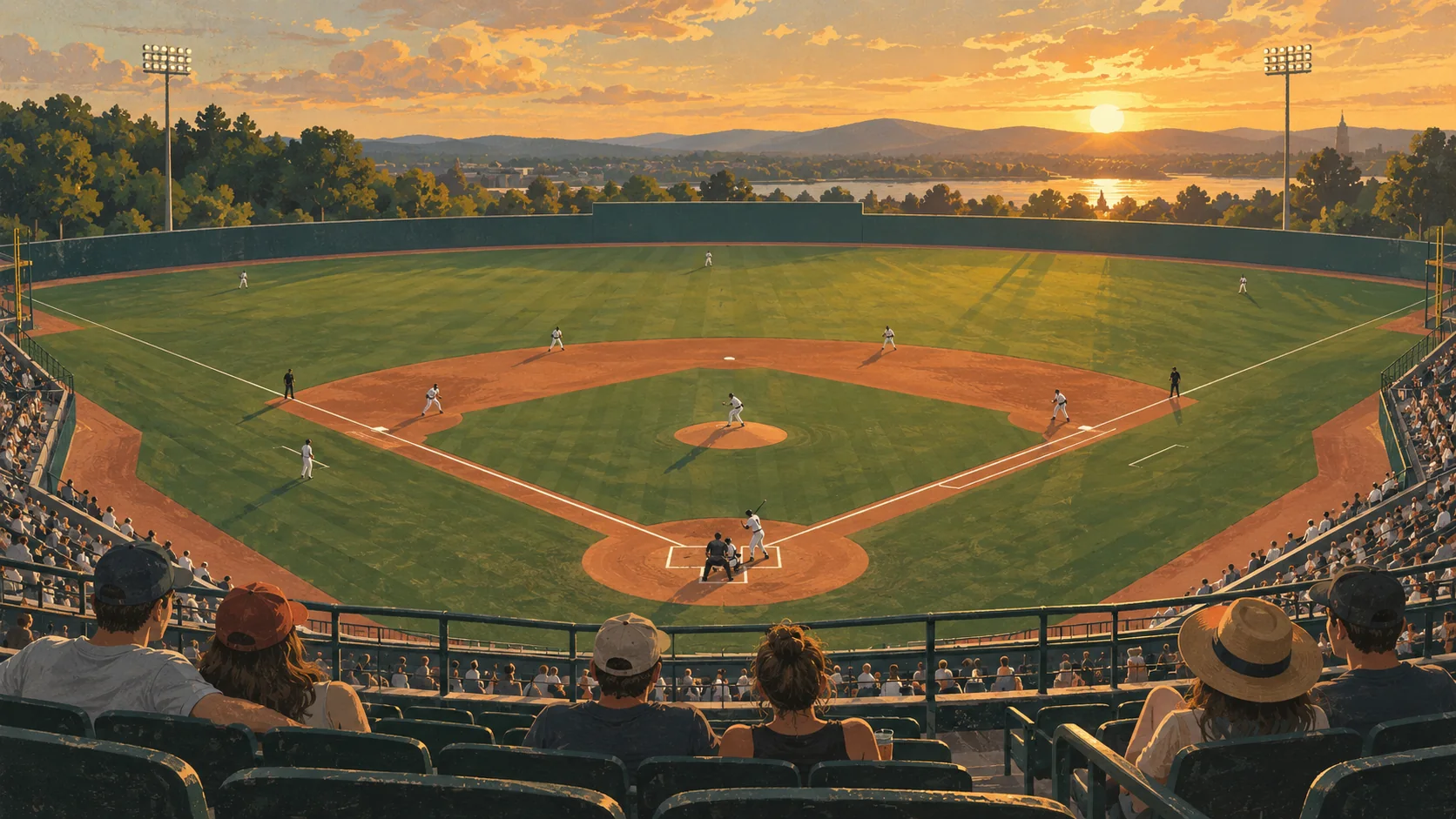
Baseball asks you to look at a patch of grass for a long time. Then, without much warning, everyone in the place looks at the same thing.
The ball leaves a hand. A runner leans. A bat makes its small, enormous sound. For a few seconds the afternoon has a direction.
There are plenty of ways to love this game: the numbers, the argument, the impossible catch, the radio voice coming through an open window. Here is another. Baseball makes a place where attention can be shared without being identical. One person keeps score. Another watches the pitcher. Someone is mostly there for the person sitting next to them. They are all at the game.
The field is a familiar sentence
The infield is a square with ninety feet on each side. Home, first, second, third, home again. The pitcher’s plate sits sixty feet, six inches from the rear point of home plate. Those distances come from the official rules, not from nostalgia.
The outfield opens beyond that little circuit. Its shape and boundaries can give a park its particular character. A shared grammar, a local accent. You can arrive somewhere unfamiliar and still recognize where a runner is trying to go.
That is an unusually good arrangement for a public place. Enough structure to understand what is happening; enough room for the place to feel like itself.
Between the things that happen
Baseball is organized around outs and innings. A regulation game is normally nine innings, with exceptions and the possibility of extra innings. That does not mean the modern game is timeless: MLB uses a pitch timer.
Still, the experience has seams. A new batter walks up. A side retires. The field changes hands. The conversation can wander and return. You can give your whole attention to a pitch without having to give every second of the afternoon the same kind of attention.
This is the PointCast reading of the game: the pauses are part of its social architecture. They leave room for a question, an explanation, a sandwich, a story someone has told before and is going to tell again.
A pencil is a way of staying
A scorecard turns watching into a small act of making. A single gets a mark. A runner gets a line. A run completes a diamond. By the end, the paper has learned something about the afternoon.
The Baseball Hall of Fame preserves hundreds of handwritten scorecards and scoresheets. A fan’s scorecard follows the action; an official scoresheet breaks it into statistics. Either way, a passing event becomes something another person can read.
You do not need to be an expert to begin. One inning is enough. Ask what the mark means. Miss a play. Ask again. The pencil is an invitation to pay attention, and a good excuse to talk to the person who knows.
Who gets to be in the picture?
A warm picture of baseball needs its history in the frame. The game’s institutions excluded people. Other people built places to play anyway.
In 1920, Rube Foster established the Negro National League at Kansas City’s Paseo YMCA, a history preserved by the Negro Leagues Baseball Museum. Jackie Robinson played for the Kansas City Monarchs in 1945 before making his National League debut for Brooklyn on April 15, 1947, as documented by the Hall of Fame.
These are not footnotes to an otherwise uncomplicated story of togetherness. They are part of the story. A crowd is not automatically a community. Someone has to open the door, and people have had to fight for the right to walk through it.
The people beside you
Albert Von Tilzer and Jack Norworth wrote “Take Me Out to the Ball Game” in April 1908. The Library of Congress keeps that song’s history. It is easy to think of a crowd as the audience. A song gives the audience a part.
The invitation does not have to be grand. A neighborhood field will do. A game on the radio will do. An inning watched with someone who can explain one thing will do.
Ask who taught them to watch. Ask which player they remember. Ask what just happened. Leave enough quiet for the next pitch.
The game gives you something to look at together. What you make of the afternoon is yours.
PointCast / a look at baseball