LOW-FI
Few parts. Huge revelation.
- Crystal Radio Picnic
- Cassette Sun Station
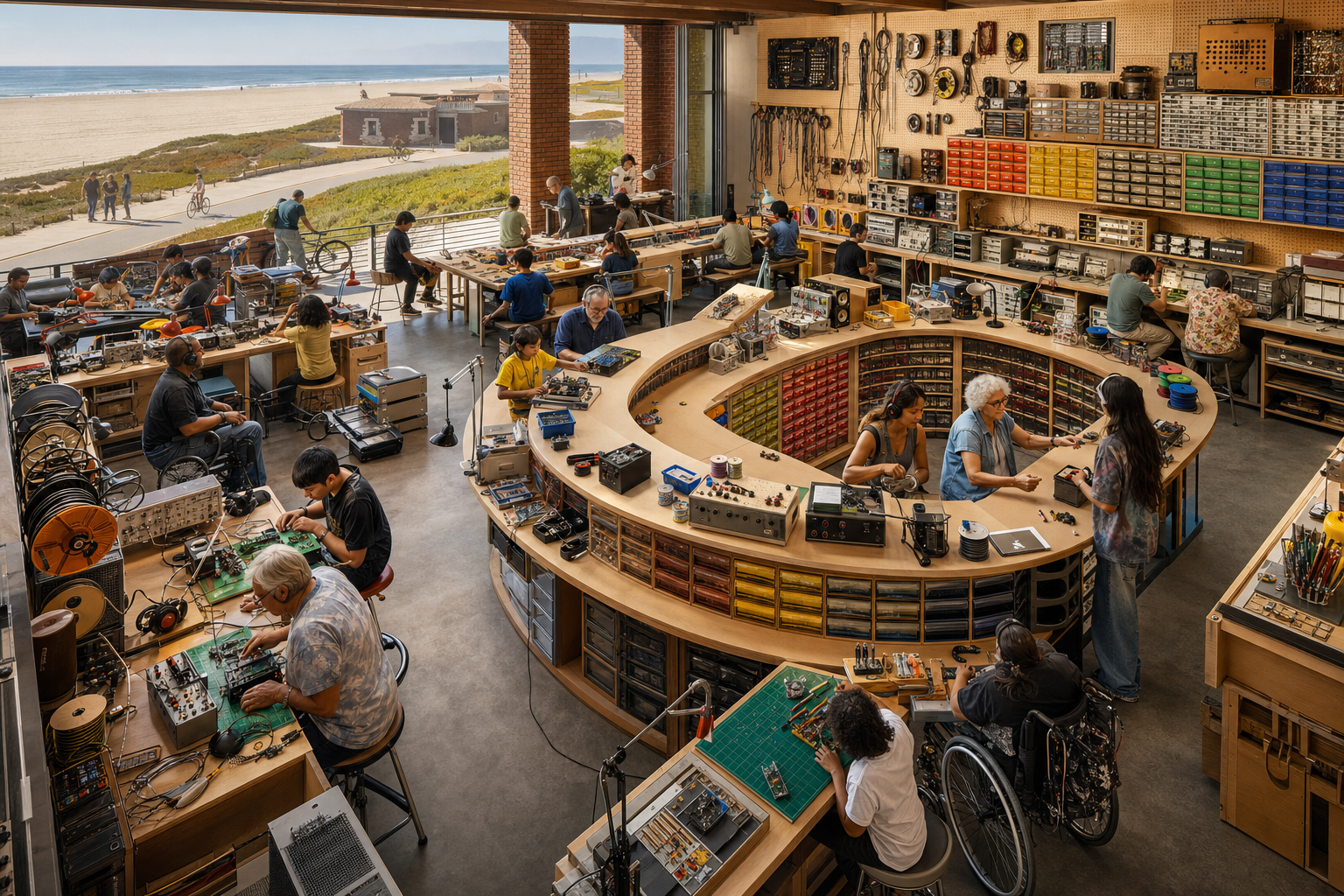
PointCast Field Study 009 · unofficial concept · El Segundo coast
The neighborhood electronics counter returns as a public coastal workshop: eight group benches, charming low-fi, ambitious hi-fi, and nothing that needs a feed.
There was a particular kind of store where the smallest object—a resistor, an adapter, a blank cassette—could start the longest conversation. Signal Shack brings that social function back as a covered group workshop.
Advanced does not have to mean isolating. The room stretches from a passive crystal receiver to local AI, but the primary technology is still a table where one person can show another what the part does.
The beach supplies light, weather, public horizon, and a reason to listen. It does not become a construction site, antenna field, campground, test range, or content backdrop.
Few parts. Huge revelation.
Sense locally. Coordinate modestly.
Receive the larger public signal.
Complex tools, transparent limits.
Each bench has a revelation, a group move, a finite tray of parts, and a boundary. The point is not to finish eight products. It is to let eight kinds of technical confidence circulate.
A neighborhood counter where asking for the tiny weird thing is the beginning of a conversation.
The build
Eight rolling benches orbit one color-sorted commons. Every tool and component checks out on a physical tray, then comes back before the bell.
The group move
Arrive with one broken object, one useful component, or one thing you know how to do. Leave having taught and learned one move.
Boundary: Low-voltage bench work in an authorized room; supervised tools, eye protection, accessible heights, protected charging, complete parts count.
Copper, a diode, an ear: the smallest possible lesson in pulling a signal from the air.
The build
Wind coils, clip passive circuits, tune slowly, compare antenna and ground demonstrations, and split one quiet receiver across two headphones.
The group move
One person winds, one clips, one logs changes with colored tokens, and one listens. Rotate every eight minutes.
Boundary: Receive only. Use a safe indoor teaching antenna and qualified mentor; no long exterior wire, transmitter, or exposed mains.
Repair the transport, catch a wave texture, cut a loop, and make the quietest dance floor on the coast.
The build
Re-belt cassette decks, make short physical loops, build contact microphones, then route tape and tiny synth voices through a four-way headphone patch.
The group move
Every team contributes exactly thirty seconds: wave texture, machine rhythm, voice-free field sound, or hand-built oscillator.
Boundary: Headphones and near-field testing inside the approved room; no amplified beach music, unattended batteries, or recording of private conversation.
Short local messages move from lantern to lantern even when the room chooses to stay offline.
The build
Fit certified low-power LoRa modules into repairable cases, keep stock antennas intact, and use a tabletop token game to understand store-and-forward routing.
The group move
Write a short practical message, hand its matching wooden token to the next bench, and watch the digital and physical routes diverge.
Boundary: Certified modules and stock antennas only. Local experimental messaging is not guaranteed coverage, emergency service, or permission to modify a transmitter.
Turn wind, pressure, warmth, humidity, and texture into light, pen movement, and private sound.
The build
Combine a compact microcontroller with environmental sensors, an analog reference, and one non-screen output: beads, light, a pen trace, or headphones.
The group move
Half the table predicts what changed; half reads the instruments. Trade sides, then discuss where the devices disagree.
Boundary: A learning instrument, not a forecast or air-quality authority; no faces, biometrics, wildlife tags, drones, kites, exterior mast, or permanent station.
Receive public weather imagery from space, then translate clouds into print, weaving, light, and sound.
The build
A mentored receive-only SDR table introduces filters, antennas, public GOES data, and the difference between receiving a signal and transmitting one.
The group move
Radio listeners describe structure; artists answer without copying the display. The finished weather window belongs to both teams.
Boundary: Receive-only demonstration with authorized equipment and placement. No transmission, hacked satellite, emergency interception, or giant command screen.
Use a small local model as a bench assistant—visible, offline, fallible, and always subordinate to human judgment.
The build
A local accelerator helps sort components, compare healthy and failing bearing sounds, and point a board-only camera toward possible solder defects.
The group move
One person asks, one verifies with a meter, one finds the service evidence, and one gets to disagree with the machine.
Boundary: Offline by default; no faces, personal data, surveillance, cloud account, autonomous repair decision, or claim that a model makes equipment safe.
Every bench becomes one channel in a collective instrument nobody outside the room has to hear.
The build
Patch repaired transports, contact microphones, analog preamps, local signal processing, meters, light objects, and a many-branch headphone tree.
The group move
Each bench sends one restrained layer. The final mix succeeds only when the group leaves enough space to hear everyone else.
Boundary: Headphone-first and permitted indoor listening; cable covers, safe levels, protected power, accessible paths, and a complete same-night pack-out.
The rotation
30minutes from question to shared listening to a completely returned tray.
Choose a role, take one tray, name one question.
Wind, solder, repair, route, measure, or draw.
The next group inherits both the object and the explanation.
Headphones on. Screens down. Compare what changed.
Count every part, record the repair, rotate or pack.
Original browser instrument · sound on by gesture only
Six tiny synthesized voices sketch the room’s low-fi-to-hi-fi spectrum. Every sound is generated live by your browser—no samples, recording, account, or auto-play.
Rack idle · choose a voice
Keep headphone volume comfortable. Each voice ends automatically.
A commons is stronger when the jobs are visible. Draw one role on arrival; trade only after you have made the room more capable.
Your first assignment
Bring one object back from almost-broken.
01
Bring one object back from almost-broken.
02
Tune a signal without becoming a broadcaster.
03
Contribute one quiet layer to the headphone mix.
04
Compare a hand observation with an instrument.
05
Count watts, isolate batteries, close the locker.
06
Keep the counter legible and every tray complete.
07
Show one move slowly enough to be repeated.
08
Find the last wire and leave no component behind.
These are current capabilities, not speculative magic. The fun is in giving each one a human-scale job and a visible stop condition.
Current shelf / 01
Meshtastic describes an open-source, off-grid, decentralized LoRa mesh with low-power devices and regional radio settings.
A small, clearly bounded store-and-forward teaching network using certified devices and stock antennas.
Meshtastic official project ↗Current shelf / 02
Raspberry Pi documents 13, 26, and 40 TOPS accelerator options for Raspberry Pi 5, including local generative models on AI HAT+ 2.
Component sorting, board-only inspection, and sound comparison with the network physically disconnected.
Raspberry Pi AI HAT documentation ↗Current shelf / 03
Arduino’s Nicla Sense ME combines motion and environmental sensing in a compact low-power form; Nano ESP32 adds Wi-Fi, Bluetooth, MicroPython, and USB-C.
Tabletop instruments that express readings through light, motion, pen, and headphones—not an authority dashboard.
Arduino Nicla Sense ME ↗Current shelf / 04
NOAA’s HRIT/EMWIN service distributes GOES imagery, warnings, and environmental data in an open format without a NOAA receive fee or license.
A qualified receive-only SDR demonstration that turns public weather data into collective art.
NOAA HRIT/EMWIN ↗From image to honest experiment
Start smallest
A private skill-share at an ordinary picnic or community table: battery-free radio experiments, repaired cassette players, hand tools, headphones, and a strict parts count. No organized public event claim.
Most credible V9
Ask LA County about reserving the Dockweiler Youth Center multipurpose room, describe the electronics program and all equipment, confirm insurance and rules, and keep the radio, soldering, charging, and listening inside the approved footprint.
Advanced version
Work with a library, school, amateur-radio club, repair café, university lab, or civic maker group that can provide qualified instructors, equipment controls, accessibility, and a safer inland venue.
A compelling public workshop begins with containment: of power, transmission, volume, small parts, claims, and the physical footprint.
Rule 01
This is not an announced beach event. LA County says organized activities and larger groups may require permits; reserve and disclose the actual program before gathering.
Dockweiler Youth Center ↗Rule 02
LA County beach rules prohibit amplified music. Use headphones, acoustic objects, and any approved indoor listening level.
LA County Beach Rules ↗Rule 03
Part 15 devices must meet authorization and interference rules. Use certified modules and supplied antennas; licensed operators control any amateur transmission.
FCC Part 15 advisory ↗Rule 04
Use enclosed protected packs, supervised charging, fire-resistant isolation, cable covers, and a stop plan. Keep batteries and electronics away from saltwater and fire rings.
LA County fire-pit rules ↗Rule 05
Dockweiler includes a fenced western snowy plover enclosure. No devices, antennas, lights, sound experiments, people, or storage enter protected habitat.
LA County Dockweiler visitor page ↗Rule 06
Small components are litter waiting to happen. Work over trays, count before and after, use lidded rolling cabinets, and stop when wind defeats containment.
LA County Beach Rules ↗