A small house. A long winter.
Ethan Frome
A winter story
Edith Wharton’s compressed story of desire and constraint. Attend to the weather, the rooms and the distance between telling and knowing.
Begin reading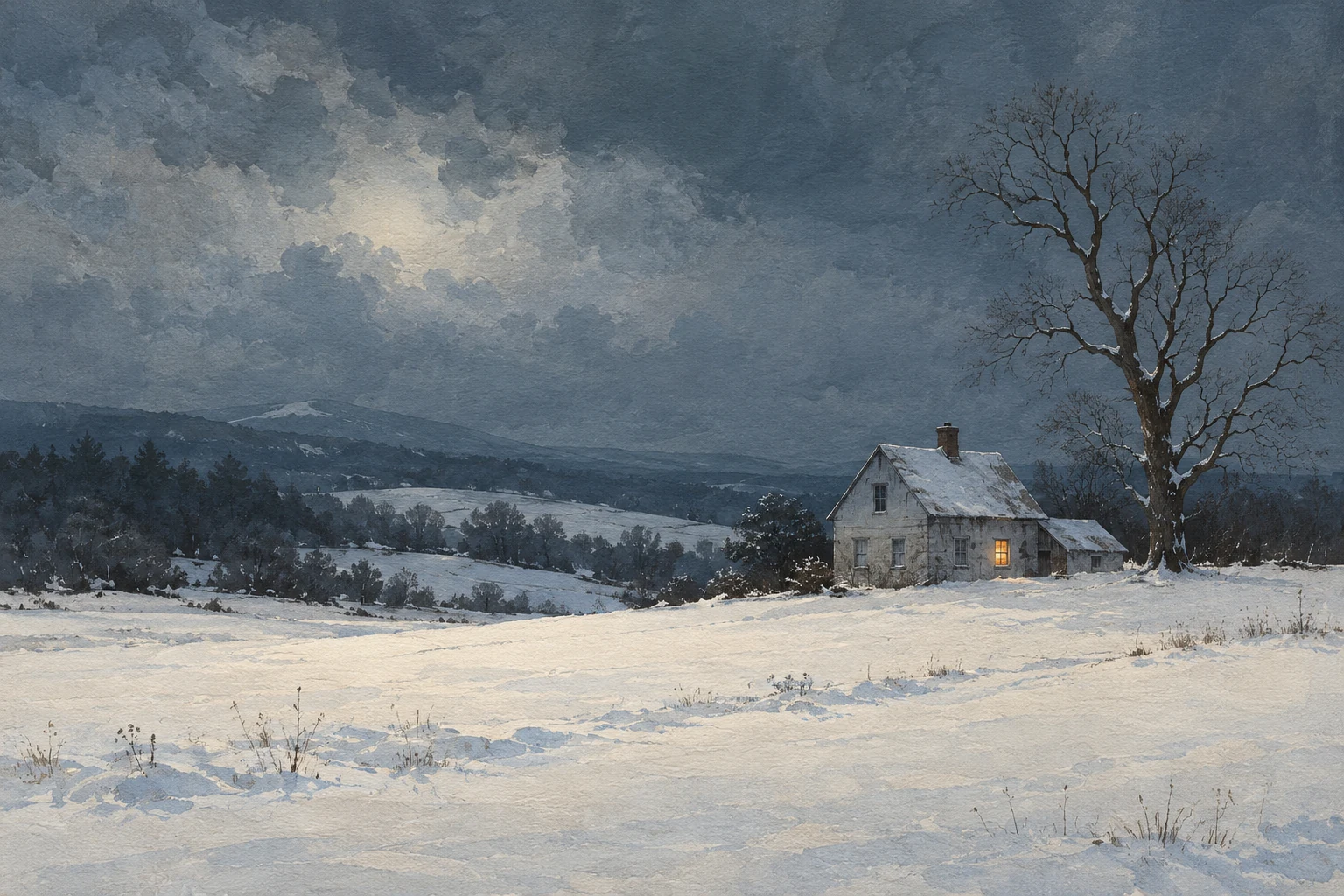
01 / A place to begin
A spoiler-light introduction.
A visitor. A place. A story taking shape.
An outsider encounters Ethan Frome in a New England town. The narrative moves toward a life shaped by work, obligation, longing and limited possibilities. Its quiet surfaces ask for close attention.
Read the frame as carefully as the story it contains. Who is speaking? How does a person become the subject of another person’s account? Keep the narrator distinct from Wharton herself.
A short novel can carry a great deal of pressure. Notice a room, a light or a change in the weather before deciding what it means. Save introductions and interpretive notes until after the ending if you want to encounter it without advance explanation.
Sources: Modernist Journals archive: Scribner’s Magazine introduction · The Mount: Ethan Frome
Reader note
A bleak story of emotional distress and constrained lives. The optional discussion addresses major developments; keep it closed until you have finished.
- First publication
- 1911
- Form
- A novella
- Original language
- English
- Publication note
- First book publication: September 1911, by Charles Scribner’s Sons. Serialization in Scribner’s Magazine ran from August to October 1911.
02 / Ways of looking
Choose a reading lens.
Three original prompts. Pick the question you want to carry into the book.
Your reading prompt
The frame
Who can know this?
At the start, distinguish what the visitor observes from what the visitor is told or imagines. Keep that distinction available as the narrative changes.
Rooms
Look at the threshold.
Choose one room, doorway or household object. Describe what it allows the characters to do and what it seems to keep outside.
Weather
Read the cold closely.
Notice a description of winter. Before calling it a symbol, ask what it does materially to travel, work, conversation or a body.
03 / The copy desk
Find the edition for you.
Outside sellers and libraries handle purchases and loans. They determine stock, prices, condition, eligibility, and waits. Routes and bibliographic details checked .
All 3 copy routes shown.
Ethan Frome — Penguin Classics
Paperback
Choose this compact annotated paperback for a first reading with scholarly help nearby.
- Publisher
- Penguin Classics
- ISBN
- 9780142437803
- Edition date
- 2005-10-25
- Pages
- 128
- Extra material
- Introduction and notes by Elizabeth Ammons
Publisher edition and external buying options. Current regional availability and retailer terms apply.
ISBN-specific discovery. Check condition, edition, seller and delivery information.
Connect your own library card, then search Ethan Frome and Edith Wharton. For print, search your local library catalogue by title, author, or a card’s ISBN. Ask about interlibrary loan if the edition you want is absent. General library discovery only; no title holding or license of this print ISBN was verified.
Ethan Frome — A Norton Critical Edition
Paperback
Choose this edition for a second reading, seminar or reading group that wants to compare historical evidence and critical interpretations.
- Publisher
- W. W. Norton & Company
- ISBN
- 9780393966350
- Edition date
- Not verified
- Pages
- 208
- Extra material
- Text based on the 1911 Charles Scribner’s Sons first edition; Annotations intended for undergraduate readers; Historical and biographical contexts, including Wharton’s correspondence; Contemporary reviews and later criticism; Chronology and selected bibliography; edited by Cynthia Griffin Wolff and Kristin O. Lauer. Exact publication day not verified; 1994 is an edition-year reference.
Publisher edition and external buying options. Current regional availability and retailer terms apply.
ISBN-specific discovery. Check condition, edition, seller and delivery information.
Connect your own library card, then search Ethan Frome and Edith Wharton. For print, search your local library catalogue by title, author, or a card’s ISBN. Ask about interlibrary loan if the edition you want is absent. General library discovery only; no title holding or license of this print ISBN was verified.
Public-domain route
Read the English text at Project Gutenberg
A historical English text, distinct from the modern annotated editions linked here.
Project Gutenberg labels this specific ebook public domain in the USA. Outside the United States, check the law where you are before downloading or reusing it. Project Gutenberg makes no worldwide rights guarantee. This historical text is distinct from the modern annotated editions. The novel’s status does not license modern introductions, notes, translations, cover art or new illustrations.
Reading sourceThe linked Gutenberg text is identified as public domain in the United States. Check the rules where you are; modern introductions, notes, translations and illustrations can carry separate rights.
04 / Alongside the book
Keep a thread.
01 / First reading
Give it an unbroken stretch.
If you can, read several chapters together. The book is brief; continuity helps you hear its pressure and changes of viewpoint.
02 / Second reading
Return to the frame.
After finishing, reread the opening and closing in your own copy. Ask what the visitor’s knowledge can now support and what remains uncertain.
03 / With an edition
Let the notes come second.
Use a scholarly introduction or critical essay after your first reading. Compare its interpretation with one concrete detail you noticed yourself.
05 / After reading
Let the questions stay.
Optional deeper reading. The panels below may discuss later events or the ending. They begin closed so you can choose when to continue.
Deeper themes · possible spoilersLook beneath the surface.
Original PointCast interpretations and prompts, rather than the author’s stated meaning. Open after reading if you want to preserve the discovery.
Desire and obligation
Where does an obligation protect a life, and where does it restrict one? Does the novella make those roles easy to separate?
The story told about a person
How does the outer narrator influence the account we receive? What is gained, and what becomes inaccessible, through that distance?
A landscape with consequences
Return to a passage about cold, distance or isolation. How does the material setting shape the available choices?
Reading group · discussion spoilersBring it into conversation.
These questions concern the whole work. Return to the edition you are reading for examples and compare passages rather than page numbers.
- How does returning to the opening after the ending change your understanding of the visitor?
- Which small domestic detail becomes more consequential on a second reading?
- Does the novella invite sympathy, judgment, uncertainty or more than one response at once?
06 / The next door
Nearby readings.
Sources / Follow the evidence
The reading is personal.
The references are inspectable.
A companion with its sources.
Primary archive or publisher publication evidence
Modernist Journals archive: Scribner’s Magazine introduction
Serial appeared August–October 1911.
Primary archive or publisher publication evidence
Library of America: centennial of Ethan Frome
Book publication September 30, 1911; verified by context research agent; direct second fetch returned an error.
Primary archive or publisher publication evidence
The Mount: Ethan Frome
Published September 1911; French-exercise origin and Berkshire context.
Author museum or primary text
The Mount: Wharton biography
Author museum context and biography.
Specific digital edition and US rights record
Project Gutenberg ebook 4517
English text, producers, digital release/update dates, US public-domain status
Provider rights policy
Project Gutenberg permissions policy
US-only copyright determinations; check other jurisdictions
Official library borrowing service
Libby — OverDrive
General participating-library route
Publisher edition record
Ethan Frome — Penguin Classics — publisher record
Introduction and notes by Elizabeth Ammons; 128-page paperback. Verified format, ISBN, pages and edition date.
Used-copy marketplace
Ethan Frome — Penguin Classics — used ISBN route
Verified ISBN-specific listings. Check individual seller condition, edition and delivery; no price or availability guarantee.
Publisher edition record
Ethan Frome — A Norton Critical Edition — publisher record
Text based on the 1911 Charles Scribner’s Sons first edition; Annotations intended for undergraduate readers; Historical and biographical contexts, including Wharton’s correspondence; Contemporary reviews and later criticism; Chronology and selected bibliography; 208-page paperback. Exact publication day is unverified; a 1994 edition year is reported, while Norton’s dated field concerns instructor copies.
Used-copy marketplace
Ethan Frome — A Norton Critical Edition — used ISBN route
Verified ISBN-specific listings. Check individual seller condition, edition and delivery; no price or availability guarantee.
Introductions, reading lenses, pathways, and discussion prompts are original editorial copy. No book text is reproduced on this page.
The artwork was generated as an original editorial atmosphere. It is not an official cover, archival evidence, an author’s artwork, or a publisher endorsement.