A chart is only the beginning.
Treasure Island
An adventure at sea
A voyage, a dangerous company and a young narrator learning to judge people. Follow the voices as closely as the map.
Begin reading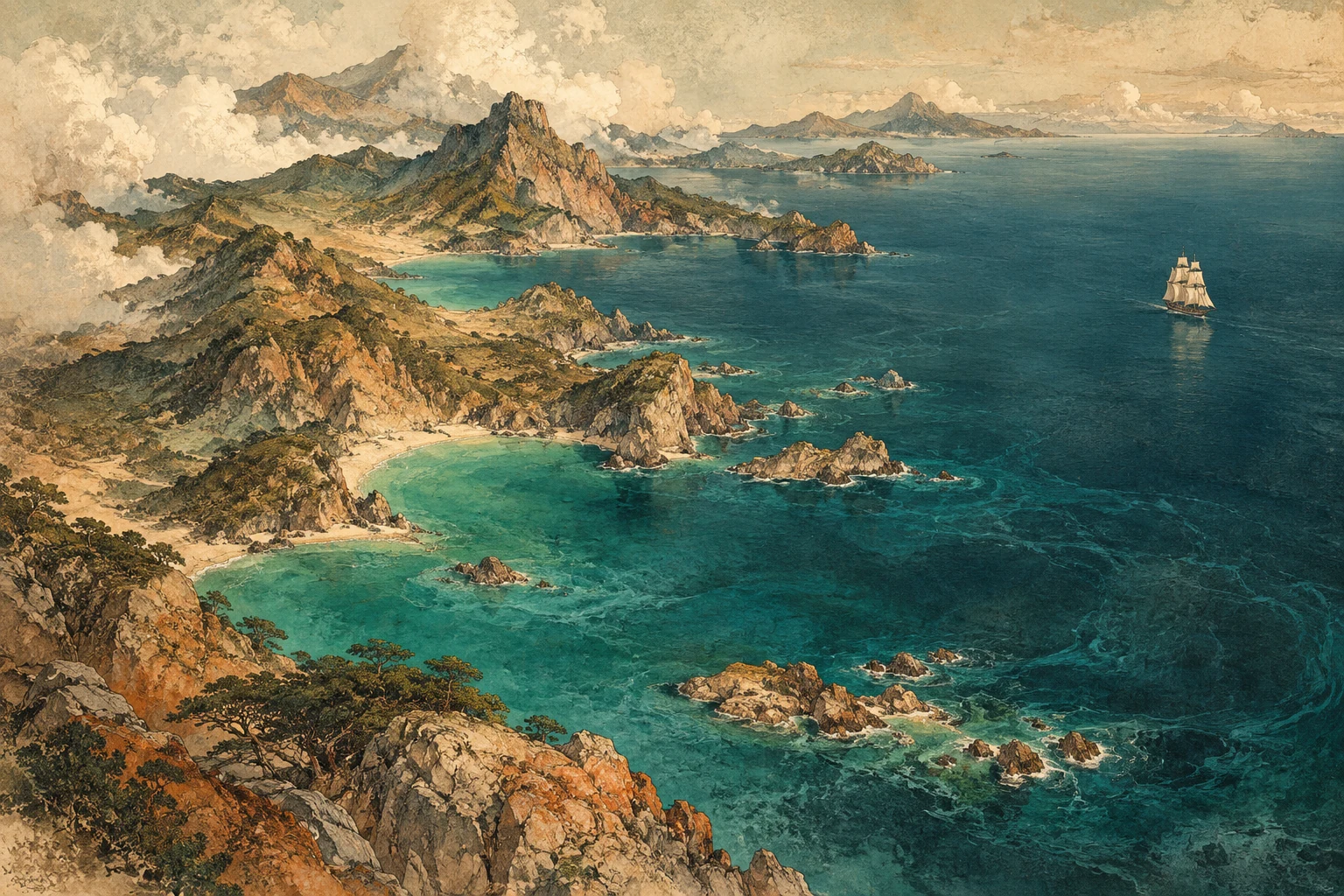
01 / A place to begin
A spoiler-light introduction.
Set out with Jim. Keep your judgment awake.
Jim Hawkins is drawn from an ordinary coastal life into a voyage after buried treasure. The pleasure of the story lies in movement, uncertainty and the company assembled around the journey.
Stevenson gives his characters distinct voices and competing desires. Notice who can persuade others, who can change sides and what Jim can actually know at each stage.
There is room for enjoyment and scrutiny together. A map can promise control over a place; the people who arrive there complicate that promise. The artwork on this shelf is an original atmosphere, not Stevenson’s map or a navigational chart.
Sources: Works Chronology — The RLS Website · Timeline — The RLS Website
- First publication
- 1883
- Form
- An adventure novel
- Original language
- English
- Publication note
- First revised book publication: November 14, 1883, by Cassell in London. The earlier Young Folks serial ran from October 1881 to January 1882 under Stevenson’s pseudonym Capt. Geo. North.
02 / Ways of looking
Choose a reading lens.
Three original prompts. Pick the question you want to carry into the book.
Your reading prompt
Voices
Listen for a motive.
Read a short exchange aloud from your lawful copy. Ask how vocabulary, rhythm and silence help you judge the speaker.
Judgment
What does Jim know?
At a decision, separate what Jim sees, what someone tells him and what he suspects. How much must he act without certainty?
The map
A promise of a place.
Notice what a map or plan appears to settle. Compare that promise with one thing the people or landscape refuse to make simple.
03 / The copy desk
Find the edition for you.
Outside sellers and libraries handle purchases and loans. They determine stock, prices, condition, eligibility, and waits. Routes and bibliographic details checked .
All 3 copy routes shown.
Penguin Classics — John Seelye
Paperback
A compact paperback for a first reading, with Seelye's introduction to return to after the story.
- Publisher
- Penguin Classics / Penguin Publishing Group
- ISBN
- 9780140437683
- Edition date
- 1999-12-01
- Pages
- 240
- Extra material
- Edited with an introduction by John Seelye. Notes or an essay appendix were not verified for this ISBN.
Publisher edition and external buying options. Current regional availability and retailer terms apply.
ISBN-specific discovery. Check condition, edition, seller and delivery information.
Connect your own library card, then search Treasure Island and Robert Louis Stevenson. For print, search your local library catalogue by title, author, or a card's ISBN. Ask about interlibrary loan if the edition you want is absent. General library discovery only; no title holding or license of this print ISBN was verified.
Oxford World's Classics — Peter Hunt
Paperback
For readers who want help with nautical language and a closer look at how the serial became a book. The textual note and appendices offer a useful second pass.
- Publisher
- Oxford University Press
- ISBN
- 9780199560356
- Edition date
- 2011-01-29
- Pages
- 272
- Extra material
- Introduction and explanatory notes by Peter Hunt; Glossary of nautical terms; Bibliography and chronology; One map; Note on the Text discussing serial/book variants; Appendices: My First Book; The Persons of the Tale; parallels from Stevenson's sources
Publisher edition and external buying options. Current regional availability and retailer terms apply.
ISBN-specific discovery. Check condition, edition, seller and delivery information.
Connect your own library card, then search Treasure Island and Robert Louis Stevenson. For print, search your local library catalogue by title, author, or a card's ISBN. Ask about interlibrary loan if the edition you want is absent. General library discovery only; no title holding or license of this print ISBN was verified.
Public-domain route
Read the historical English text at Project Gutenberg
A historical English text, distinct from the modern annotated editions linked here.
Project Gutenberg labels this specific ebook public domain in the USA. Outside the United States, check the law where you are before downloading or reusing it. Project Gutenberg makes no worldwide rights guarantee. This historical digital edition is distinct from the modern Penguin and Oxford editions. Public-domain status of the novel does not make modern introductions, annotations, translations, covers or new illustrations free to reuse.
Reading sourceThe linked Gutenberg text is identified as public domain in the United States. Check your jurisdiction. Modern editing, introductions, cover art and illustrations are not automatically free with the original novel.
04 / Alongside the book
Keep a thread.
01 / First voyage
Let the chapters pull you on.
Read for the movement of the adventure. Keep nautical words from interrupting every scene; look up one when it becomes essential.
02 / Second voyage
Follow one voice.
Choose a character and note a few changes in speech or allegiance. Compare your first impression with what the whole book makes possible.
03 / Read together
Take a scene aloud.
Choose a brief exchange in a lawful copy and give its voices different readers. Discuss what changed when you heard it rather than saw it.
05 / After reading
Let the questions stay.
Optional deeper reading. The panels below may discuss later events or the ending. They begin closed so you can choose when to continue.
Deeper themes · possible spoilersLook beneath the surface.
Original PointCast interpretations and prompts, rather than the author’s stated meaning. Open after reading if you want to preserve the discovery.
Trust and charisma
How does a persuasive voice affect what Jim and the reader are willing to believe? Where do admiration and distrust coexist?
Treasure and cost
After the adventure, what is gained, what is lost and what does the narrative leave difficult to count?
The story of a voyage
How does looking back shape Jim’s account? Consider what a narrator can understand later that a participant could not know then.
Reading group · discussion spoilersBring it into conversation.
These questions concern the whole work. Return to the edition you are reading for examples and compare passages rather than page numbers.
- Which judgment would you revise after the ending, and which would you keep?
- What does the book suggest about loyalty when interests change?
- How do the voyage’s pleasures and dangers affect your response to its conclusion?
06 / The next door
Nearby readings.
Sources / Follow the evidence
The reading is personal.
The references are inspectable.
A companion with its sources.
University-developed scholarly author bibliography
Works Chronology — The RLS Website
Young Folks volumes 19–20; October 1881–January 1882; pseudonymous title; Revision for London Cassell book in 1883.
University-developed scholarly author chronology
Timeline — The RLS Website
Braemar beginning in August 1881; Serial begins October 1 1881; Book published November 14 1883; Author life dates.
Digital edition catalog and specific rights statement
Project Gutenberg ebook 120
English text; Louis Rhead listed illustrator; US public-domain status; Digital release/update dates.
Official library borrowing service
Libby — OverDrive
General participating-library borrowing route.
Publisher edition record
Penguin Classics — John Seelye — publisher record
Edited by John Seelye; Introduction by John Seelye. Verified format, ISBN, pages and edition date.
Used-copy marketplace
Penguin Classics — John Seelye — used ISBN route
Verified ISBN-specific listings. Check individual seller condition, edition and delivery; no price or availability guarantee.
Publisher edition record
Oxford World's Classics — Peter Hunt — publisher record
Introduction and explanatory notes by Peter Hunt; Glossary of nautical terms; Bibliography and chronology; One map; Note on the Text discussing serial/book variants; Appendices: My First Book; The Persons of the Tale; parallels from Stevenson's sources. Verified format, ISBN, pages and edition date.
Used-copy marketplace
Oxford World's Classics — Peter Hunt — used ISBN route
Verified ISBN-specific listings. Check individual seller condition, edition and delivery; no price or availability guarantee.
Introductions, reading lenses, pathways, and discussion prompts are original editorial copy. No book text is reproduced on this page.
The artwork was generated as an original editorial atmosphere. It is not an official cover, archival evidence, an author’s artwork, or a publisher endorsement.