A NOTE FROM THE ROAD
Southwark · the Tabard
The fictional company gathers at the Tabard Inn in Southwark. Harry Bailey proposes a contest: two tales each on the outward journey and two on the return, with a meal for the winner.
Geoffrey Chaucer / late fourteenth century
One road.
A very lively company.
Saints, swindlers, lovers, a talking rooster.
Come for the pilgrimage. Stay for the argument.
Six doorways into a much larger, unfinished book.
Spoiler-light until you choose to turn the page.
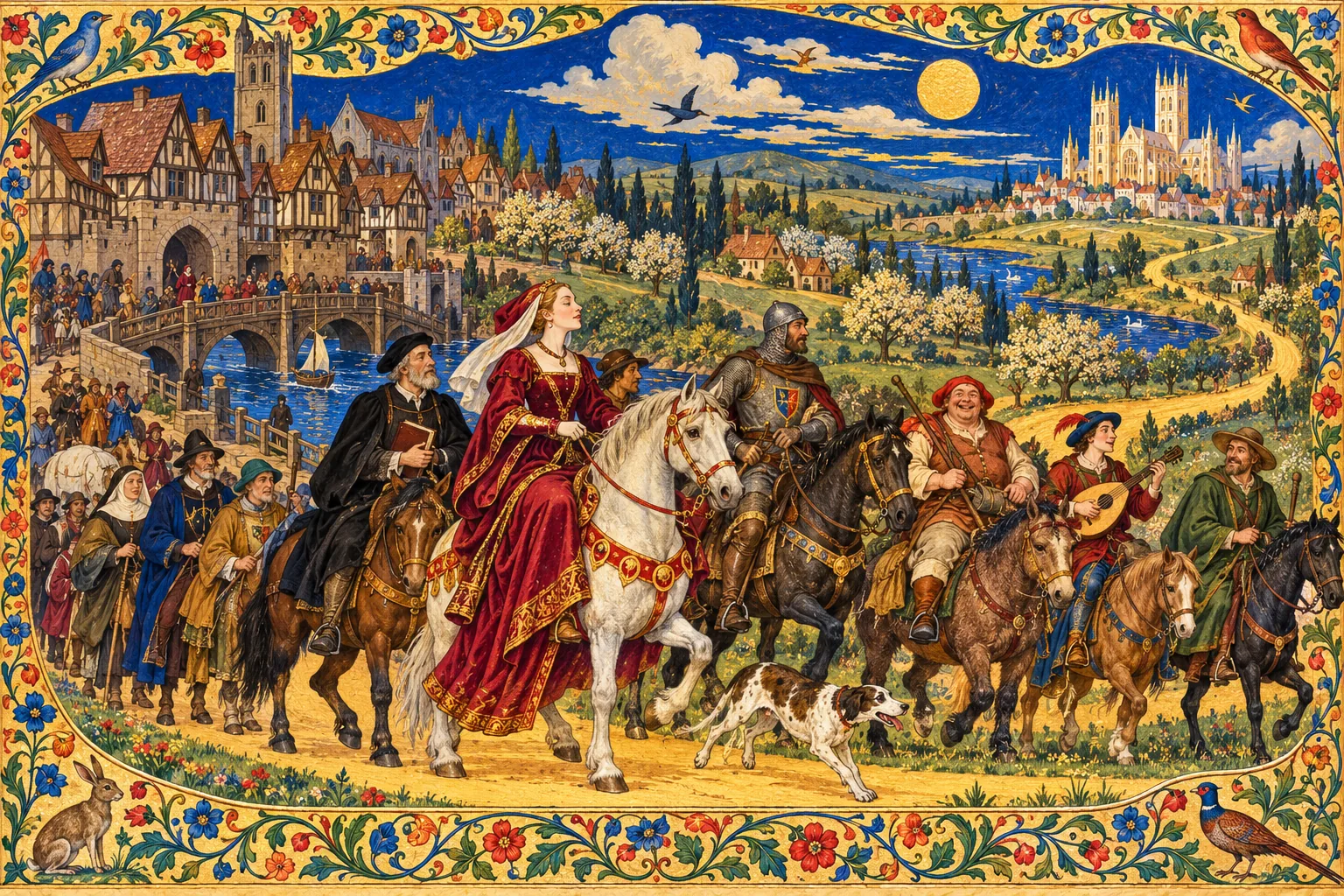
A story is different
when someone else tells it.
I / Pull up a seat
Six storytellers. Six ways of seeing.
Select a portrait to meet the pilgrim.Select a portrait to read the tale. These are imaginative portraits of literary characters.
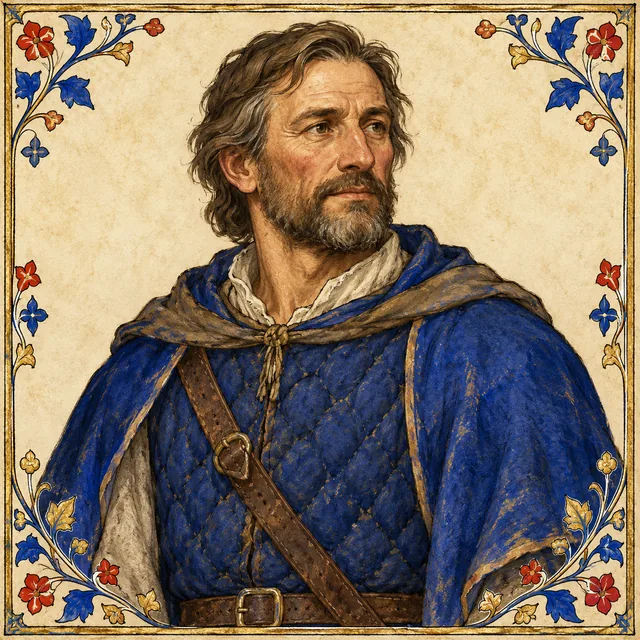
A seasoned soldier brings the company a grand romance of rivalry, ceremony and uncertain fortune.
Meet the storyteller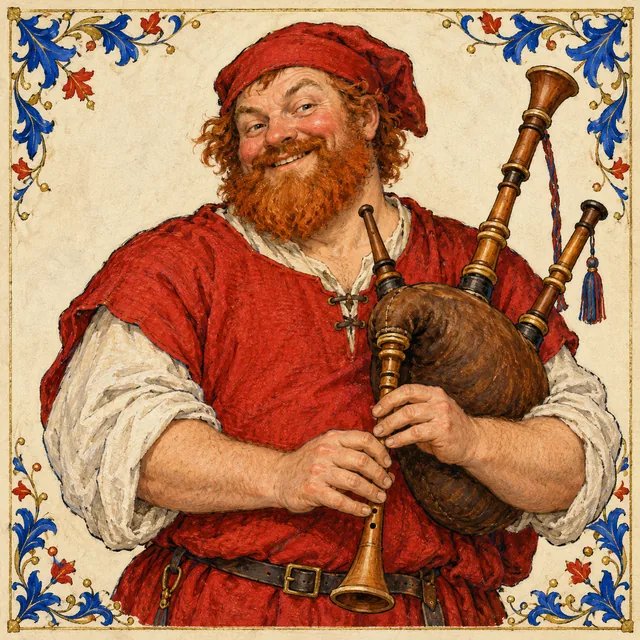
An intoxicated interrupter answers the Knight’s noble romance with an outrageous Oxford household comedy.
Meet the storyteller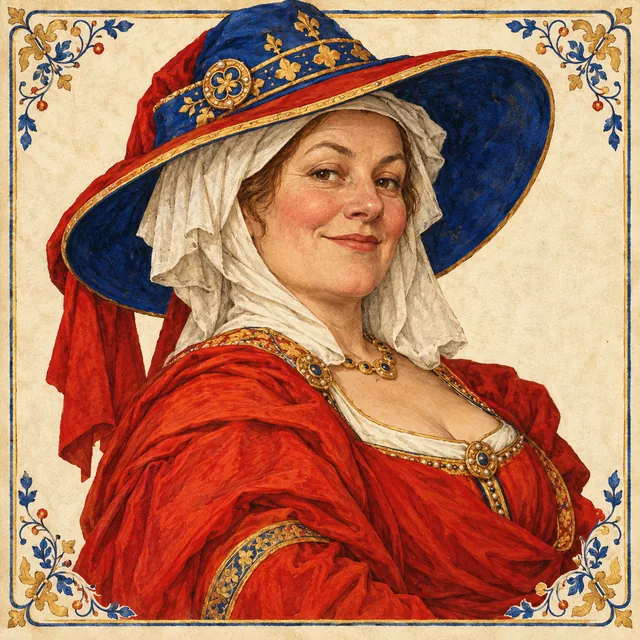
A widely traveled woman with five marriages insists that lived experience deserves a hearing.
Meet the storyteller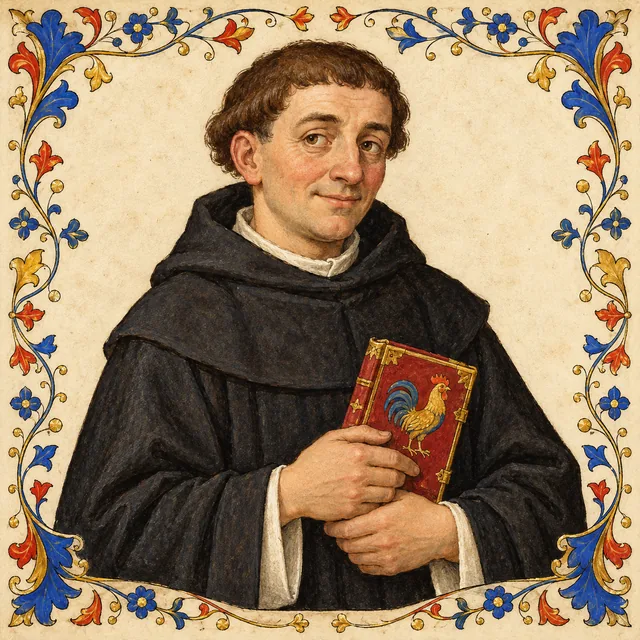
A priest accompanying the Prioress makes a farmyard sound as consequential as an epic battlefield.
Meet the storyteller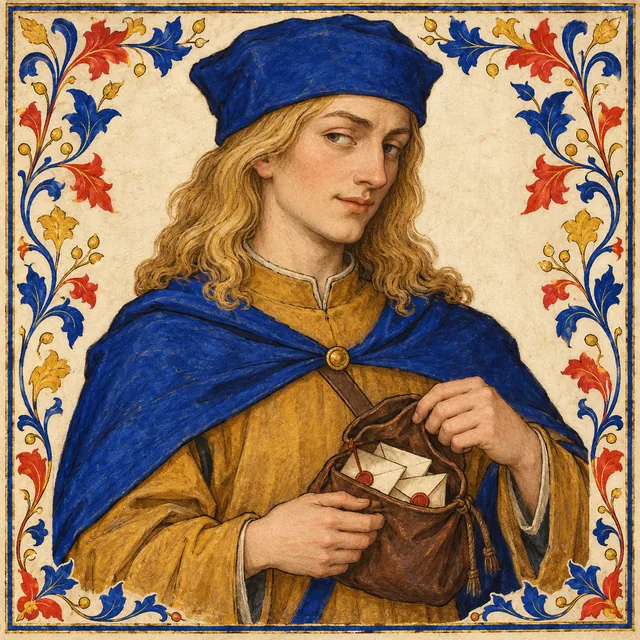
A preacher boasts about exploiting his listeners, then delivers a powerful warning against greed.
Meet the storyteller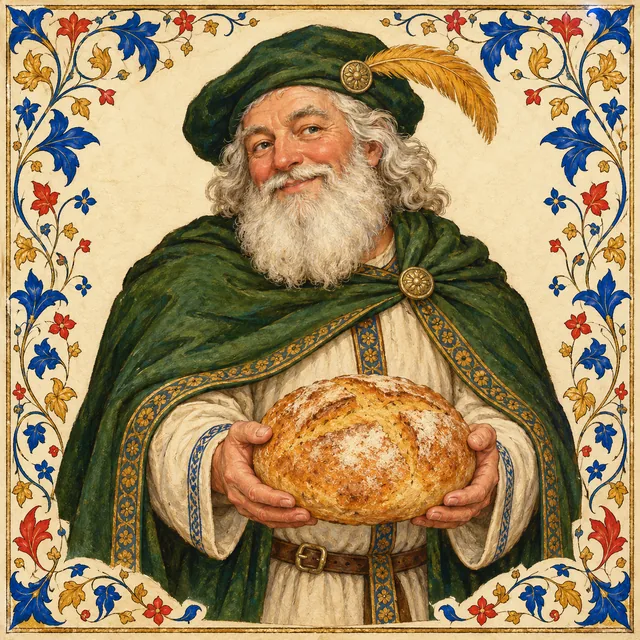
A prosperous landowner associated with generous hospitality asks what generosity might cost.
Meet the storytellerII / A reader’s compass
You can begin anywhere. These short paths are PointCast’s invitations, not Chaucer’s tale order.
YOUR FIRST TWO TALES
Begin with a fox’s compliment, then meet a preacher who knows exactly how words work.
Two tales put authority, marriage and the cost of a promise under pressure. Read their content notes first.
Hear the Knight’s grand story, then the Miller’s unruly reply. The second stop brings adult humor.
A path is a starting point. Every tale stays open to you.
III / Out of the inn, into the imagination
A schematic of the frame and its story worlds. No measured distances, reconstructed itinerary, or fixed sequence of tales is implied.
A NOTE FROM THE ROAD
The fictional company gathers at the Tabard Inn in Southwark. Harry Bailey proposes a contest: two tales each on the outward journey and two on the return, with a meal for the winner.
The fictional company gathers at the Tabard Inn in Southwark. Harry Bailey proposes a contest: two tales each on the outward journey and two on the return, with a meal for the winner.
Rochester is a real anchor on scholarly reconstructions of the road to Canterbury. Our illustrated journey is a schematic: it does not fix the company’s exact itinerary or place these six tales at particular stops.
A tale can leave Kent behind: ancient Athens, Oxford, Arthurian Britain, a widow’s farmyard, Flanders, coastal Brittany. These are the stories’ imagined settings, not stops on the pilgrimage or pins on a historical map.
The pilgrims seek Thomas Becket’s shrine at Canterbury Cathedral. Chaucer’s surviving work never completes the announced contest or the return journey. Our arrival scene imagines the destination, rather than supplying a missing ending.
IV / Six illuminated doorways
Begin with the premise. Sit with the question. Open the ending only when you’re ready.
All summaries and questions here are original PointCast writing.
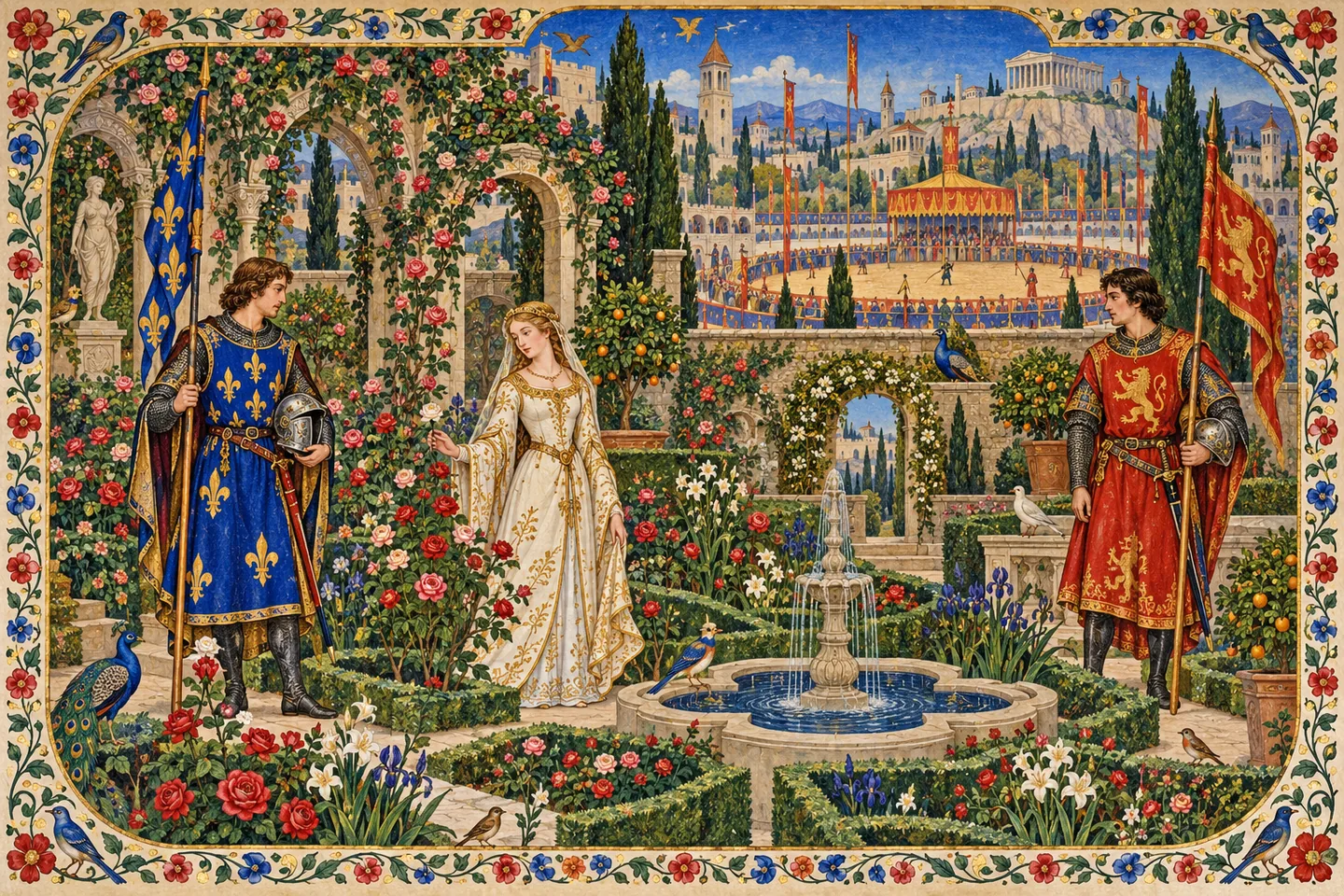
TOLD BY THE KNIGHT
Two imprisoned cousins see Emelye from their window and become rivals. Their story unfolds in an imagined ancient Athens, where human plans must contend with the gods.
A question to carryWhose wishes count when a romance makes a woman the prize?
Content note. War, imprisonment, fatal injury and women’s restricted choices.
THE STORY OPENS / ORIGINAL SUMMARY
Theseus arranges a tournament to decide whether Palamon or Arcite will marry Emelye. The three pray for different things: Palamon for love, Arcite for victory, and Emelye to remain unmarried—or, failing that, to marry the man who loves her most.
Arcite wins, but an accident fatally injures him. After mourning and the passage of time, Theseus arranges Emelye’s marriage to Palamon. The ending establishes peace while leaving readers room to question the price of that order.
Read the Middle English at Harvard’s Chaucer site ↗Fragment I, lines 859–3108. Modern translations have separate copyrights; these are our summaries.
TOLD BY THE MILLER
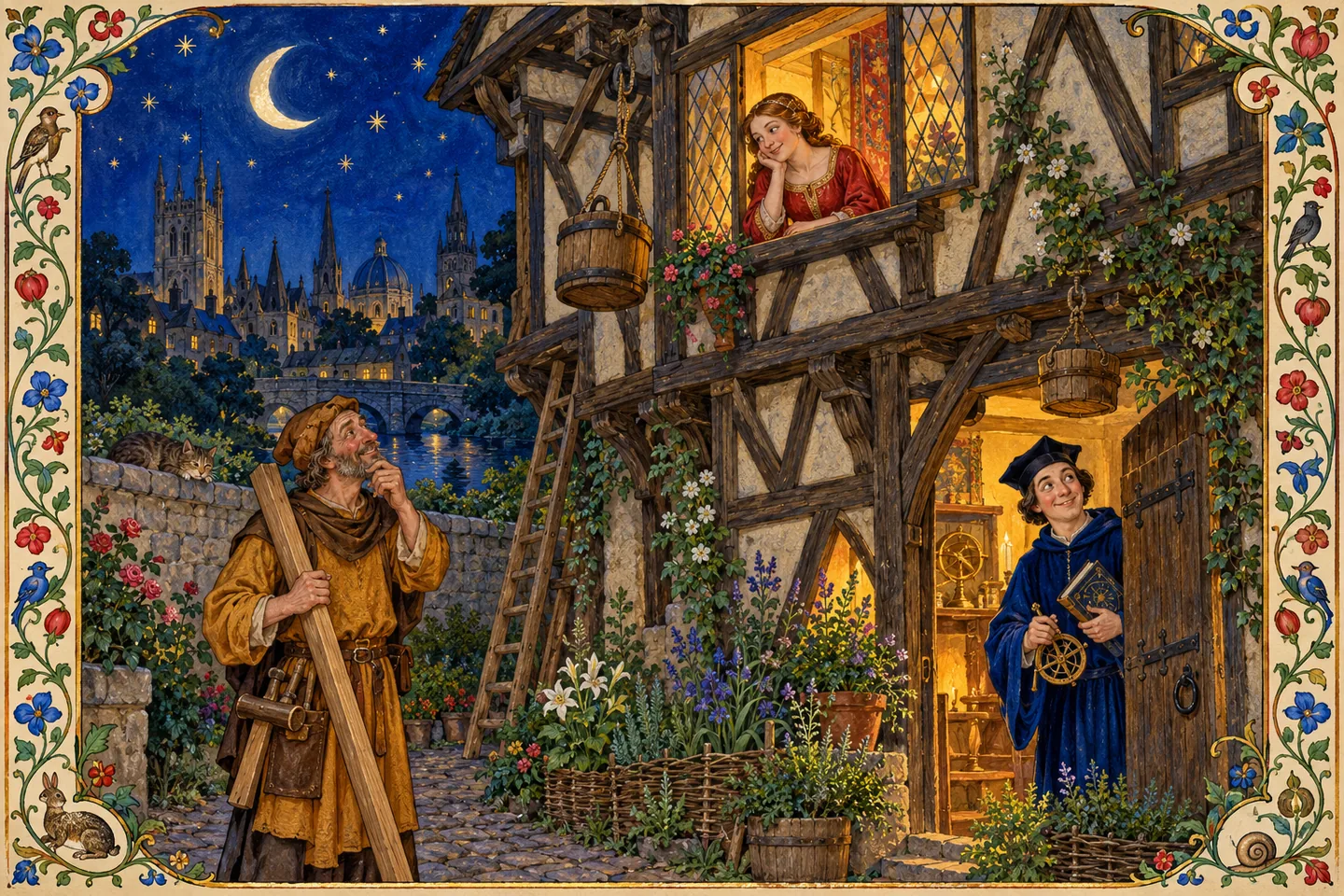
A jealous carpenter, his young wife, a clever student and an eager parish clerk have very different ideas about love. Nobody has quite the control they imagine.
A question to carryWhen everyone is trying to be clever, who gets to tell the final version?
Content note. Adult sexual and scatological humor, unwanted sexual touching, adultery and injury.
THE STORY OPENS / ORIGINAL SUMMARY
Nicholas persuades John that another great flood is coming, so John hangs tubs from the roof as makeshift boats. While John sleeps in his tub, Nicholas and Alisoun meet downstairs. At the window, Alisoun gives her other admirer, Absolon, a humiliating substitute for a kiss.
Absolon returns with a hot plough blade. Nicholas receives the burn and shouts for water; John thinks the flood has arrived, cuts his rope and falls. His neighbors accept the lovers’ account that he is mad. The comedy’s victory depends on someone else’s pain and public humiliation.
Read the Middle English at Harvard’s Chaucer site ↗Fragment I, lines 3109–3854; unwanted touching at 3276–3287. Modern translations have separate copyrights; these are our summaries.
TOLD BY THE WIFE OF BATH
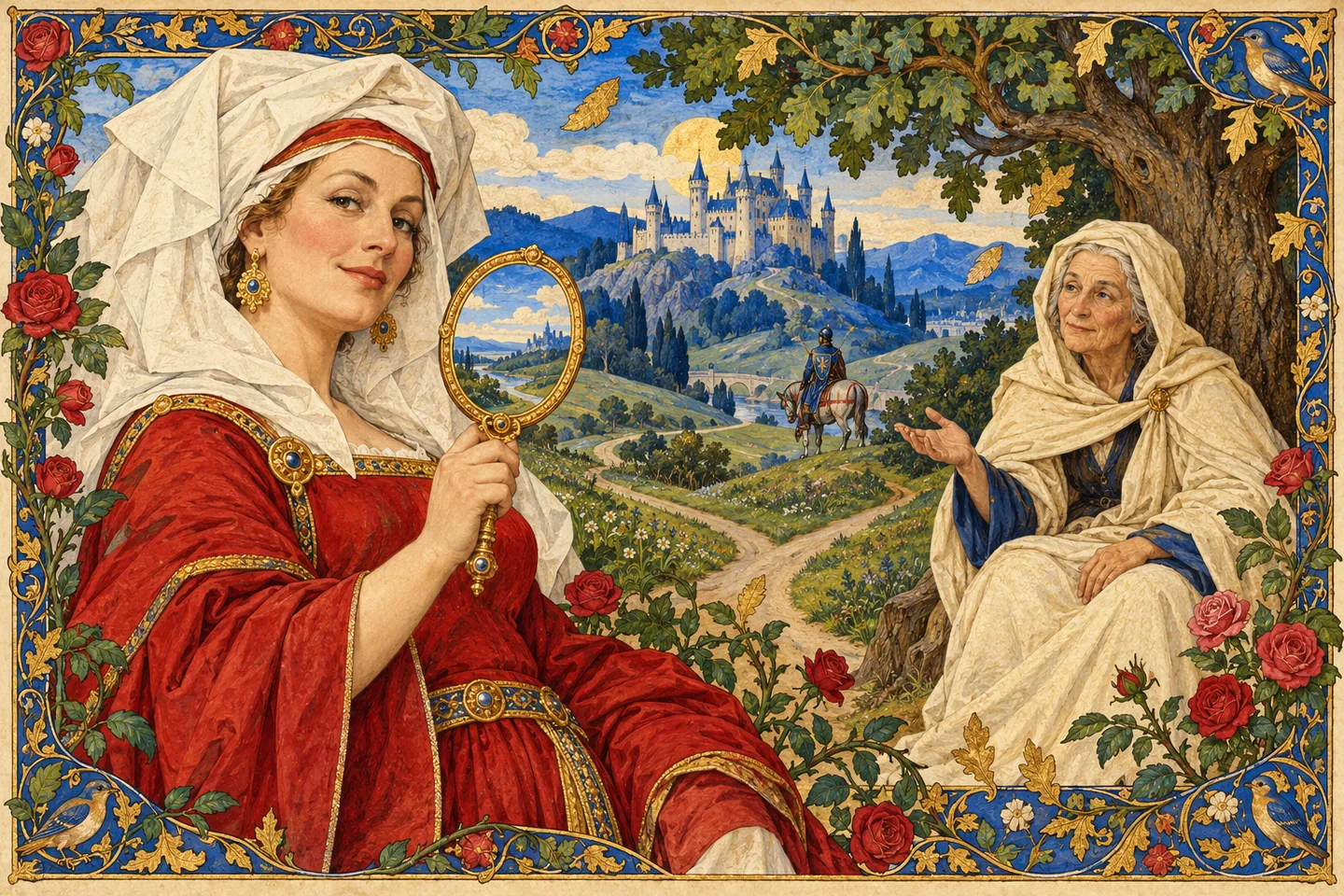
In an Arthurian setting, a knight who has raped a woman faces judgment. The queen gives him a year and a day to discover what women most desire.
A question to carryCan someone learn to respect another person’s choices without controlling the answer?
Content note. Rape, coercive marriage, misogyny; domestic abuse in the accompanying prologue.
THE STORY OPENS / ORIGINAL SUMMARY
An older woman supplies the answer: women want power within relationships, rather than to be ruled by husbands or lovers. In return, the knight has promised to do what she asks; she asks him to marry her. When he rejects her age, appearance and social standing, she challenges his ideas about what makes a person noble.
She offers him a choice about her appearance and fidelity. He leaves the decision to her, and the tale rewards that surrender of control with a transformation and a happy marriage. That resolution does not erase the assault that began the story or tell us what happened to its victim.
Read the Middle English at Harvard’s Chaucer site ↗Fragment III, prologue 1–856; tale 857–1264; rape at 887–888. Modern translations have separate copyrights; these are our summaries.
TOLD BY THE NUN’S PRIEST
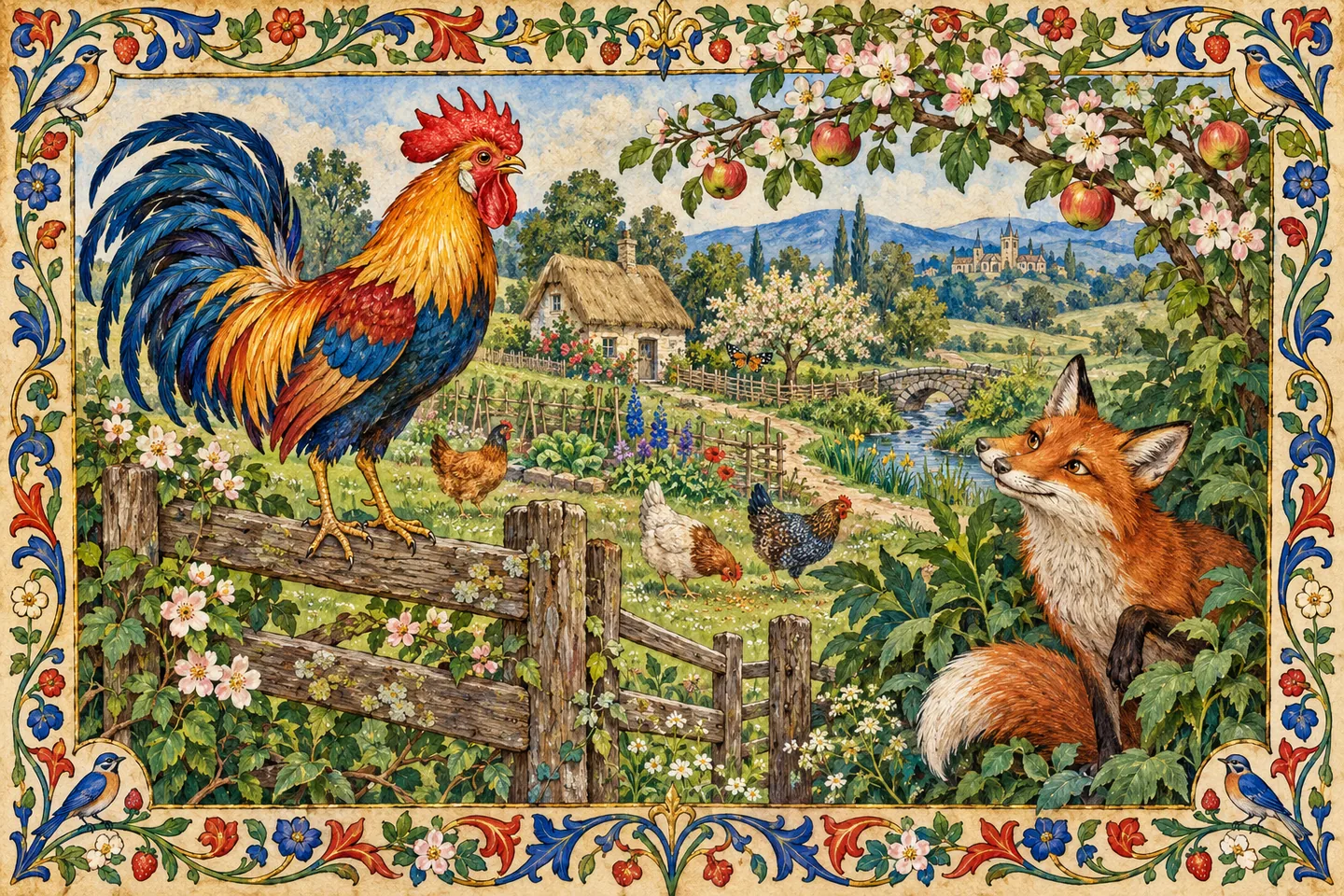
Chanticleer, a magnificent rooster, has a disturbing dream. His companion Pertelote disputes its meaning, while a fox waits for the right moment to flatter him.
A question to carryWhat happens when a compliment sounds better than a warning?
Content note. Animal peril, sexual innuendo and misogynistic claims voiced and qualified by the storyteller.
THE STORY OPENS / ORIGINAL SUMMARY
The fox praises Chanticleer’s singing and persuades him to close his eyes and stretch his neck. The fox seizes him, sending the widow’s household into a noisy chase.
Chanticleer turns speech into an escape tool: he suggests that the fox taunt the pursuers. When the fox opens his mouth, the rooster flies free. Both creatures have been tricked by words, and the storyteller offers several lessons rather than one tidy answer.
Read the Middle English at Harvard’s Chaucer site ↗Fragment VII, tale 2821–3446. Modern translations have separate copyrights; these are our summaries.
TOLD BY THE PARDONER
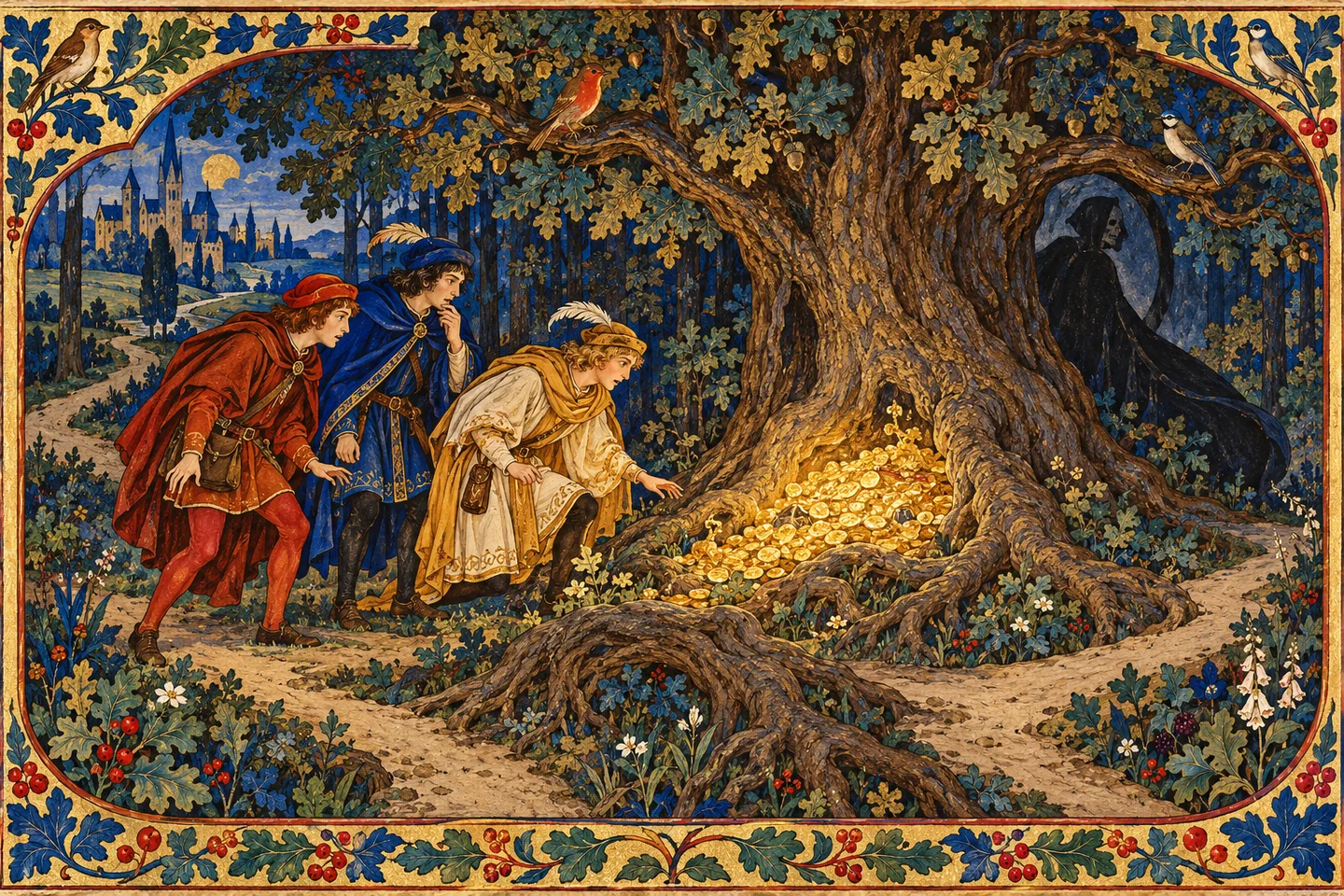
Three young revelers set out to kill Death. A mysterious old man points them toward a tree, where their search takes an unexpected turn.
A question to carryCan a dishonest storyteller tell a story that is true about us?
Content note. Murder, poisoning, death, drunkenness and religious exploitation.
THE STORY OPENS / ORIGINAL SUMMARY
Under the tree they find gold. They send the youngest to buy provisions while the other two plot to murder him and keep his share. He independently buys poison to kill them.
They stab him when he returns, then drink the poisoned wine and die. After demonstrating what greed can do, the Pardoner tries to sell his own wares to the company. The Host’s furious response exposes the gap between the sermon and its salesman.
Read the Middle English at Harvard’s Chaucer site ↗Fragment VI, prologue 329–462; tale and concluding exchange 463–968. Modern translations have separate copyrights; these are our summaries.
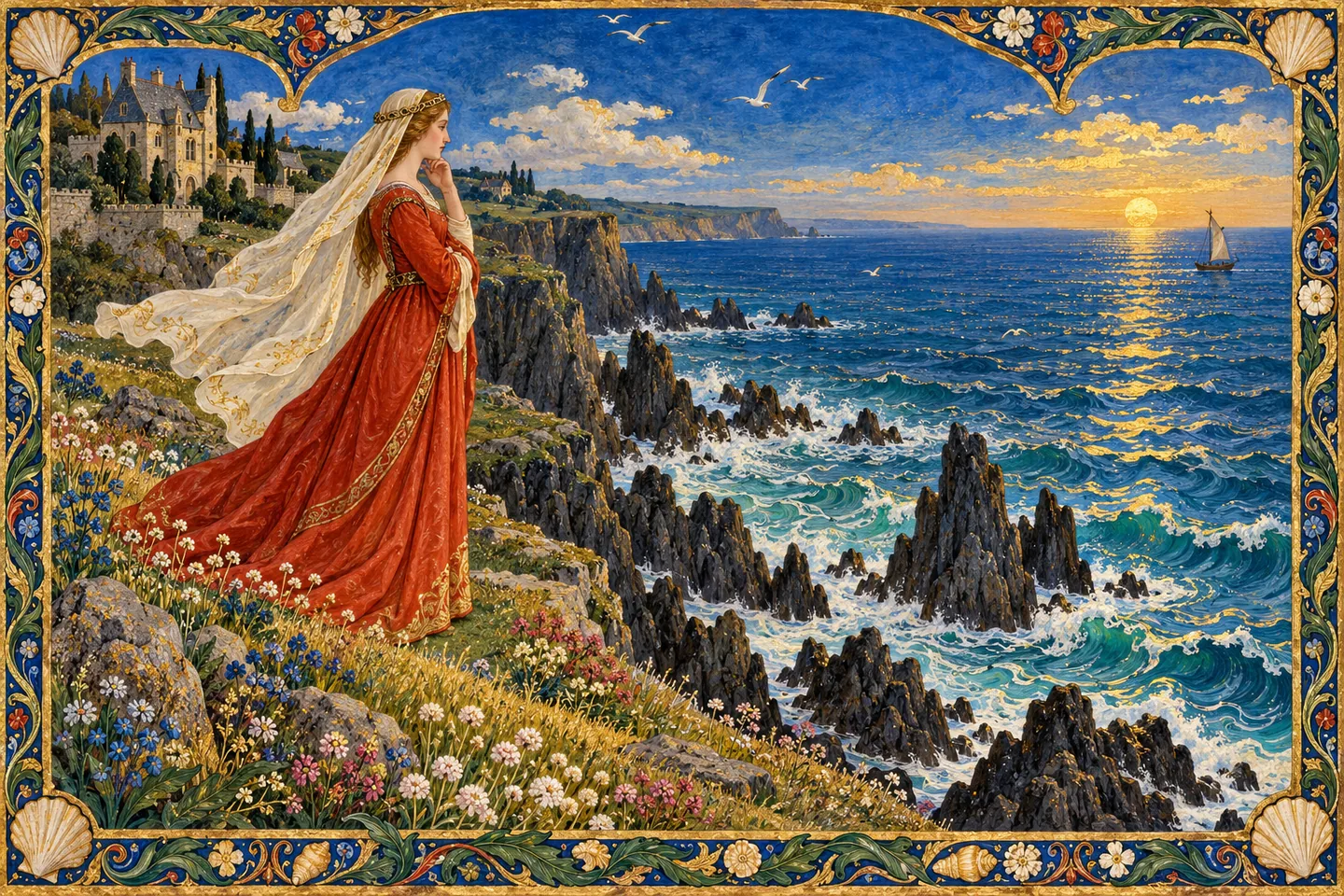
TOLD BY THE FRANKLIN
On the coast of Brittany, Dorigen worries about her absent husband and the rocks that threaten his ship. An unwelcome suitor hears what she thinks is an impossible condition.
A question to carryIs keeping a promise always the right thing to do?
Content note. Sexual pressure, suicidal thoughts and references to rape and suicide in classical examples.
THE STORY OPENS / ORIGINAL SUMMARY
Dorigen says she will accept Aurelius’s love if he removes the coastal rocks. A learned magician makes the rocks seem to disappear, and Aurelius presses her to honor the promise. Dorigen is distraught; her husband Arveragus insists that she keep her word.
Aurelius releases her rather than demand fulfillment. The magician, hearing what happened, cancels Aurelius’s enormous fee. The Franklin asks his listeners to judge who was most generous. Readers can also ask how the men’s exchange of generosity accounts for Dorigen’s freedom.
Read the Middle English at Harvard’s Chaucer site ↗Fragment V, tale 729–1624; Dorigen’s distress and examples at 1355–1456. Modern translations have separate copyrights; these are our summaries.
V / Follow a thread
These pairings are reading interpretations. Compare the storytellers’ values, then let the tales disagree.
The Wife’s tale asks who should hold authority in marriage. The Franklin’s asks what happens when promises and generosity determine someone else’s choices. Where do you hear freedom—and where do you hear pressure?
A fox performs admiration; a Pardoner performs moral authority. Both understand their listeners’ desires. Compare the claims a listener is invited to trust before opening either ending.
The Knight’s rival lovers inhabit an elevated world of ceremony. The Miller’s inhabit a crowded Oxford household. His interruption is a reply inside the frame: how do status, voice and the audience’s laughter change a love story?
VI / Four lines, two ways of hearing
A tiny, curated window into the General Prologue, four separate selections (12, 16, 27, 46). The Middle English is Chaucer’s public-domain text; the accessible gloss is our own, not a published translation.
Check the lines in the source ↗MIDDLE ENGLISH / FOUR SEPARATE LINES
12Thanne longen folk to goon on pilgrimages,16Of Engelond to Caunterbury they wende,27That toward Caunterbury wolden ryde.46Trouthe and honour, fredom and curteisie.POINTCAST’S ACCESSIBLE GLOSS
12At that time, people feel the pull of a pilgrim journey.16From across England, they make their way to Canterbury.27They intended to travel on horseback toward Canterbury.46The Knight valued faithfulness, honor, generosity and courteous conduct.
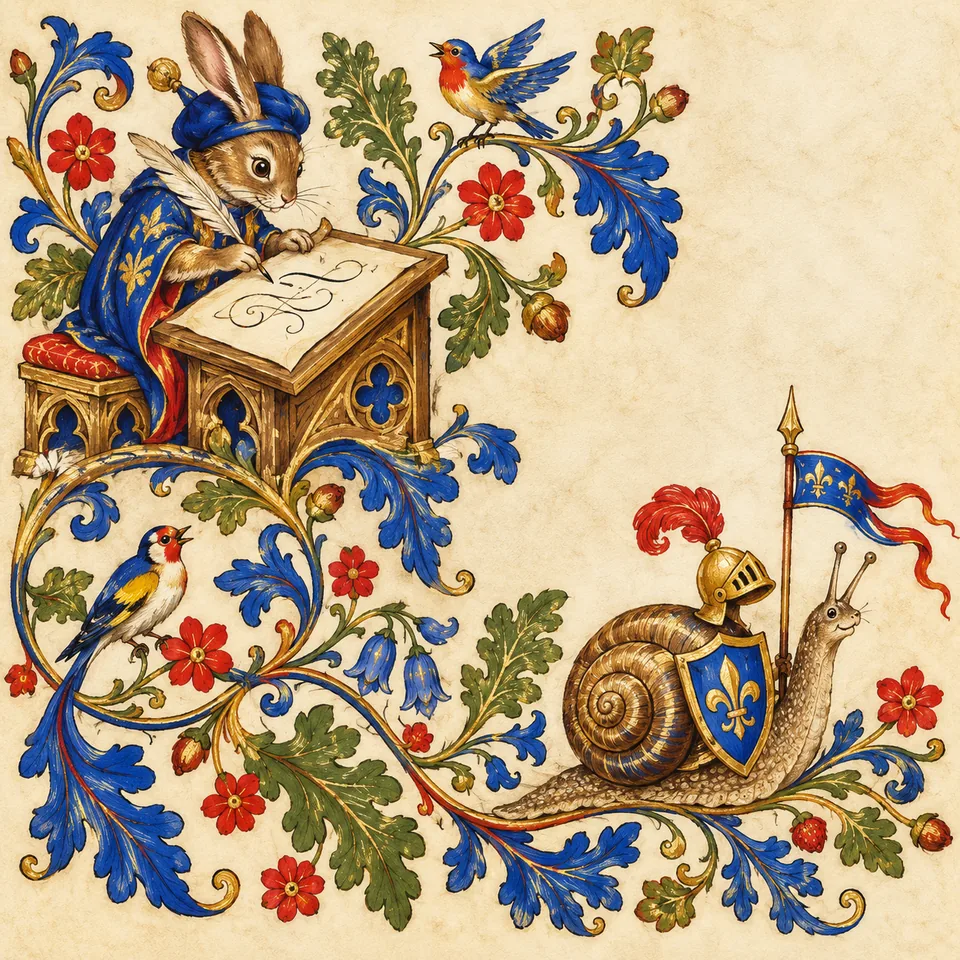
A diversion in the margins
Medieval manuscripts could host improbable creatures at their edges. Our newly imagined rabbit and snail are here to interrupt your certainty. Visit the British Library’s margins ↗
The Pardoner condemns greed while confessing his own fraud. A tale can carry a useful warning even when the person delivering it is compromised. Would you trust the lesson, the speaker, both, or neither?
The Wife of Bath’s long prologue makes room for experience to argue with inherited authority. When reading, notice who asks a question, who must answer, and who gets to decide whether an answer counts.
A playful modern interpretation, not a reproduction of any historical manuscript.
Before you go / keep the frame in view
Geoffrey Chaucer is the author. The traveling “Chaucer” who describes the company is a constructed narrator and fellow pilgrim. The storytellers are fictional voices inside that frame. A character’s claim is not automatically the author’s view.
The Host proposes two tales from each pilgrim on the way out and two on the return. The surviving work contains 24 tales, some unfinished. Its manuscripts preserve different arrangements; the order between fragments is debated. This page’s six-tale selection is editorial, not a complete or definitive sequence.
The work contains sexual violence, coercion, misogyny, and antisemitism. In particular, the Prioress’s Tale, outside this selection, tells an antisemitic blood-libel story. Recognizing its historical context does not make that hostility acceptable. Content notes appear before our deeper reveals.
These original AI-generated illustrations evoke manuscript painting; they are imaginative interpretations, not evidence of Chaucer’s appearance or a reconstructed medieval journey. Our summaries and gloss are new writing. Consult a scholarly edition for the full text and its historical complexity.
The source shelf / checked October 2026
Scholarship and primary texts inform the frame, tale summaries, and content notes. Interpretive questions and artwork belong to this PointCast edition.
Reading paths & sources · JSON ↗Middle English sampler: Fragment I, lines 12, 16, 27 and 46. Four separate selected lines, not a continuous passage. PointCast’s glosses are original reading aids.
Tabard gathering, Harry Bailey’s contest, and the Miller’s interruption of the intended speaking order.
The unfinished frame, ten linked fragments and disputed ordering between fragments.
Catalogue of the 24 surviving tales. Some tales are incomplete; ‘24 tales’ does not mean 24 complete stories.
Keep the fictional reporter distinct from the poet and the historical Geoffrey Chaucer.
Scholarly route reconstruction in two stages, Southwark to Rochester and Rochester to Canterbury. Maps consulted as evidence, not reproduced.
Historical pilgrimage destination and distinction between Chaucer’s fictional travelers and real pilgrim routes.
Primary Middle English text; original summary and reveal. Fragment I, 859–3108.
Primary text; original summary, reveal and content note. Fragment I, 3109–3854.
Primary text; original summary, reveal and content note. Fragment III, 1–1264.
Primary text; original summary, reveal and content note. Fragment VII, tale 2821–3446.
Primary text; original summary and reveal. Fragment VI, prologue 329–462, tale and final exchange 463–968.
Primary text; original summary, reveal and content note. Fragment V, 729–1624.
Context for the excluded tale’s antisemitism and false blood-libel accusation; no retelling or imagery reproduced.
Public-domain Middle English edition edited by W. W. Skeat; an optional full-text destination, separate from PointCast’s original summaries.
Historical manuscript marginalia and the debated meanings of improbable creatures. No collection images are reproduced.