Adults first
Makers, collectors, repairers, and curious households can test the institution without pretending a children’s product compliance program already exists.
WORKING PROPOSAL · SOUTH BAY → GREATER LOS ANGELES
A company can publish a creature. Only an institution can keep the conditions of care from disappearing with the company.
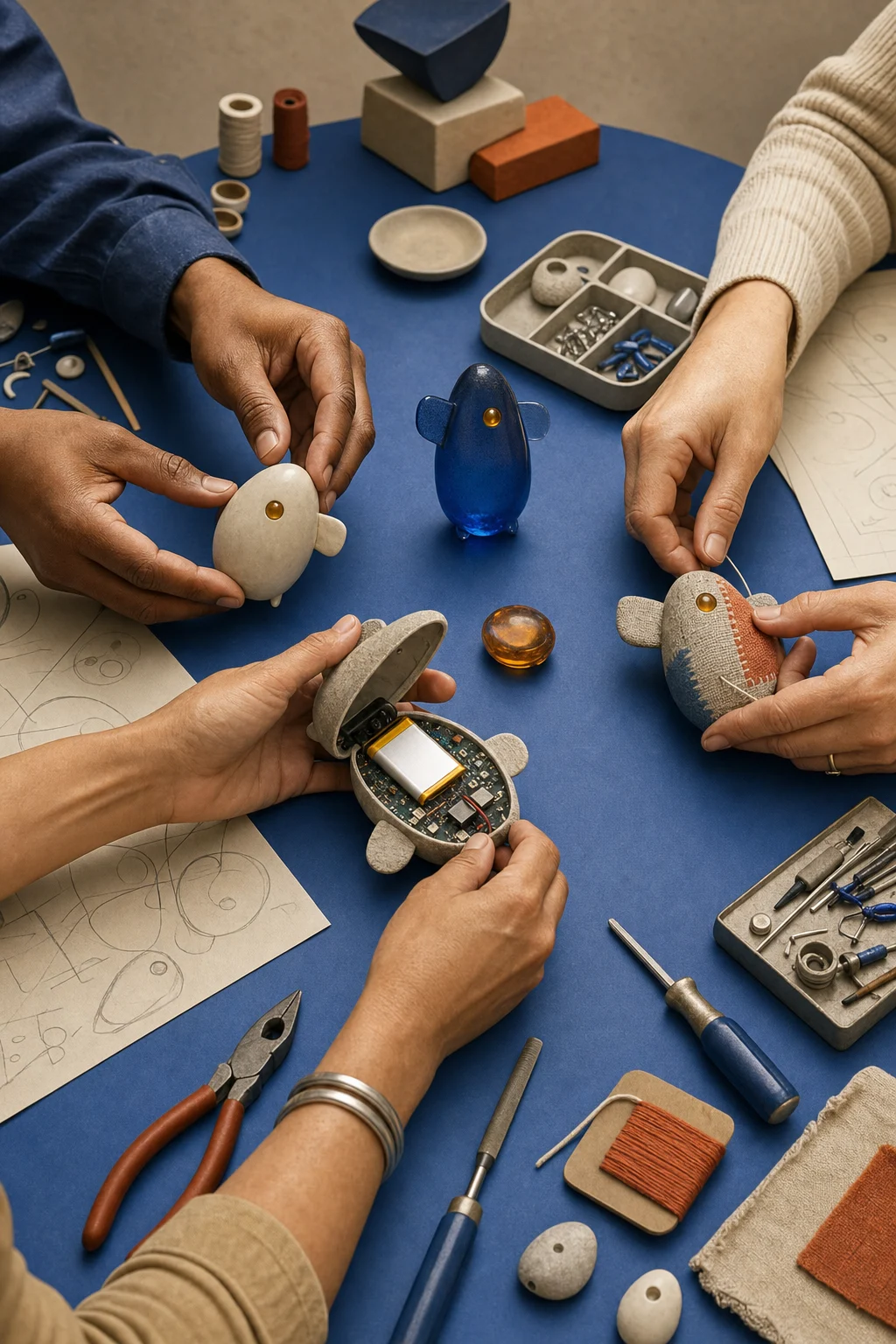
Makers, collectors, repairers, and curious households can test the institution without pretending a children’s product compliance program already exists.
The commons stewards continuity infrastructure. Creators retain characters, canon, and the right to publish specific creatures.
Make three non-sale references, publish the Memory Passport and Local Life Standard, and run recurring build and repair sessions in partner space.
COMPANION ESSAY · 790 WORDS
A digital pet company can make a beautiful promise and still be the wrong shape to keep it. Companies are built to ship products, defend margins, change strategies, and eventually end. A creature asks for commitments that outlive each of those events: repair knowledge that remains public, memory that can leave the maker, parts that can be found after a model leaves the catalog, and an ending more deliberate than an authentication error. Those commitments need an institution of their own.
Call it Creature Commons LA: a local layer beneath an authored creature economy. It would not invent every animal or own every story. It would steward the boring, intimate conditions that make long relationships possible—the offline-life test, the Memory Passport, service documentation, a parts library, repair practice, and a graveyard protocol. An artist can still write the character. A studio can still publish an edition. The commons keeps the floor from vanishing underneath both of them.
Los Angeles is unusually suited to try this because the necessary work already lives near one another. ACME says its Carson facility can build one circuit-board prototype or a run of twenty thousand. DTLA and Huntington Park contain soft-goods developers, sample rooms, pattern makers, technical sewing, and small production. Upland has tooling, overmolding, and injection-molding capacity. The first hundred bodies do not need to appear by magic at the end of a global sourcing spreadsheet. Their builders can meet, open the same object, and discover where the design is lying.
That proximity is not localism as decoration. It is product intelligence. When the sewing developer can show the embedded engineer where a service seam will fail, the body changes before a support ticket exists. When the repairer can ask the board assembler for a connector that survives repeated opening, maintenance enters the bill of materials. When an owner can bring a worn creature back to the people who made its layers, care becomes observable design input rather than a retention metric.
The commons should not own every character. The studio should not own the owner’s accumulated relationship.
The organization should have two sides with a bright line between them. The commons side owns the shared continuity infrastructure: standards, reference tools, supplier learning, workshops, repair records, and the archive. The authored-studio side owns named creatures, canon, editions, performances, and commercial collaborations. The commons should not own every character. The studio should not own the owner’s accumulated relationship. A healthy agreement lets creative specificity remain valuable without making basic survival proprietary.
Start with adults and three non-sale reference creatures. Give each one a replaceable battery, an obvious service path, a visible microphone state, a minimum local personality, and a memory object that can be exported and inspected. Then run the first build circle and repair night. The test is not whether the creatures look ready for retail. It is whether a person outside the design team can identify what remains alive without a network, what can be replaced, what the household owns, and what happens if the organization disappears.
Do this for ninety days before signing a lease or filing an entity because a commons is a practice before it is a corporation. Borrow partner space. Request real manufacturability reviews and quotes. Publish the disagreements. If education, public access, repair literacy, and preservation become the center, fiscal sponsorship or a California public-benefit corporation may fit. If workers and caretaker-members need economic ownership, a cooperative may fit. If selling authored hardware becomes the center, keep a taxable studio and let it contract with or contribute to the commons.
Children can become a later constituency, not an implied launch market. A connected, battery-operated creature marketed as a children’s toy enters real CPSC testing and certification territory; collecting a child’s voice can enter COPPA territory. “Community” cannot be an excuse for informal safety. The adult pilot should treat compliance, privacy, radio authorization, liability, and truthful claims as founding functions rather than paperwork waiting beyond the prototype.
The public output is not a startup demo day. It is a field guide: three opened bodies, two draft standards, a supplier map, the costs people were willing to quote, the failures nobody could explain away, and a calendar for the next repair night. PointCast can publish the argument while the bench tests it. The result may become a nonprofit program, a cooperative, a studio partnership, or simply a better set of promises. Any of those is more useful than incorporating an exciting name before the community knows what it is for.
A company can publish a creature. Only an institution can keep the conditions of care from disappearing with the company. The future of digital pets therefore needs more than founders and customers. It needs stewards, repairers, archivists, and households with enough power to carry the relationship forward. It needs a commons before it needs a campus.
THE BRIGHT LINE
The point is not to make every character communal property. It is to prevent survival, memory, and repair from becoming private leverage.
FIVE ROOMS · ZERO LEASES YET
Electronics, mechanisms, soft-body sampling, teardown, service documentation, and small-run assembly.
Reference bodies, component samples, tools, field guides, memory schemas, and known-good offline builds.
Repair nights, diagnosis, battery and textile replacement, memory export, and second-owner transitions.
PointCast essays, build logs, supplier interviews, owner stories, and an annual state-of-the-creature report.
Repair exhaustion, migration, memorial, secure deletion, parts donation, and responsible material recovery.
THE FIRST NINETY DAYS
Three non-sale reference creatures, a Memory Passport, a Local Life Standard, and recurring build and repair nights.
Days 01–14
Days 15–45
Days 46–75
Days 76–90
LOCAL SOURCING · RESEARCH LIST, NOT ENDORSEMENTS
No commitment or quote is claimed. The first action is a request for information and a real manufacturability conversation.
Electronics + PCBA
One-piece prototype through 20,000-unit PCBA production; electronics R&D and board design listed.
Verify stated capability ↗Soft-goods development
Materials, construction, sampling, tech packs, prototype direction, and manufacturing readiness.
Verify stated capability ↗Technical sewing
Pattern making, fabric sourcing, production-ready samples, specialty soft goods, and manufacturing.
Verify stated capability ↗Enclosures + tooling
DFM, prototype and production tooling, insert molding, overmolding, testing, and part sampling.
Verify stated capability ↗Supplier discovery
California manufacturing directory and supplier-visibility network.
Verify stated capability ↗FOUNDING GATES
No children’s product or study in the pilot. If the audience changes, identify the applicable toy standard, testing, certification, labeling, and privacy requirements first.
No marketed radio-frequency product without an identified FCC equipment-authorization path and a named responsible party.
No incorporation claim or charitable fundraising until the pilot proves a public program, governance need, receiving structure, and ongoing reporting capacity.
THE COMPANION SERIES CONTINUES
FOUNDING CIRCLE · LISTEN FIRST
Send one concrete correction, capability, or constraint. PointCast is looking for embedded hardware, soft-goods, repair, privacy, compliance, community education, and archive experience—not applause for an organization that does not exist yet.
Send one concrete note ↗