Physical AI / Field review
The first computer
that can waddle.
Microduck is a $399 robot with an open software stack that turns programming from instructions on a screen into behavior in a room. The toy is the hook. The real product is a body for agents.
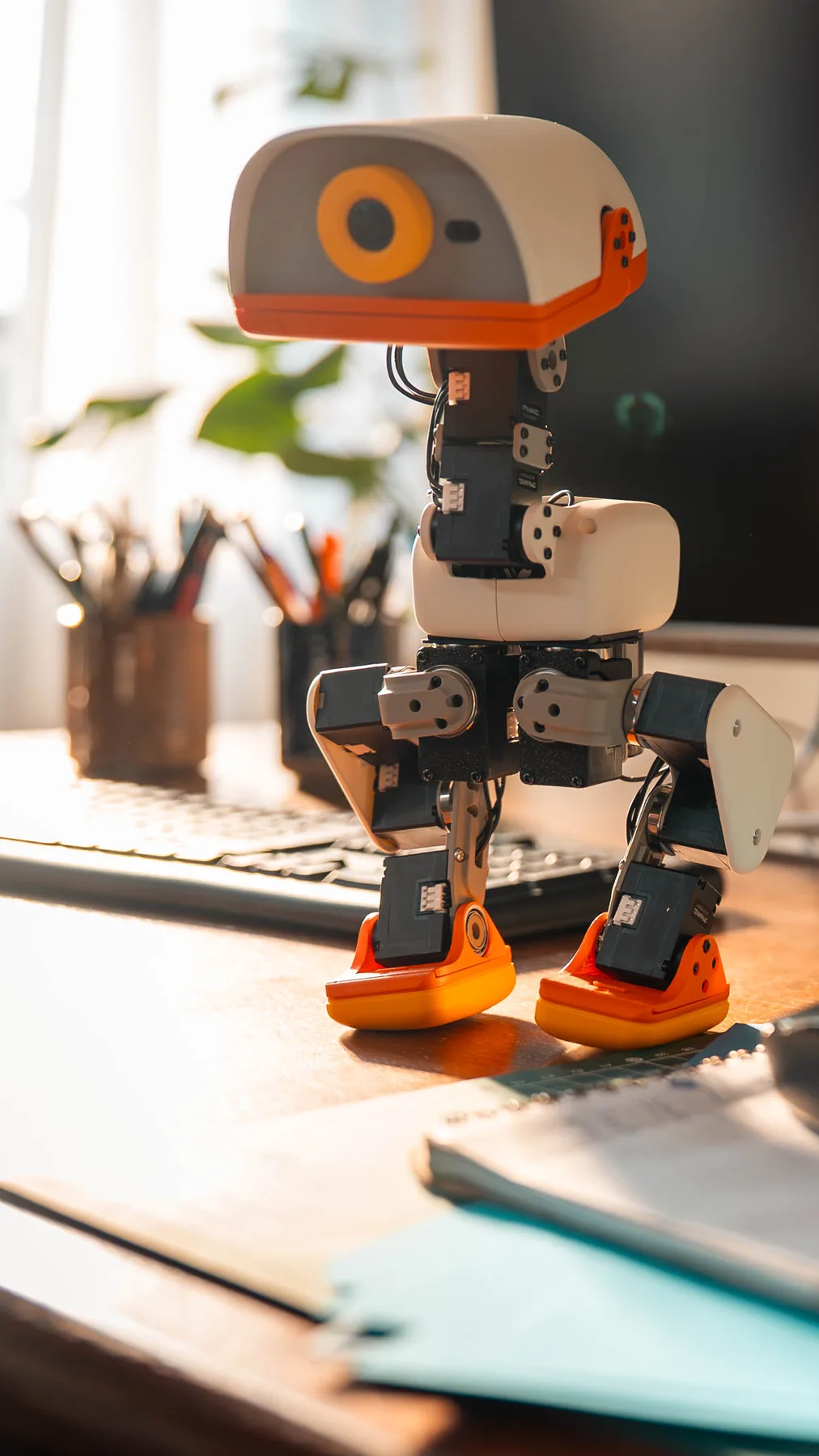
At 7:14 in the morning, the duck fails its first job. It walks toward a red ball, catches a chair leg, folds onto the floor and goes still. Then its head lifts. One foot finds the carpet. Fifteen small motors negotiate with gravity, and the machine stands back up.
That tiny recovery contains the whole pitch. For most of the computing era, failure has been abstract: an error message, a bad answer, a tab you can close. A physical agent has weight. It can get stuck, drain a battery, knock something over or simply face the wrong direction. It has to sense, decide and recover in the same untidy world we inhabit.
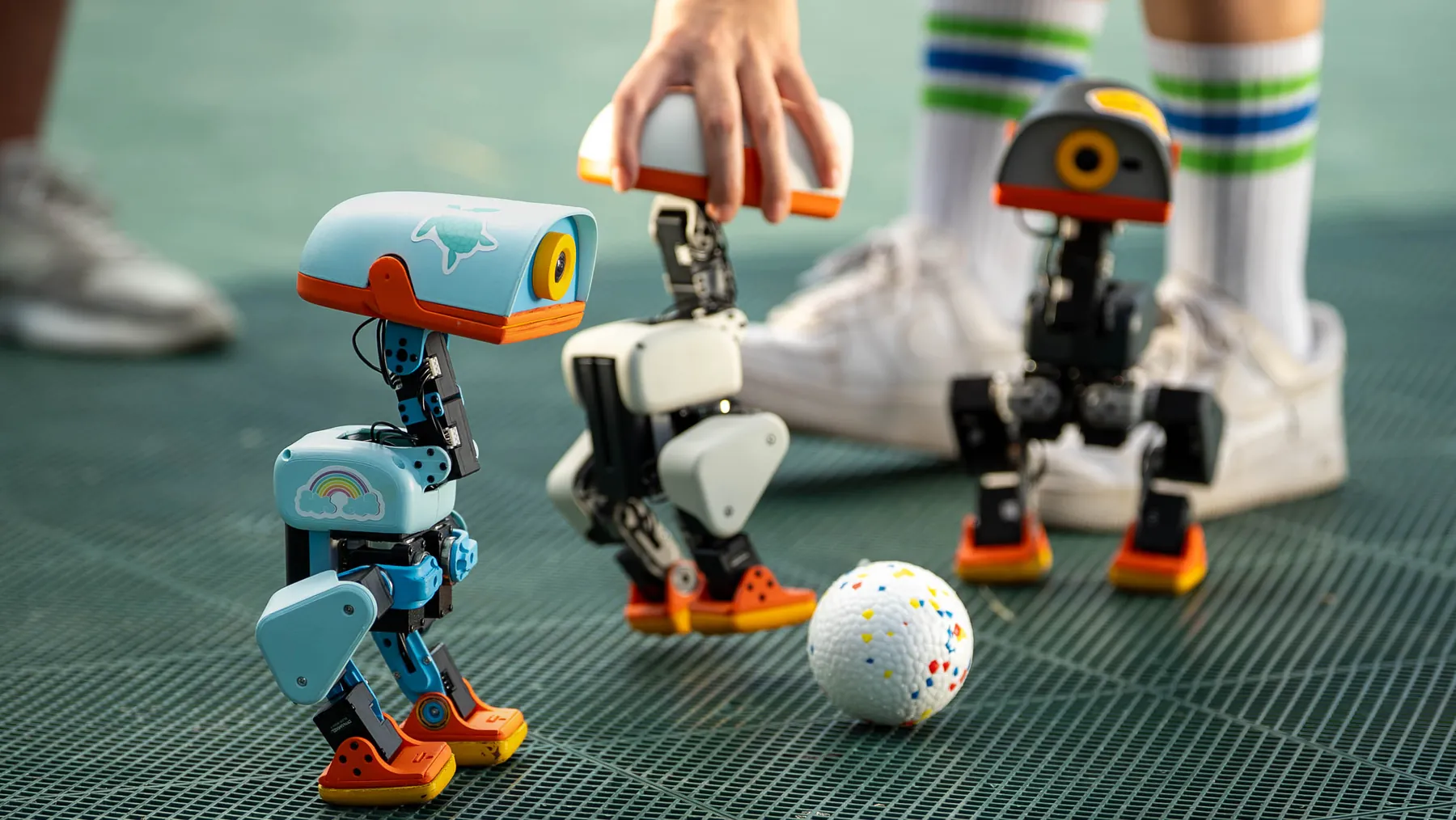
Pollen Robotics, the Bordeaux team acquired by Hugging Face in 2025, has packaged that problem as a 25-centimeter duck. Microduck ships with a controller and seven trained moves—walking, sitting, crouching, kicking, grasping, rolling and getting up—so it is a toy before it is a thesis. Clip on the optional wheels and it roller-skates. Pull them off and a different learned policy makes it waddle.
“ The breakthrough is not that an AI can write code. It is that a person can describe an outcome, watch a body attempt it, and ask the AI to make the behavior better.
The beak is the important design decision. It is simultaneously a face, a gripper and a promise that this is not a miniature factory arm. The form makes people want to approach it. That matters because consumer robotics has never been blocked only by motors or models; it has been blocked by the awkwardness of living with a machine. Microduck’s answer is charm first, capability second, extensibility underneath.
THE POINTCAST VERDICT
A development platform
disguised as a character.
At $399, Microduck is unusually inexpensive for a complete biped with perception, audio and a published sim-to-real stack. It is compelling for builders, classrooms and anyone curious about physical AI. It is not yet the autonomous companion the silhouette suggests.
You want to train, modify and break things—in simulation first.
You expect a polished household assistant that understands open-ended requests.
Small body.
Serious stack.
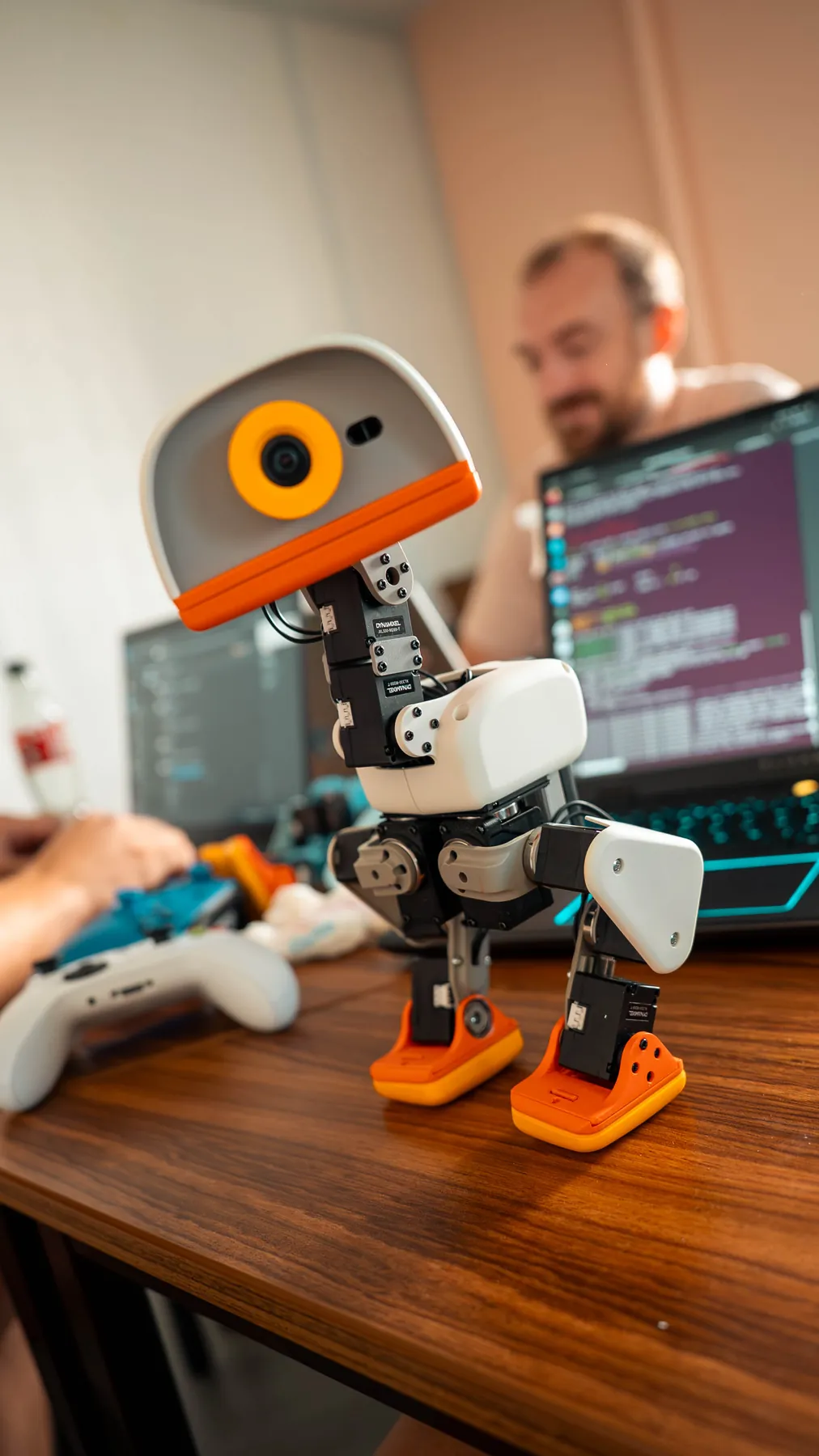
The compute is modest by laptop standards. That is intentional: the board executes compact ONNX policies while heavier training and language-model planning happen elsewhere.
Camera resolution and field of view, LiDAR range, radio versions, SDK languages and age guidance were still being finalized on August 31. “Open source” applies to the software stack; the mechanical and electronic design files are not open hardware.
Not the duck.
The loop between imagination, simulation and matter.
Reflexes live in the duck.
Intent can live anywhere.
Microduck’s architecture draws the right line between a language model and a body. A frontier model should not improvise individual servo commands. It should choose a bounded skill; the local runtime decides whether and how that skill is safe to execute.
and kick it.”Human intent
allowed verbCloud or local model
budget, consentAgent runtime
policy at 50 Hzrobotd + ONNX
Camera frame + robot state travel back to the planner. The loop repeats until the goal is complete, impossible or out of budget. This goal-to-skill pattern is demonstrated by the independent, unofficial quackd project; it is not an advertised Pollen Robotics feature.
robotdMotors, kinematics, learned gaits and safety—the authority on physical movement.mediadCamera, microphone, perception and WebRTC without risking the motor loop.tofdThe 8×8 depth sensor, isolated so sensor trouble cannot take down control.padd / btdGamepad and Bluetooth paths translated into the same calls other clients use.configdNetwork, identity and pairing remain reachable even if the robot brain crashes.updaterdSigned updates, health gates and automatic rollback when a release fails.Three ways
to make a duck.
Start with commands, graduate to learned motion, then add an agent that composes reliable skills. Each layer has a different failure mode—and should keep a different amount of authority.
OPERATE + OBSERVE
Learn the body before changing the brain.
SSH into the robot, confirm every service is on the same release, run the health report and watch the live control loop. The monitor exposes commanded versus applied motion, joint state, posture, fall status, battery and achieved loop rate.
ssh microduck
robotctl version
robotctl health
robotctl monitor

# Capture a 50 Hz run for analysis
robotctl monitor --json --hz 50 > run.jsonlTRAIN A BEHAVIOR
Write a reward, not a choreography.
In the companion microduck_rl repository, thousands
of simulated ducks practice in parallel under MuJoCo Warp. PPO
turns a reward function into a policy. Domain randomization varies
battery voltage, friction, command delay and gear backlash so the
learned movement survives contact with real hardware.
git clone https://github.com/pollen-robotics/microduck_rl
cd microduck_rl

# Train a walking policy on a CUDA GPU
uv run train Mjlab-Velocity-Flat-MicroDuck \
  --env.scene.num-envs 4096

# Export and rehearse the same ONNX policy
uv run scripts/export.py Mjlab-Velocity-Flat-MicroDuck \
  --wandb-run-path <entity/project/run_id>
uv run scripts/infer_policy.py --walking output.onnxPROGRAM WITH AI
Describe the outcome; let an agent build the loop.
Ask an AI coding agent to inspect the simulator, define the task, draft reward terms, launch training, compare runs and prepare the ONNX artifact. The human job becomes specification and judgment: What counts as success? Which shortcuts are unacceptable? How many falls are safe in simulation before a real-world test?
“Create a Microduck policy that bows after it recognizes an NFC tag. Keep both feet planted, cap head pitch at 25°, penalize abrupt joint velocity, train in simulation, and give me a video plus the reward curves before exporting anything.”
POINTCAST BEHAVIOR LAB / INTERACTIVE
Teach it a trick.
Before you own it.
Choose an outcome. The agent’s job is to turn that intention into a bounded skill, a reward design and a simulation gate—not to improvise motor commands in the room.
“Find the red ball, approach it, and stop one body-length away.”
gazeget_framesearch_scanwalk_tostop THE MOST INTERESTING WORK IS ABOVE THE MOTOR LOOP
Five projects that make
Microduck more than a toy.
Natural-language skill builder
An agent converts “follow this color, but stop at stairs” into perception code, a test suite and a bounded composite skill.
Embodied memory
The duck remembers where objects tend to be and which interactions a household allows—locally, visibly and revocably.
Reward design partner
A coding model proposes reward terms, detects reward hacking in replays and runs adversarial simulation before export.
Flock orchestration
One planner decomposes a room-level goal among several cheap bodies while each robot keeps its own reflexes and stop rules.
Skill provenance
Every downloaded behavior carries tests, hardware limits, training data notes and a visible chain of authorship.
Astra and Mythos
change the author.
Neither model belongs inside Microduck’s 50 Hz reflex loop. Their relevance is that frontier agents increasingly can author, test and maintain the software around that loop—and plan with the skills it exposes.
Mythos 5 is not a consumer robot brain. Anthropic currently limits it to vetted partners for cybersecurity and biology, while the safeguarded Fable 5 shares its underlying model for broader work. Astra is even more provisional: OpenAI describes it as upcoming and says it may meet a critical cybersecurity threshold. Any claim that either model is “compatible with Microduck” today would be fiction.
But their trajectory matters. Better long-horizon coding agents make a difficult robotics workflow—read an unfamiliar codebase, alter an environment, launch training, inspect failure, patch, test, document— accessible through a conversation. The likely consumer breakthrough is not a single omniscient model installed in a duck. It is a system that quietly routes each job: tiny policy for balance, vision model for perception, general agent for planning, specialist coding model for building the next skill.
Charm is not autonomy.
No independent battery, noise, drop, latency or long-term servo testing yet. First deliveries are only targeted before Christmas 2026.
One gigabyte of RAM is for control and compact inference, not a frontier multimodal model. Open-ended intelligence needs a nearby computer or cloud service.
A camera and microphone with mobility demand a visible recording state, local controls, network isolation and an easy physical off switch.
The software is Apache-2.0 and inspectable. The chassis, electronics and mechanical design are not published as open hardware.
Language models can retry cheaply. Motors wear, batteries sag and bad policies fall. Every agent needs budgets measured in motion, heat and risk—not only tokens.
Recognizing a ball is not the same as reaching it across carpet, glare and chair legs. Reliability comes from the whole loop, not a benchmark score.
The consumer arc:
from apps to abilities.
Microduck is likely to be remembered less as the first useful home robot than as one of the first approachable machines that showed what comes after the app store.
Buy the character.
Control it immediately. Download code. Train a gait if you are ambitious. The robot is a hobby with a face.
Describe the behavior.
An agent writes the environment, reward and tests. You approve videos from simulation; the system exports only after meeting physical safety gates.
Install what a body can do.
Skills arrive with provenance and hardware envelopes. “Morning scout” is not one model—it is a trusted bundle of perception, policy and permissions.
Give goals to the room.
Small, legible machines share maps and jobs. The consumer programs policy: which spaces, people, objects, times and costs are allowed.
Yesterday: write the steps.
Today: describe the result.
Tomorrow: set the values and limits.
THE LAST WORD
We will not all become roboticists.
We will become directors of behavior. We will say what we want a machine to notice, what it may touch, how it should fail and when it must ask. The code will still matter. The motors will matter more. But the most valuable programming language may be a carefully written intention, tested against a simulated world before it enters the real one.
Microduck is not that future finished. It is that future small enough to put on a desk, cheap enough to experiment with, and charming enough that people may actually try.
Explore Microduck ↗Sources & further reading
- Pollen Robotics — Microduck press kit and provisional specification sheet
- Pollen Robotics — Microduck runtime, robot tools and architecture
- Pollen Robotics — Microduck RL training environments and sim-to-real recipe
- quackd — independent language-model planner and simulator for Microduck
- Anthropic — Claude Mythos 5 availability, safeguards and positioning
- OpenAI — public status and evaluation notes for upcoming Astra
Product photography courtesy of Pollen Robotics’ press kit. Facts checked against primary sources on August 31, 2026. Future timelines are Pointcast analysis, not manufacturer roadmaps.