ART SOFTWARE / RESPONSIVE WEB / 10ꜩ PREVIEW
THE
LISTENING
GROVE
A huge Midjourney archive becomes an unusually elegant audiovisual instrument—with three generative scores, touch navigation, variable pacing, and one unfinished collect button.
EDITOR'S
CHOICE 4.5 OUT OF 5
DESKTOP
+ MOBILE
This is not a grid with a soundtrack. The Listening Grove is an ambient record with 617 covers: a high-resolution Midjourney archive turned into a responsive instrument for bells, gongs, color fields, swipes, and unhurried looking.
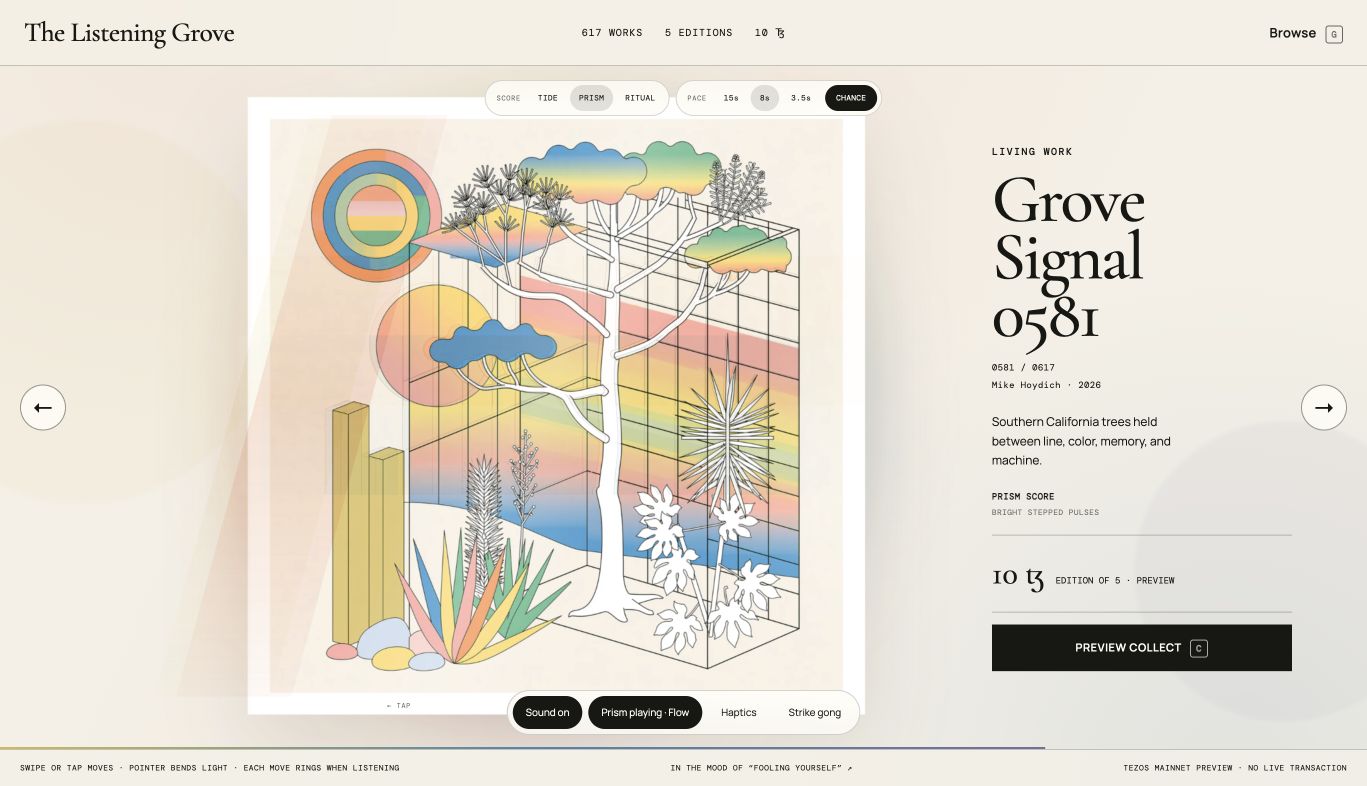
The fourth version fixes the central problem of enormous image collections. Instead of making the visitor manage the archive, it makes the archive perform. Tide drifts. Prism flickers. Ritual hangs a low gong in the room. You can conduct it one image at a time or let auto mode assemble an endless, slightly different audiovisual score.
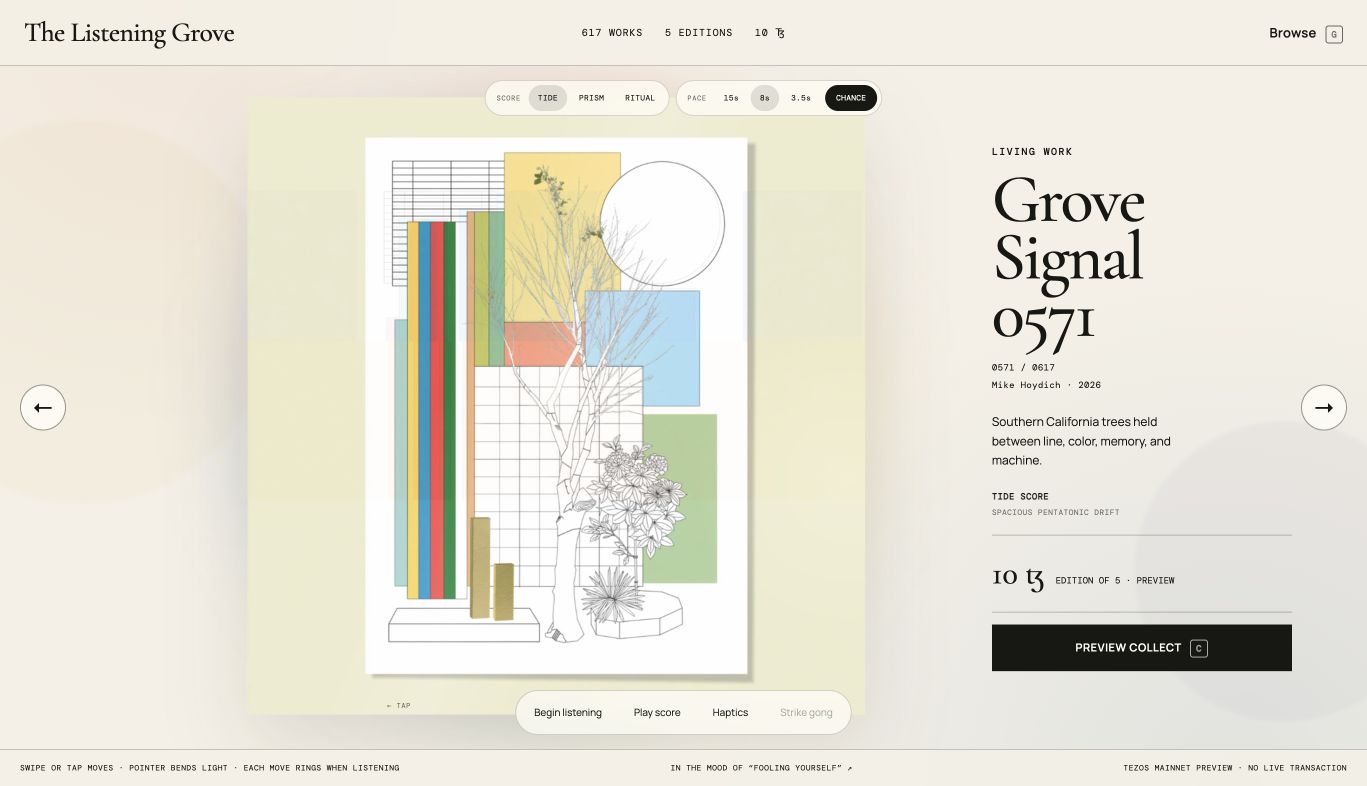
A GALLERY THAT PERFORMS
THE COLLECTION BECOMES THE SCORE
Click Begin listening and the browser opens an instrument instead of a playlist. Each transition feeds a small generative system: tones, stereo position, decay, image color, and the tempo of the next visual event change together. Nothing is a prerecorded song, so the same session does not return in quite the same form.
That matters. Slideshow audio usually sits on top of the pictures like rented furniture. Here, moving through the archive is the composition.
THE THREE SCORES
PICK A WEATHER SYSTEM
Spacious pentatonic drift. Slow, translucent, and best for longer looking.
Bright stepped pulses with digital light. The lively afternoon setting.
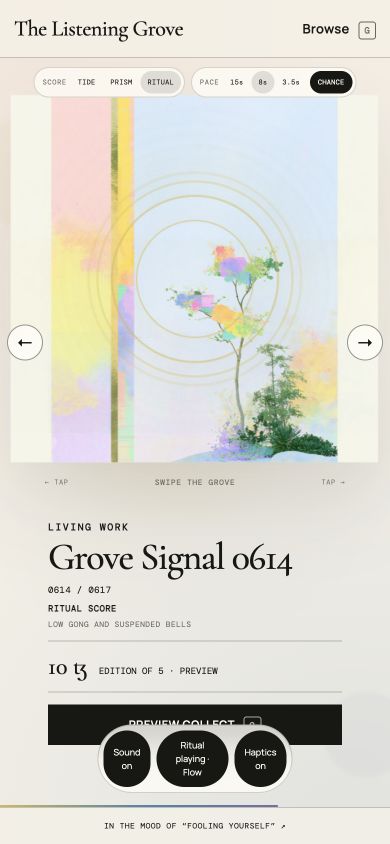
Low gongs and suspended bells. The most meditative—and our favorite.
BUILT FOR A THUMB
SWIPE IS THE NEXT BUTTON
The mobile layout is not a shrunken desktop. Swipe advances, touch awakens audio, controls wrap without covering the artwork, and the speed selector remains readable. Haptics add a small pulse on compatible devices, but the feature correctly stays optional: browser and hardware support still vary.
THE FIDELITY FIX
SHARPER BY
SHOWING LESS
Earlier builds pushed some source images beyond the size at which they looked convincing. Version 4 preserves the high-fidelity derivatives, respects each image's aspect ratio, and uses the viewport as a frame rather than a mandate to fill every pixel.
The result is not a fake “enhance” pass. It is better exhibition design: large enough to enter, contained enough to keep edges and texture intact. On small screens, the same rule prevents pinching and accidental crops.
THE UNFINISHED ROOM
COLLECTING IS STILL A PREVIEW
The interface presents a 10ꜩ price and an edition size of five, then hands the visitor toward a Tezos wallet. That handoff is useful, but it is not proof of a mint. We did not verify an operation hash or an independently indexed Mainnet transaction, so PointCast labels the current state exactly as the product does: Tezos Mainnet preview.
Browse and listen now. Treat the collect button as a production test until the contract, token metadata, supply counter, and completed transaction are all verifiable.