POINTCAST COLLEGE FOOTBALL · ARCHIVE DESK 001 · ISSUE 003
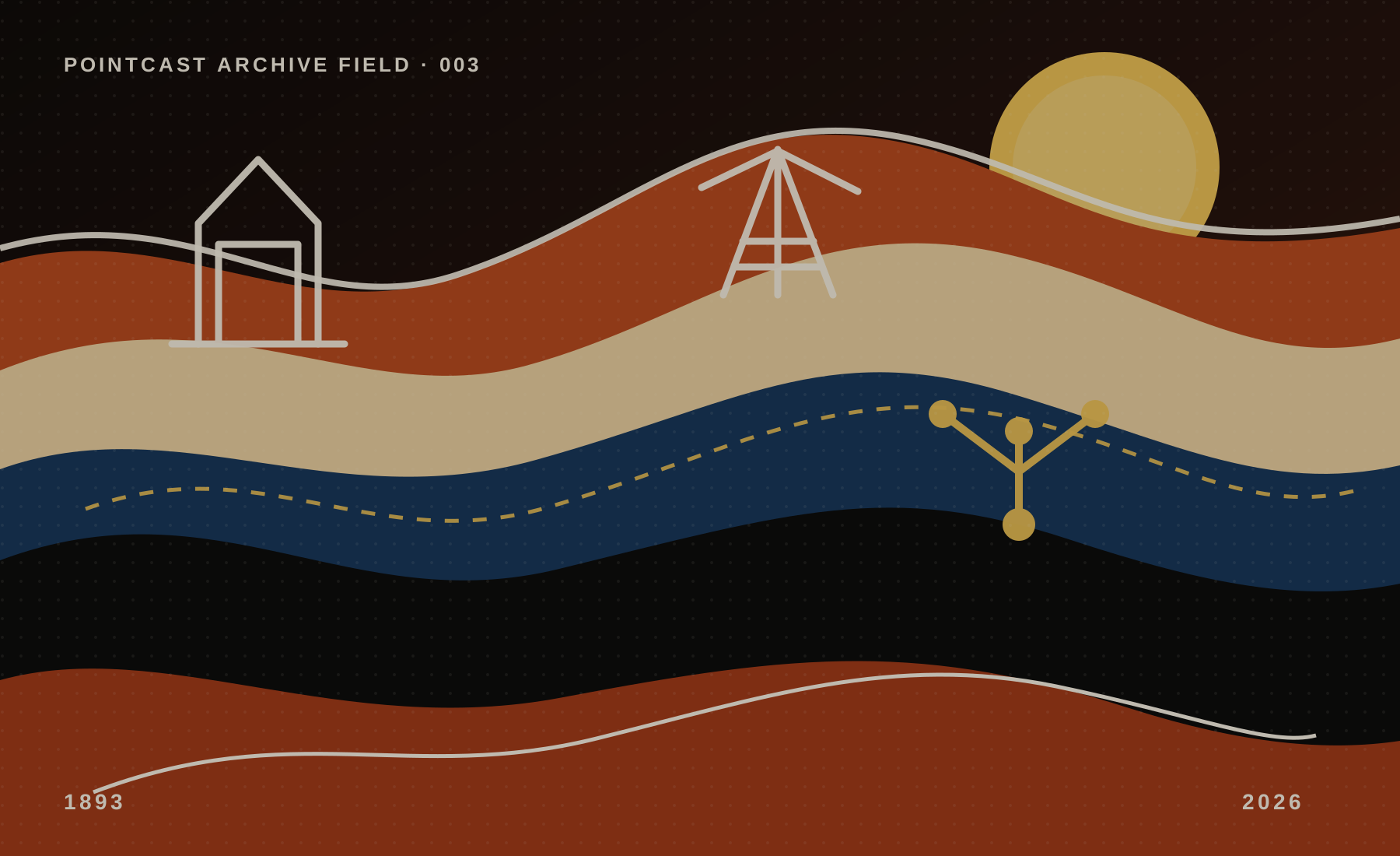
Abstract Texas football history as burnt-orange geological layers with a memorial arch, oil derrick, wishbone diagram, and line from 1893 to 2026

POINTCAST MAGAZINE · AUGUST 12, 2026

THE HISTORY
OF TEXAS
FOOTBALL

“A history in ten objects—and one unfinished season.”
10 objects 134 seasons 01 unfinished year

ORIGINAL POINTCAST VECTOR FIELD · NO OFFICIAL SCHOOL MARKS

Texas was never
inevitable.

The oldest feeling at Texas is that Texas has always been Texas. It has not.

It began as students arranging a game. The colors were a vote. The mascot was an alumni purchase. The stadium was a memorial. The dynasty was an offensive experiment. Integration arrived late enough to complicate the championship photographs. Television made the program both richer and more portable. Conference realignment moved a 131-year-old institution into a new neighborhood.

The continuity is not that nothing changed. The continuity is the size of the claim: this team can make a young public university feel ancient, make a campus feel like a state, and make one Saturday look like evidence about who Texas is.

Texas football is not a monument. It is a construction site that learned how to call itself a monument.
1893first football season
04claimed national titles
02Heisman winners
1924Memorial Stadium opens
105,213largest listed DKR crowd
10–32025 record

Things that
became Texas.

Not the ten greatest moments. Ten objects that reveal how an institution manufactures continuity.

01

1893

A gold-and-white jersey

Before the Longhorn, there was a student club.

The first Texas team was unofficial, student-run, and called the Varsity. Its first notable game came on Thanksgiving at the Dallas Fairgrounds, where it beat the Dallas Football Club 18–16. The club won four games that fall. In 1894, alumni donations hired a seasonal coach and bought uniforms. The original colors were gold and white, chosen to echo the yellow brick and pale limestone of the young campus. The first lesson is almost comic in hindsight: the largest identity in college football began as students improvising a team.

Texas did not discover a tradition. Students made one, then alumni paid for the next version.
RECEIPT · Dolph Briscoe Center / TARO ↗
02

1900 / 1925

An orange ribbon

The color was a vote before it was a law of nature.

Orange and white first appeared around Texas athletics as ribbons in 1885, but the early football crowd wore nearly everything—orange, yellow, crimson, maroon, even blue. In 1900, 1,111 students, faculty, staff, and alumni voted; orange and white won, with orange and maroon second. Burnt orange arrived later as a deliberate distinction from every other orange school. The shade disappeared when its dye became unavailable during World War II, then Darrell Royal restored it in the early 1960s. Even the color that now feels eternal had to be selected, manufactured, lost, and recovered.

Tradition is often a design decision that survives long enough to become emotional infrastructure.
RECEIPT · UT Austin News ↗
03

1916

A steer in a boxcar

Bevo arrived frightened, thin, and not yet immortal.

Alumnus Stephen Pinckney found an orange-hued longhorn during cattle-rustling work near Laredo. With one-dollar gifts from 124 alumni, he bought the animal and sent it to Austin by rail. Two West Texas cowboys dragged the steer onto Clark Field at halftime of the A&M game. The alumni magazine named him Bevo soon afterward. The famous branding origin story is a later myth. The likely source is “beeve,” period slang for an animal destined for beef, plus the fashionable “o.” Bevo I was eventually served at a 1920 football banquet. It was a less sentimental age—and proof that mascots become sacred only after people keep telling the story.

Texas mythology works because the absurd fact is usually better than the polished legend.
RECEIPT · UT Austin News ↗
04

1924

A memorial stone

The stadium began as remembrance, then learned to become a city.

Texas Memorial Stadium opened in 1924 and was dedicated to Texans who served in World War I. A century of additions turned the memorial into an immense Saturday apparatus: decks, suites, academic space, a war memorial plaza, medical and performance rooms, food, screens, and a south-end-zone training complex completed for 2021. The largest crowd listed by Texas Athletics is 105,213 for Alabama in 2022. Yet beneath every renovation is the original civic claim embedded in the name: this was supposed to remember service before it monetized attention.

The building is both memory and machine. A good history refuses to choose only one.
RECEIPT · Texas Athletics ↗
05

1923

The Santa Rita derrick

The oil well did not call a play. It changed the horizon.

One year before the stadium opened, Santa Rita No. 1 struck oil on University Lands in Reagan County. The first royalty payment to the Permanent University Fund was $516.53. University Lands now manages 2.1 million acres across nineteen West Texas counties for the PUF. That endowment story is not the same thing as an athletics budget, and the derrick did not invent Texas football. But oil changed the scale, confidence, and capital environment of the university whose name football carried into living rooms. Texas became a place where public land, private extraction, higher education, and spectacle could occupy the same horizon.

Capital is not culture. It decides how large culture is allowed to build.
RECEIPT · University of Texas System ↗
06

1968

Wishbone chalk

The most traditional era was powered by an invention.

Darrell Royal arrived in 1957 and finished 167–45–5 at Texas with three national titles. In 1968, he installed the wishbone: the fullback close behind the quarterback, two halfbacks spread like the arms of a Y, and every defender asked to make a bad choice at speed. Texas won 30 straight games and six consecutive Southwest Conference titles with the formation. The irony matters. The era most often treated as the stable old Texas was a laboratory. Royal’s greatest act of preservation was to abandon the offense that no longer worked.

At Texas, nostalgia’s favorite formation was once radical software.
RECEIPT · Texas Athletics ↗
07

1969 / 1970

Julius Whittier in bronze

The championship picture had an edge it tried not to show.

The university formally opened athletics to Black students in 1963. Football still took seven more years to produce its first Black letterman. Julius Whittier arrived in 1969, played on the freshman team, and lettered from 1970 through 1972. Roosevelt Leaks followed and became Texas’s first Black football All-American in 1973. Earl Campbell arrived after them. Whittier’s statue now stands at the north end of DKR, helmet raised. It corrects the frame without pretending the delay was incidental. Texas integrated while winning national championships, not before its great era began.

The honest version of glory includes who was made to wait outside it.
RECEIPT · UT Austin News ↗
08

1977 / 1998

The number 34, twice

The state learned its power through two running backs.

Earl Campbell, the Tyler Rose, won Texas’s first Heisman in 1977 after leading the nation with 1,744 rushing yards. Twenty-one years later, Ricky Williams won the program’s second after a senior season that turned every carry into an appointment. He finished his Texas career with 6,279 rushing yards and dozens of records. Campbell made power look regional, the body of East Texas arriving in Austin. Williams made reinvention feel possible after the Southwest Conference dissolved and Texas entered the Big 12. The same number became two different bridges between eras.

A program becomes a history when one child’s hero lives long enough to greet the next one.
RECEIPT · Texas Athletics ↗
09

1903 / 2021

A song with a footnote

The archive sings back, sometimes uncomfortably.

“The Eyes of Texas” debuted in 1903 in a setting the university’s historical committee described as racist and almost certainly involving blackface. The committee found no evidence that the lyrics were intended as nostalgia for slavery and very low likelihood that the title came from Robert E. Lee. Those findings do not erase the setting; they make the history harder and more specific. The song later became a hymn, a protest vehicle, a commencement ritual, and a source of renewed student-athlete dissent. A living tradition is not one everybody experiences the same way. It is one a community is willing to research in public.

Owning a song means owning more than the feeling it gives you.
RECEIPT · University of Texas at Austin ↗
10

2006

Fourth-and-five

For one night, the whole machine became a single person improvising.

Texas entered the Rose Bowl against USC carrying its history like equipment. Vince Young made it weightless. He ran for 200 yards, passed for 267, and on fourth-and-five with the national championship in reach, crossed the goal line for the decisive touchdown. Texas won 41–38 and claimed its fourth national title. The play endures because it compresses every institutional advantage—recruiting, coaching, money, history, expectation—into an unscripted human decision. The machine did its work so one player could escape it.

The greatest Texas moment is remembered not as inevitability, but as a quarterback running out of the play.
RECEIPT · Texas Athletics ↗

The tune can unite.
The footnote must remain.

UT’s historical committee found that “The Eyes of Texas” almost certainly debuted in blackface at a racist setting, while also finding no evidence the lyrics were written as nostalgia for slavery and very low likelihood that the title came from Robert E. Lee. The same song later appeared at funerals, commencements, protests, battlefields, and football games—and became a new site of student-athlete dissent in 2020.

The point is not to flatten those facts into a verdict. It is to insist that belonging grows stronger when the archive stays open.

READ THE UNIVERSITY’S FULL HISTORICAL REPORT ↗

Capital.
Place.
Repetition.

01

Capital makes scale possible.

University Lands, donors, tickets, media, and facilities live in different ledgers. Together they produce an institution that can think in decades and build at city scale.

02

Place makes it legible.

Austin, the Forty Acres, the Tower, Dallas in October, College Station in November, and high-school towns across Texas make the program more than a professional franchise with homework.

03

Repetition makes it sacred.

Wear the color. Make the sign. Light the Tower. Cross the fairgrounds. Sing, argue, return. A ritual becomes tradition only when another generation decides it is still worth doing.

04

Players make it human.

The institution supplies the stage, but people remember Campbell’s shoulders, Whittier’s courage, Williams breaking free, Young making a fourth-down choice, and the current team becoming itself in public.

The map moved.
The pressure did not.

Texas enters 2026 after three straight 10-win seasons: CFP semifinals in 2023 and 2024, then a 10–3 finish and Citrus Bowl win over Michigan in 2025. Steve Sarkisian is 48–20 at Texas. The Longhorns are no longer asking whether they can return to national relevance. They are asking what permanence costs inside the SEC.

SEP 05

Texas State

Home · 2:30 CT

The state at the front door
SEP 12

Ohio State

Home · 6:30 CT

Night game · GameDay in Austin
SEP 26

at Tennessee

11:00 CT

First Texas trip to Neyland
OCT 10

Oklahoma

Dallas · 2:30 CT

The rivalry refuses campus
NOV 14

at LSU

Flex

A new conference test in an old cathedral
NOV 27

at Texas A&M

Friday · 6:30 CT

The state closes the argument

The schedule is unusually good history-writing material. Texas State begins the year inside DKR. Ohio State arrives at night with College GameDay. Texas makes its first trip to Neyland Stadium. Oklahoma waits in the Cotton Bowl. LSU offers a new conference cathedral. A&M gets the final Friday night.

History is no longer the thing Texas can point to when the present disappoints. History is the standard the present has volunteered to meet.

Not the formation.
Not the conference.
The appetite.

Texas survived gold uniforms, bright orange, two world wars, the end of the Southwest Conference, lean decades, great coaches, fired coaches, protests, new money, bigger scoreboards, and a move east.

What survived was the belief that a football team can carry more than a football result. That belief is beautiful. It is also dangerous. It can make athletes into symbols before they get to be students, turn a university into a brand before it gets to be a place, and make honest criticism feel like disloyalty.

The best Texas history does not reduce the program’s size. It gives the size somewhere honest to stand.

18 OFFICIAL + ARCHIVAL RECEIPTS · CHECKED AUGUST 12, 2026
  1. UT Football Scrapbooks, 1893–1896Dolph Briscoe Center / TARO
  2. The first Thanksgiving gameTexas Athletics
  3. Your questions about UT traditions answeredUT Austin News
  4. DKR–Texas Memorial StadiumTexas Athletics
  5. Memorial Stadium renovation historyTexas Athletics
  6. History of University Lands and PUF LandsUniversity of Texas System
  7. Darrell Royal: 1924–2012Texas Athletics
  8. Changing the Field: Integrating Athletics at UTUT Austin News
  9. Texas Athletics remembers Julius WhittierTexas Athletics
  10. Texas national award winnersTexas Athletics
  11. Earl Campbell player historyTexas Athletics
  12. Ricky Williams player historyTexas Athletics
  13. Eyes of Texas Historical Committee reportUniversity of Texas at Austin
  14. 2005 National ChampionsTexas Athletics
  15. Steve Sarkisian coaching recordTexas Athletics
  16. Texas 41, Michigan 27Texas Athletics
  17. Texas 2026 football scheduleTexas Athletics
  18. Ohio State and Texas A&M kickoff timesTexas Athletics

POINTCAST COLLEGE FOOTBALL · ARCHIVE DESK 001 · BLOCK 0569

RETURN TO THE MAGAZINE ↗READ BLOCK 0569 ↗OPEN THE POINTCAST 25 ↗
Unofficial, timestamped PointCast editorial history. PointCast is not affiliated with or endorsed by the University of Texas, Texas Athletics, the SEC, the NCAA, any named player or coach, or any rights holder. Records and 2026 schedule details are current through August 12, 2026 and link to official sources. No betting advice, odds, recruiting projection, or merchandise is offered.