LOOK
Attention before possession.
- The Tide Cabinet
- Shell + Stone Borrowing Library
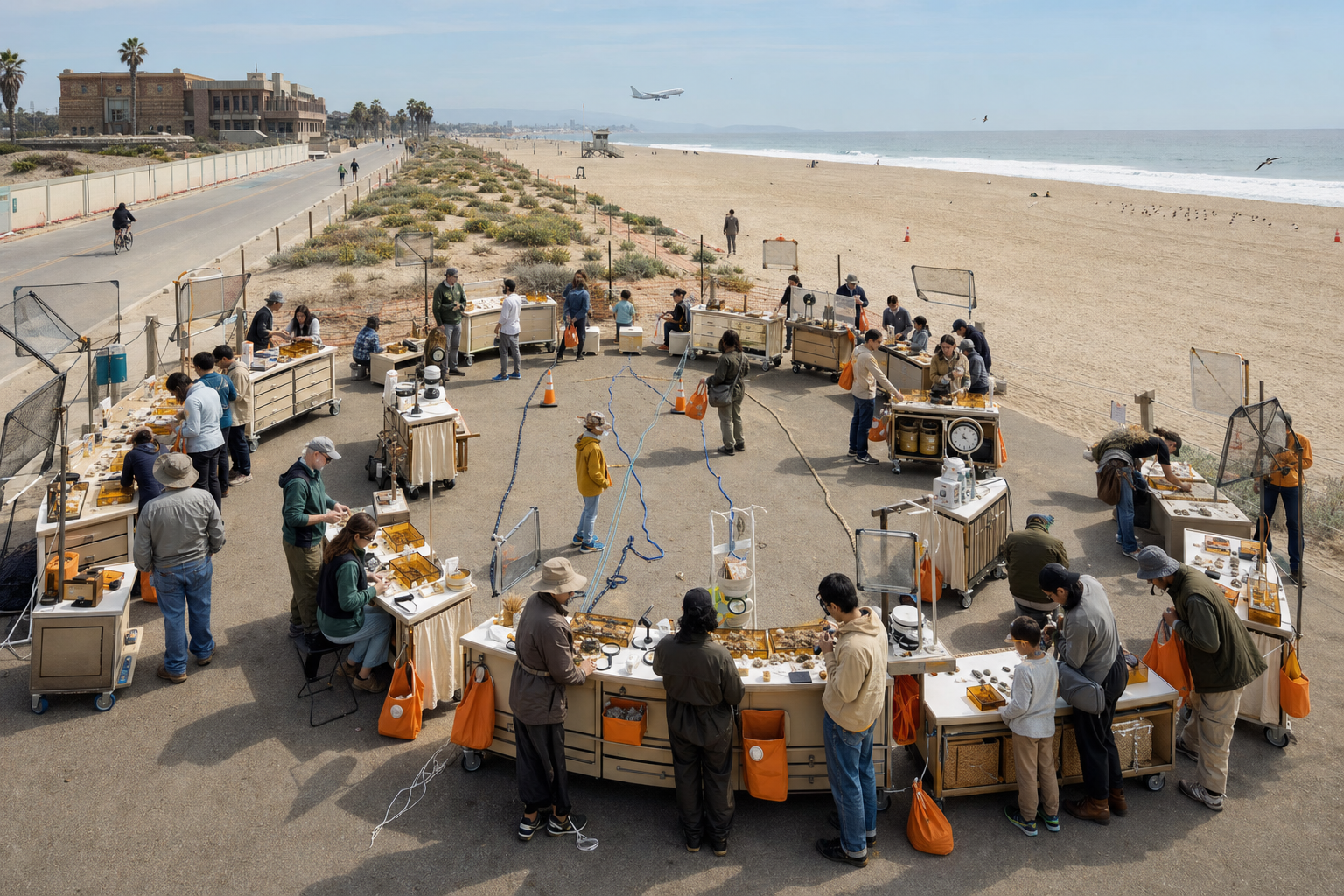
PointCast Field Study 010 · unofficial concept · El Segundo coast
An eight-part field museum for borrowing attention, not nature: shells and stones return home, the walking net catches only perspective, and restoration begins with the right habitat and partners.
Shells and stones are almost irresistible because they seem to hold the whole coast in one hand. Tide Cabinet keeps that intimacy, then turns possession into a short-term loan from an exact place.
The permanent collection is made of attention. Compare curves. Draw weathering. Photograph color. Tell a plausible story and mark it as uncertain. Then return the object before the next one enters the cabinet.
The larger project follows life outward: wrack to dune, moon to grunion, eelgrass to fish, and Dockweiler curiosity to native-oyster partners in the sheltered estuaries where that work belongs.
Attention before possession.
A net can frame, not catch.
Observe the living cycles.
Right habitat. Right partners.
Each plate offers a build, a social move, and a firm ecological boundary. The sequence begins with looking and ends by transferring community energy to restoration partners.
A museum that closes every evening with an empty collection.
The build
Roll eight shallow cabinets to a legal paved or indoor footprint. Each drawer holds only viewing tools, return cards, blank labels, and litter bags.
The group move
One person remembers the find spot, one describes, one sketches or measures, and one completes the return before another object enters the tray.
Boundary: The cabinets are temporary furniture, not beach storage. No natural object becomes inventory; all gear and anthropogenic litter leave the same day.
Borrow the encounter, not the object.
The build
Use one-object trays and a simple provenance card: exact find spot, tide relationship, color, texture, likely story, time borrowed, time returned.
The group move
Make a family without ownership: find three objects that rhyme by curve, color, weathering, or weight, then return them one by one.
Boundary: California State Parks generally prohibits removing natural resources. Even empty shells can be habitat or future sand. Observe in place whenever possible; never take living, attached, occupied, protected, or culturally sensitive material.
Carry a net that catches only attention.
The build
Stretch soft, large-grid cord across light handheld frames. Hold them high, turn them toward horizon and sand, or cast a temporary shadow grid for counting color and movement.
The group move
Pairs take turns framing a ten-second scene and describing what crossed the grid: foam, kelp fly, bird shadow, bottle cap, cloud, nothing.
Boundary: No sweeping, dragging, digging, seining, trapping, entangling, chasing, or water entry. Ocean take is regulated by species, season, place, license, and authorized gear; this tool is not fishing gear.
Read the beach’s delivered newspaper before tidying the page.
The build
Set stools landward of the newest wrack, mark a no-step buffer, and separate natural beach-cast kelp from human-made litter without raking or rearranging.
The group move
Call a quiet inventory: seed, feather, kelp holdfast, fly, track, shell fragment, plastic fragment. Only the last category enters the litter bag.
Boundary: Wrack is food-web material and helps build dunes. Leave kelp, driftwood, shells, plants, and animal remains where they are; avoid protected plover habitat and give birds escape space.
Make the rare night bigger by touching it less.
The build
Use the official forecast as a possibility, arrive quietly, stay back until fish establish a run, keep light low, and turn observation into a collective lunar score.
The group move
One person watches the tide, one logs first fish, one counts waves, one protects the dark, and everyone listens before speaking.
Boundary: Closed season is April through June. During open season current limits, license rules, marine-area rules, and hand-only take apply—but the Tide Cabinet’s choice is observation, never pursuit or take.
The most advanced beach structure may be a living one underwater.
The build
Create a dry-land interpretation table for the existing Dockweiler offshore eelgrass pilot: scale ribbons, fish silhouettes, sediment jars, current arrows, and partner monitoring updates.
The group move
Build one shared food-web map from blades to epiphytes to invertebrates to fish, then add the human job that keeps monitoring possible.
Boundary: No DIY transplanting, anchoring, diving, harvesting, marker placement, or claims about project results. Support and learn from the permitted living-shoreline partners already doing the work.
Move the idea to the habitat instead of forcing the habitat into the idea.
The build
A Dockweiler learning table hands off to a qualified bay or estuary partner: native-oyster history, screened cultch, conservation aquaculture, monitoring, permits, and long-term stewardship.
The group move
Sponsor or join one partner-defined job—mapping, monitoring, shell preparation, nursery support, access, or interpretation—only after the project names the need.
Boundary: Olympia oysters are bay and estuary restoration organisms, not an exposed Dockweiler surf release. Never plant store-bought oysters, shells, reefs, cages, or animals; restoration take and placement require qualified partners and authorization.
Build a calendar of attention long enough to notice life returning.
The build
Link four seasonal windows: dune and plover space, wrack pulses, grunion nights, and partner updates from eelgrass or native-oyster projects.
The group move
Each gathering inherits the last group’s question and leaves the next group one observation, one stewardship action, and one unanswered mystery.
Boundary: No single beach day proves ecological recovery. Publish uncertainty, partner definitions, and monitoring timeframes; do not substitute spectacle, stocking, feeding, or touching for restoration.
The borrowing loop
30minutes from first attention to exact return and a completely empty cabinet.
Observe in place first; record the precise relationship to tide and wrack.
If lawful and clearly nonliving, use one shallow tray for a brief close look.
Measure, sketch, photograph, describe, and admit what nobody knows.
Close the loop before another object enters the temporary cabinet.
Pack every tool and safely remove only human-made debris.
Original browser instrument · sound on by gesture only
Six tiny synthesized voices connect shell, stone, wrack, moon, eelgrass, and oyster. Every sound is generated live by your browser—no samples, recording, account, or auto-play.
Score idle · choose a voice
Keep headphone volume comfortable. Each voice ends automatically.
A commons is stronger when the jobs are visible. Draw one role on arrival; trade only after you have made the walk more attentive.
Your first assignment
Remember the exact find spot and close every borrowing loop.
01
Remember the exact find spot and close every borrowing loop.
02
Keep the frame high, soft, dry, visible, and empty.
03
Name the natural deliveries without rearranging them.
04
Protect darkness, distance, and the quiet of the run.
05
Remove only the clearly human-made objects you can carry safely.
06
Describe what you see without touching or pretending certainty.
07
Ask the restoration team what help is actually useful.
08
Count every tool and leave the beach with less human litter.
The useful technology is an accurate relationship: know what the wrack does, where the living shoreline already is, when grunion may arrive, and why oysters require another habitat.
Living system / 01
The Bay Foundation describes wrack as a natural beach process that helps build dunes and supports wildlife and the coastal food web.
Treat the wrack line as a reading room: observe, map, and protect it while lifting only anthropogenic litter.
The Bay Foundation living shoreline ↗Living system / 02
The Los Angeles Living Shoreline Project includes about four acres of dune habitat and a one-acre offshore eelgrass pilot at Dockweiler.
Make the local project legible from dry land and direct volunteer energy toward its real partners and monitoring needs.
Dockweiler project overview ↗Living system / 03
CDFW manages a closed season, current open-season rules, and observation guidance for California grunion runs.
Stage a no-take moon watch built around darkness, distance, patience, tide timing, and the possibility that no fish arrive.
CDFW grunion guidance ↗Living system / 04
Olympia oysters historically formed habitat in Southern California bays and estuaries; current restoration uses expert planning, prepared cultch, monitoring, and permits.
Connect beach curiosity to qualified bay and estuary partners instead of attempting a release at Dockweiler.
CDFW native oyster restoration ↗From image to honest experiment
Start next week
Four friends carry field cards, hand lenses, a dry walking frame, and one litter pouch. Observe natural objects in place, keep clear of wildlife and protected areas, take photographs rather than specimens, and pack out every tool.
A credible public prototype
Ask LA County about the appropriate authorization and site for one supervised viewing table on pavement or indoors. The museum opens empty, receives only brief lawful observations, publishes no sensitive locations, and closes empty.
Real restoration
Invite the Dockweiler living-shoreline team, a grunion educator, or a native-oyster restoration partner to define one useful community role. Follow their habitat, season, access, monitoring, and permit framework.
A generous encounter depends on restraint: leave the natural collection, keep the net empty, give wildlife an exit, and move restoration ambitions into expert hands.
Rule 01
California State Parks says removing natural resources is generally prohibited. Shells, rocks, plants, driftwood, and animal remains are part of the place; use photographs, rubbings without contact, sketches, and written descriptions as the permanent collection.
California State Parks FAQs ↗Rule 02
Ocean take is regulated by species, season, place, license, and gear. At Dockweiler, the Tide Cabinet net is a dry-land visual frame and litter carrier only—never a sweep net, seine, trap, or wildlife tool.
CDFW ocean fishing regulations ↗Rule 03
Do not touch, turn over, move, corner, feed, bucket, bait, release, or crowd wildlife. Keep out of the western snowy plover enclosure and increase distance whenever a bird changes behavior because of you.
LA County Dockweiler visitor page ↗Rule 04
CDFW closes April through June and maintains current rules for open months. The project goes further: no take, holes, handling, bright light, or pursuit; let fish establish the run and accept a night with none.
CDFW grunion guidance ↗Rule 05
Planting shellfish, placing habitat, transplanting vegetation, or taking organisms for science is not casual stewardship. Work through qualified project leads and applicable restoration or scientific-collecting authorization.
CDFW Restoration Management Permit ↗Rule 06
Beach access, wildlife protections, fishing regulations, tides, fire rules, and event requirements change. Recheck official sources before each walk; organized activities or larger gatherings may require LA County authorization.
LA County beach rules FAQ ↗