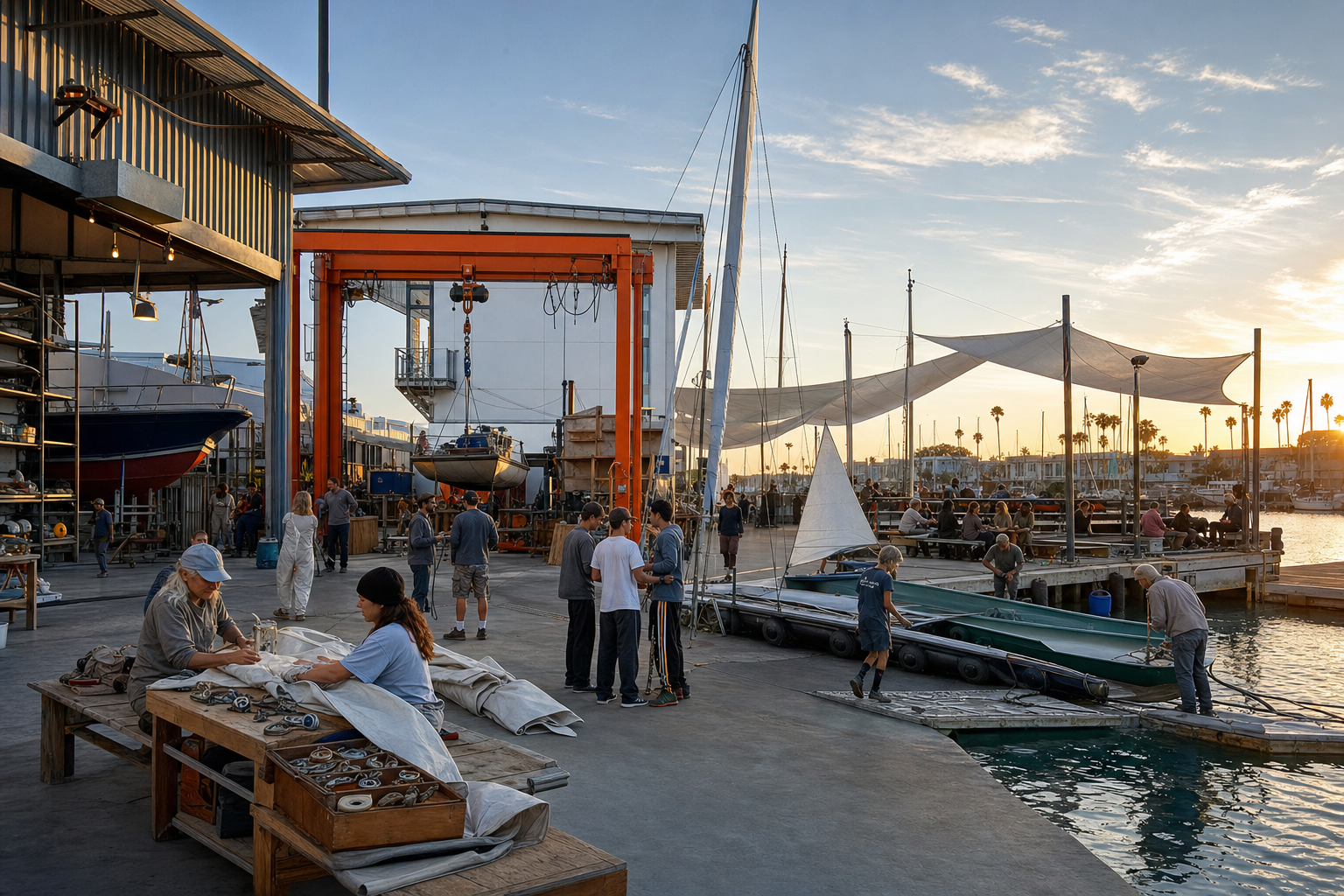
A sunset marina combines an authorized repair yard, orange gantry, sailcloth shade, small-craft launch, shared worktables, and calm public seating.
PointCast Field Study 012 · unofficial concept · Marina del Rey

Harbor
Works

A marina should not only store boats. It should teach a city how to keep things afloat.

Sort one imagined boat ↓
Ownership before reuse Repair before replacement Work happens on land No discharge Public access stays open Utility earns contentment
The proposition

A marina is not parking. It is metabolism.

Boats arrive as transportation, craft, memory, work, sport, liability, material, and sometimes trouble. A useful harbor has a dignified path for every one of those states.

Harbor Works puts triage, repair, training, clean-water utility, public launch, industrial archaeology, electronics, art, and slow public life into one working civic imagination.

The goal is not to decorate neglect. It is to make maintenance visible enough that people want to participate in it.

Provocation ≠ condition report

The originating post describes Marina del Rey as languishing and points to undeveloped land, a fire-damaged yacht-club building, and abandoned boats. This edition treats that as a creative prompt, not a verified inventory.

LA County’s current pages describe active capital work and more than 4,600 slips across 23 marinas. County material also confirms the former California Yacht Club clubhouse was seriously damaged by a December 2023 fire and describes a later licensing path for the adjacent former Tony P’s site.

So the useful question is not “what can we take over?” It is: what public, industrial, environmental, and cultural systems should a modern working harbor make easier?

Eight useful harbor rooms.

Each image is a speculative architectural prototype. Together they form a vessel lifecycle: understand, repair, share, recover, keep the water clean, learn the signal, and sit down when the work is done.

01working harbor / public atelier

The Useful Marina

Storage becomes stewardship when the work is visible.

Program
Place hardstand repair, teaching, parts, launch support, clean-harbor services, art, and quiet public life in one legible working landscape.
Boundary
This is a prototype, not a site plan. Every use depends on ownership, lease, coastal planning, navigation, access, environmental, fire, building, labor, insurance, and operating review.
02sail / repair / share / parts / dismantle

The Five-Future Triage Hall

No boat becomes material before it becomes a documented decision.

Program
Give each vessel an owner-and-title check, professional condition survey, contamination screen, reuse path, cost range, and named responsible party.
Boundary
Unknown ownership stops the process. Fuel, oil, batteries, sewage, antifouling coatings, lead, asbestos, fiberglass dust, and structural instability require qualified handling.
03coastal parts counter

The Hull Library

A cleat with provenance is inventory; a cleat without it is debris.

Program
Inspect, clean, catalog, price, lend, teach, and trace safe components by material, vessel, condition, load rating, and possible second life.
Boundary
No casual stripping, dock storage, counterfeit safety rating, uncertified load-bearing reuse, or sale of contaminated or ownership-disputed parts.
04no-discharge utility

The Clean Bilge Lab

The most beautiful harbor room may be the one that prevents a sheen.

Program
Make pump-out literacy, absorbent-pad exchange, oil and battery return, bilge diagnostics, water sampling, and spill response as inviting as a great public library desk.
Boundary
Nothing is discharged to harbor water. Used absorbents and fluids follow hazardous-waste rules; soap never treats a fuel sheen.
05shared small craft

The Public Launch Commons

A marina becomes public when the first safe boat is easy to borrow.

Program
Build a low-cost shared fleet with adaptive transfer, mentors, PFD fitting, lockers, hand carts, route briefings, rinse containment, repair time, and an honest cancellation policy.
Boundary
Access does not mean unmanaged water entry. Weather, capacity, training, vessel condition, personal flotation, harbor rules, supervision, and rescue planning govern every launch.
06industrial archaeology / atelier

The Workboat Cutaway

Keep one honest hull open enough to show how floating is maintained.

Program
After title, contamination, engineering, fire, access, and preservation review, interpret a land-based hull as a working anatomy lesson and fabrication studio.
Boundary
A decaying floating vessel is not automatically a studio, habitat, sculpture, or public room. Stabilize and decontaminate before any cut, climb, occupancy, or reuse.
07lofi ↔ hifi / useful signal

Harbor Radio at Blue Hour

The night workshop listens before it transmits.

Program
Teach VHF procedure, weather reception, navigation-light repair, low-voltage power, contact-mic listening, buoy electronics, analog sound, and careful soldering.
Boundary
No interference, emergency-channel play, pirate transmission, exposed high voltage, unattended batteries, public surveillance, or sound spilling into working slips and habitat.
08work ends / harbor remains

The Contentment Pier

Contentment is a harbor where usefulness earns the sunset.

Program
End the day with mending, drawing, tea, models, stories, low-volume music, packed tools, places to be alone, and a table that does not require buying a yacht.
Boundary
Keep the promenade, emergency access, working slips, neighbors, sanitation, operating hours, food rules, alcohol rules, sound limits, and same-day close legible.
Local educational instrument

One boat. Five futures.

Set five imaginary conditions. The sorter applies the gates in order: ownership, hazards, structure, public usefulness, then inspectable components.

The interesting result may be a hold. A boat does not become available just because someone calls it abandoned.

This browser-local exercise is not a title search, marine survey, lien determination, appraisal, environmental test, disposal instruction, salvage authorization, or recommendation about a real vessel. It stores and sends nothing.

Path 01 / cleared to assess

Keep Sailing

Documented ownership, cleared hazards, and sound structure point toward survey, a bounded repair list, and safe return-to-service review.

Choose conditions, then sort this imagined boat.

01Keep Sailing
02Repair + Train
03Donate to the Shared Fleet
04Harvest Safe Parts
05Licensed Dismantling

Three ways to make it real.

Start with existing lawful capacity. The first version can teach and exchange knowledge without acquiring one boat or pretending a new public yard already exists.

smallest credible test

Path A / One useful Saturday

At an existing authorized landside facility: a repair café, parts-identification table, absorbent-pad exchange, one adaptive small-craft demo, and a quiet sunset table. No boat acquisition, dismantling, slip work, or water event.

one operating year

Path B / The Harbor Works residency

A yard, school, marina operator, environmental partner, artists, and trades run recurring repair teaching, clean-harbor services, a small shared fleet, a parts library, and one professionally cleared cutaway exhibit.

long civic horizon

Path C / The working public harbor

Coastal planning, lease and capital work connect public access, skilled maritime employment, vessel lifecycle management, water quality, adaptive launch, industrial heritage, art, and quiet everyday use.

The harbor says no.

  1. 01
    Resolve title, ownership, liens, authorization, and responsible party before touching or moving a vessel.
  2. 02
    Survey structure and hazards before repair, occupancy, donation, parts recovery, art use, or dismantling.
  3. 03
    Keep major repair, fabrication, grinding, painting, fluid removal, and dismantling in authorized contained landside facilities.
  4. 04
    Preserve the harbor’s no-discharge rule, navigation, five-knot limit, working slips, public paths, emergency access, and habitat.
  5. 05
    Use qualified people and lawful streams for fuel, oil, batteries, sewage, refrigerants, lead, asbestos, antifouling coatings, fiberglass dust, and contaminated absorbents.
  6. 06
    Do not treat a boat, slip, parcel, building, lease, or waste stream as abandoned, available, safe, or public without current evidence and authority.
  7. 07
    No live project, acquisition drive, salvage call, contribution request, public launch, lease claim, permit, or event is announced by this study.

Current-source dock.

Official County and coastal-planning pages anchor the current operating context. The X post remains linked as the creative provocation that started the assignment.

What is not claimed: PointCast has not verified a “massive abandoned boat epidemic,” counted abandoned vessels, identified available parcels or boats, inspected the fire-damaged building, obtained a lease, secured agency partners, designed an approved facility, or announced a public program. The visuals depict an imagined working marina, not present-day conditions.

Harbor Works plate