Current headline count published by Billion Oyster Project.
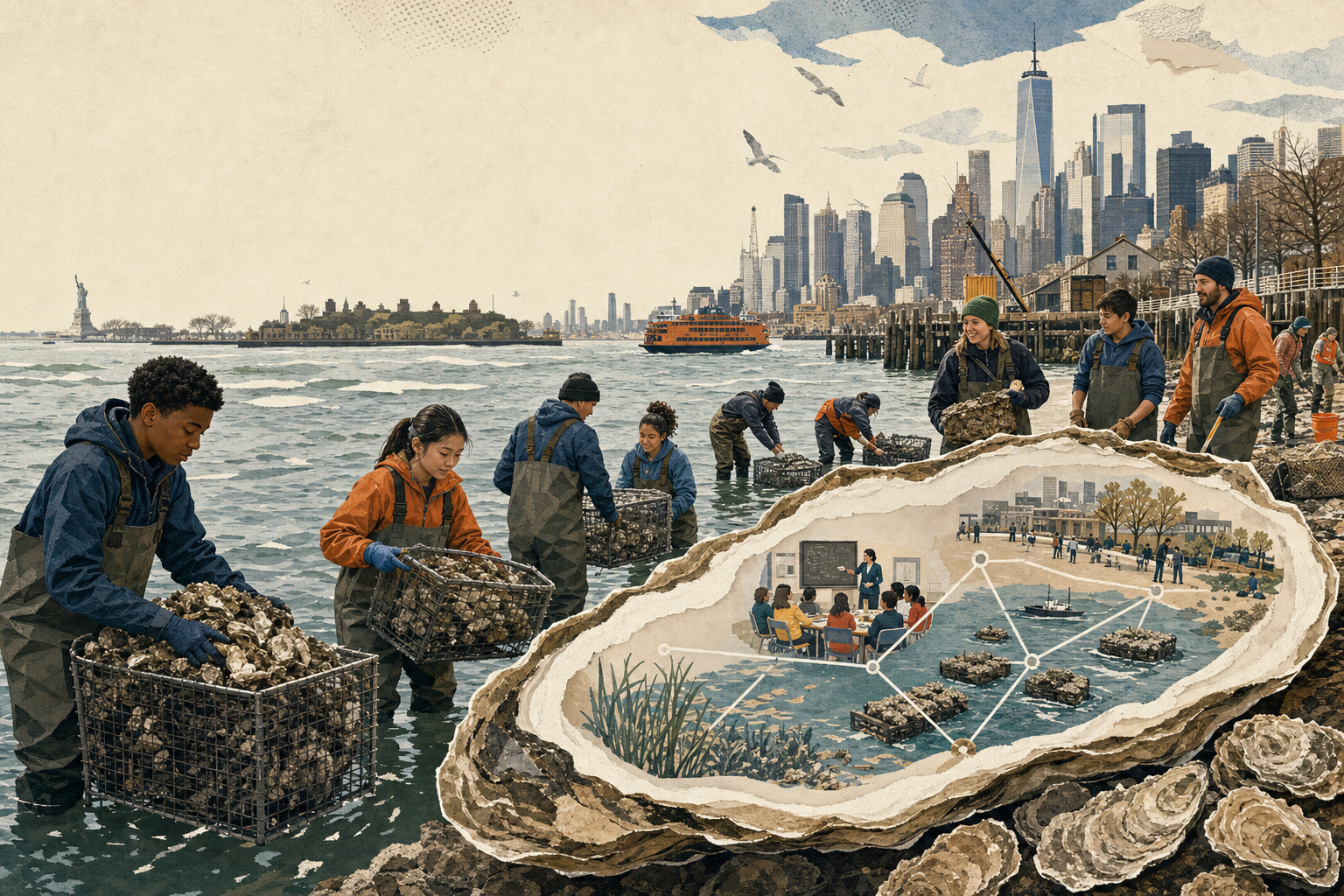
PointCast Field Study 016 · Reported commons
The Billion Little New Yorkers
The oysters did not save the harbor. The project may have saved the idea of a harbor.
The short answer
A civic success. A real ecological achievement. An unfinished self-sustaining reef.
New York has always been excellent at hiring organisms without benefits. Pigeons do atmosphere. Rats run night sanitation. Plane trees keep the avenues from looking entirely like a real-estate prospectus. And, in the harbor, oysters have been asked to filter water, build habitat, soften waves, host science class, receive restaurant shells, explain climate adaptation, and—by 2035—appear one billion strong.
It is an unfair job description for a bivalve. It is also one of the most persuasive public projects in America.
Restaurant shell diverted into restoration work.
BOP reports more than 100 participating schools.
Estimated in a six-acre lower Hudson restoration study.
Yes, it worked. No, the slogan has not come true.
Billion Oyster Project’s arithmetic is easy to love. New York Harbor once held vast oyster reefs. Overharvesting, dredging, pollution, and shoreline transformation helped erase them. The project, launched from the New York Harbor School ecosystem, proposed a number big enough to reverse the direction of imagination: one billion oysters restored by 2035.
The current public counter says roughly 150 million oysters, three million pounds of restaurant shell collected, more than 40,000 students reached, and over 100 schools involved. A peer-reviewed lower Hudson study estimated 5.8 million live oysters across a six-acre restoration. At Jamaica Bay, researchers found adults surviving, growing, and reproducing—but did not observe the natural recruitment that would let the population casually take the operation off human hands.
So the honest judgment has three columns. As a literal race to one billion, the project is behind the velocity its title implies. As ecological restoration, it has produced genuine oysters, habitat, data, and better methods at meaningful local scales. As a civic institution, it is a knockout.
The project’s most scalable product is not the oyster. It is the invitation to do consequential work in public.
A shell leaves a restaurant instead of a waste stream. It cures, receives juvenile oysters, moves through a classroom, arrives at a reef, and becomes a reason to test water, count life, learn a harbor, and come back. The oyster is not merely restored. It is assigned a social life.
The useful audit
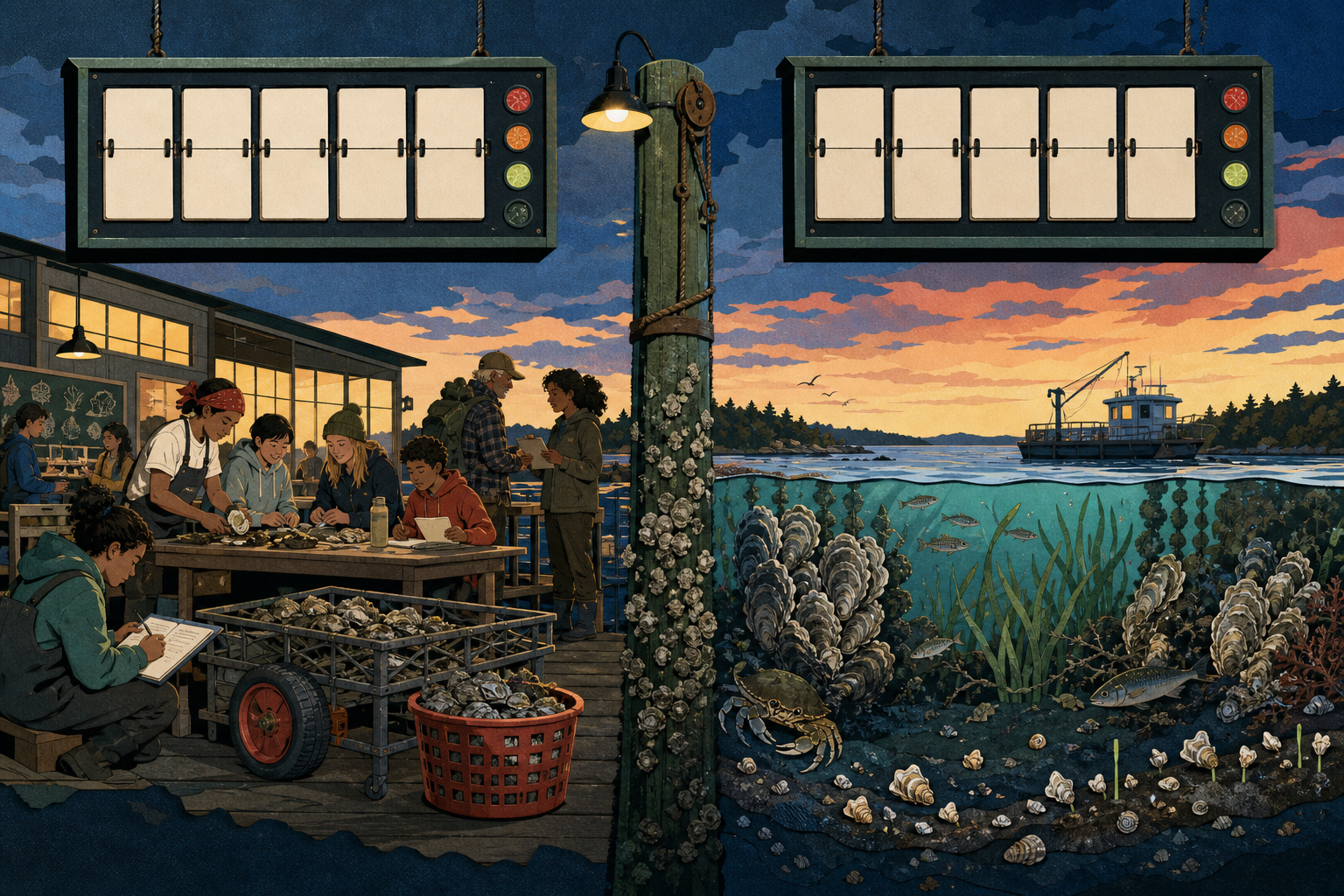
Every restoration commons needs two scoreboards.
One counts whether people can keep the institution alive. The other counts whether living systems can increasingly keep themselves alive. Neither score cancels the other.
01
Yes—convincingly.
Does the human commons reproduce?
A restaurant shell becomes classroom material; a classroom becomes a monitoring crew; a monitoring crew becomes harbor literacy. The strongest thing BOP has restored may be the chain of custody between New Yorkers and their water.
- Do schools return next term?
- Can a child do real, legible work?
- Do restaurants, scientists, agencies, and neighbors share one operating loop?
- Can participation deepen from field trip to stewardship?
02
Promising, local, unfinished.
Does the living system reproduce?
Oysters survive, grow, build habitat, and sometimes reproduce. But natural recruitment remains uneven, restoration still depends on hatcheries and hands, and a billion by 2035 requires a pace closer to infrastructure than gardening.
- Are oysters surviving through seasons?
- Are larvae settling without being placed?
- Does biodiversity accumulate around the reef?
- Can intervention decline without the system declining too?
Oysters are not a municipal alibi.
The charming version of the story says an adult oyster can filter many gallons in a day, so simply add oysters until the harbor becomes clear. The adult version notices pipes. New York’s great improvements in harbor water quality came through wastewater treatment, regulation, infrastructure, and decades of monitoring. Combined sewer overflows still put stormwater and sewage into waterways during rain.
Reefs matter. They add habitat complexity, filter particles, create nursery ground, and may contribute to shoreline resilience. But a reef is not permission to avoid the treatment plant, the overflow plan, the budget hearing, or the public dashboard. When a charismatic organism is made responsible for a city’s metabolism, the organism gets the press release and the pipe escapes the meeting.
This is another reason Billion Oyster Project succeeds. Its education work can turn a magical filter story into something harder and better: a generation that knows a harbor is biological and infrastructural at once.
For El Segundo, the instruction is simple:
Steal the operating system.
Do not steal the organism.
The West Coast remake should not be “Billion Oysters, but by LAX.”
New York Harbor is an estuary with a particular history, salinity, substrate, shoreline, regulatory world, and oyster ecology. Dockweiler is an exposed sandy Pacific beach beside an airport, a wastewater plant, remnant dune habitat, a bike path, fire rings, and astonishing civic weirdness. A copy-paste reef would confuse a mascot with a method.
The method is more interesting anyway. Pick a local living process. Build a chain of custody around it. Give a first-timer real but bounded work. Connect school, science, maintenance, agency, and public story. Publish both scoreboards. Return next season.
Here, the most legible foundation species may be coastal buckwheat supporting the El Segundo blue butterfly. The most urgent civic metabolism may be wastewater and recycled water. The most visible protection work may be dune fencing, sediment capture, native planting, and careful access. The most useful public ritual may be monitoring—not moving nature around, but becoming a reliable witness to it.
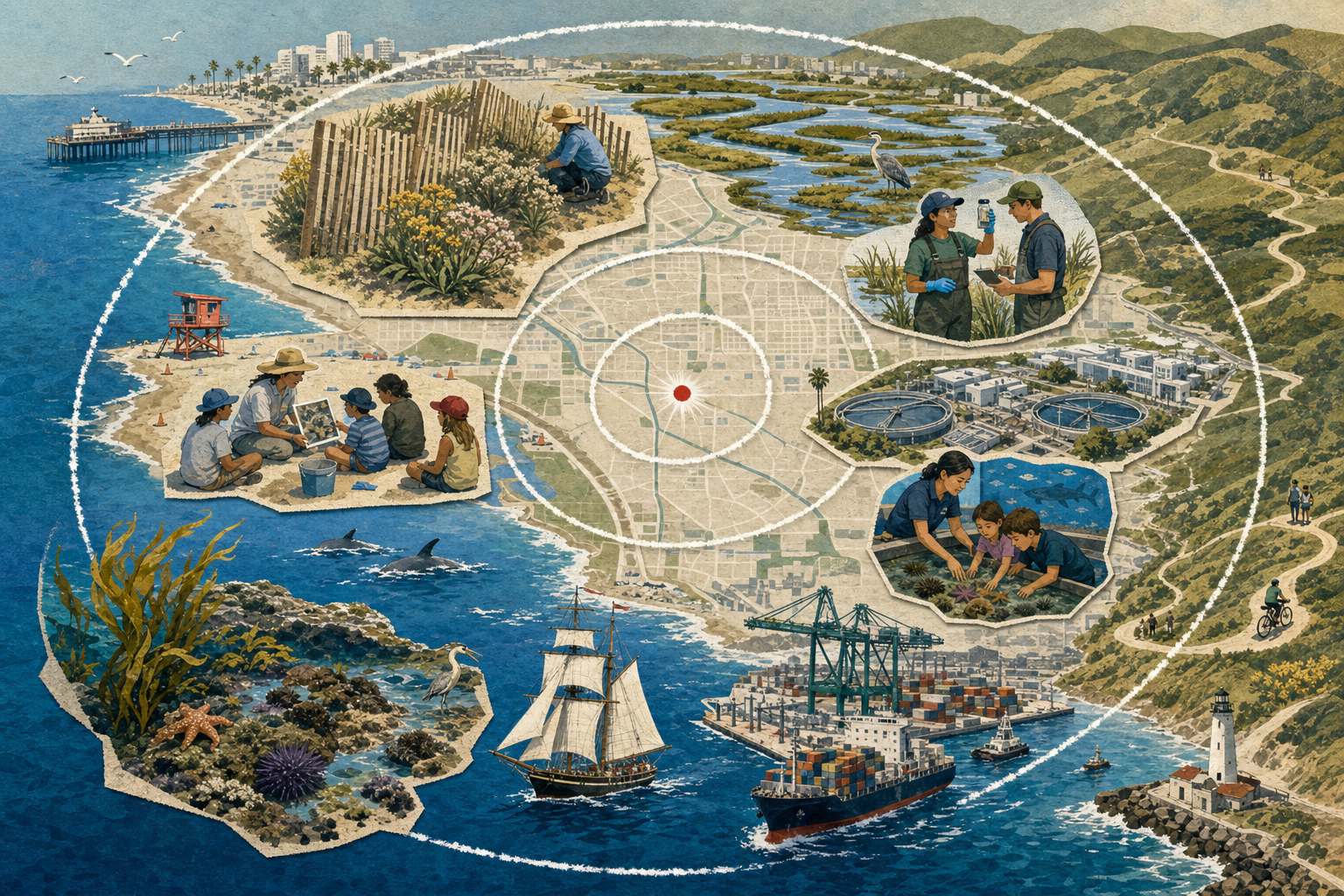
The El Segundo 25-mile desk
Eight doors already open.
A community resource, not a takeover plan. Distances are broad orientation bands from El Segundo, not precise travel measurements. Check current access, programs, and volunteer requirements with each organization.
Distance
Useful work
Showing all 8 resources.
Los Angeles County Beaches & Harbors
Read a living shoreline already in progress
Start at Dockweiler’s dune work: sand fencing, sediment capture, native habitat, and active management on an exposed Pacific beach.
Observe from established access; dunes are habitat, not a project-material aisle.
Open current resource ↗The Bay Foundation · LAX Dunes
Follow the butterfly through the dune
Learn why coastal buckwheat, weed removal, and long volunteer continuity matter to the endangered El Segundo blue butterfly.
Check current access and volunteer listings before visiting restoration areas.
Open current resource ↗City of El Segundo · Hyperion information
Make wastewater visible civic knowledge
Track plant performance, odor reporting, public updates, tours, and advanced water-purification plans. Clean water is mostly infrastructure before it is mascot.
Open current resource ↗Roundhouse Aquarium
Borrow an aquarium’s public doorway
Volunteer or visit a free, hands-on marine education room at the end of Manhattan Beach Pier—the smallest useful version of a public field station.
Open current resource ↗Friends of Ballona Wetlands
Study a wetland without pretending it is uncomplicated
Use education programs, cleanups, and water-quality work to understand a living place whose restoration future is active, technical, and contested.
A commons can hold disagreement; this listing is a doorway, not an endorsement of one restoration design.
Open current resource ↗Los Angeles Waterkeeper
Become a repeat witness
Look for MPA Watch and other volunteer science. A coast becomes legible when the same people return, use the same method, and publish what they see.
Open current resource ↗AltaSea · LA Waterfront STEM Network
Connect the classroom to the working harbor
Follow the emerging network linking AltaSea, Cabrillo Marine Aquarium, Los Angeles Maritime Institute, Battleship Iowa, and LA Harbor College.
Open current resource ↗Cabrillo Marine Aquarium
Volunteer where specimens become stories
Explore education, interpretation, and citizen-science roles at the edge of the Port of Los Angeles.
Open current resource ↗A first season that requires no pretend nonprofit
Four weeks. Existing partners. One public receipt.
This is an editorial rehearsal, not an announced program. It proposes observation and partnership before intervention; no collecting, planting, moving habitat, or unsanctioned monitoring.
- 01
The coastline orientation
Walk one public route from Dockweiler dunes to the Hyperion boundary. Record only what is already public: access, smell, wind, water color, signs, habitat fencing, maintenance, and questions.
- 02
The institution field trip
Visit or volunteer with one existing organization. Ask how people enter, what useful work a first-timer can do, what requires training, and what keeps regulars returning.
- 03
The two-scoreboard supper
Bring six neighbors together. Score one local effort twice: once for human continuity and once for ecological reproduction. Do not let attendance masquerade as habitat.
- 04
The public receipt
Publish one page: what was observed, who already does the work, which claims remain unknown, where to volunteer, and what nobody has permission to touch.
A good commons makes the work visible enough to desire.
Billion Oyster Project has a genius for intermediate objects: shell piles, reef cages, monitoring stations, spat-on-shell, boats, gloves, clipboards, countable oysters. The work has texture. You can see where your hand enters the system. “Awareness” becomes less necessary because the object itself carries the explanation.
El Segundo has intermediate objects too: a dune fence catching sand; coastal buckwheat with a butterfly story attached; a water sample; an odor log; a tank at the Roundhouse; a shoreline survey; a student moving from aquarium volunteer to harbor science. Beach Commons should make these chains pleasurable to follow without pretending to own them.
The local opportunity is not a giant new organization. It is a beautiful public index of the work already underway, plus seasonal occasions when people can see how the parts connect. One field trip should lead naturally to a second. One organization’s exit door should point toward another’s entrance. The commons is the connective tissue.
Two listening rooms
Harbor shift / Pacific radius
Private Spotify playlists created as companions to this edition.
01 · Spotify
Billion Little New Yorkers — Harbor Shift
Post-punk, soul, jazz, disco, ferry light, physical work, and the civic pleasure of a job with other people.
Open in Spotify ↗ 02 · SpotifyTwenty-Five Miles of Pacific — El Segundo Commons
Surf psych, jazz-funk, ambient, Latin, indie, dune wind, bicycle pace, sunrise to blue hour.
Open in Spotify ↗Two visual rooms
Forty field pins, evenly split.
01 · Pinterest
LIVING REEFS — Billion Little New Yorkers
20 pins: harbor classrooms, shell recycling, working reefs, oyster ecology, and restoration as visible public work.
Open the 20-pin board ↗ 02 · Pinterest25 MILES OF PACIFIC — El Segundo Commons
20 pins: dunes, the El Segundo blue butterfly, wetlands, water monitoring, aquariums, and the working harbor.
Open the 20-pin board ↗Reporting desk
Sources, boundaries, and the counts that move.
01
Billion Oyster Project · current project totals
↗ 02 Headline restoration, shell, and student counts.
Billion Oyster Project · STEM education
↗ 03 School network and student participation.
Billion Oyster Project · FAQ
↗ 04 2035 goal, methods, and project framing; project pages contain counts from different update cycles.
Successful initial restoration in the lower Hudson River Estuary
↗ 05 Peer-reviewed six-acre restoration results, including an estimated 5.8 million live oysters.
Developing a self-sustaining oyster population in Jamaica Bay
↗ 06 Adult survival, growth and reproduction alongside absent observed recruitment.
NYSDEC · Bush Terminal restoration application
↗ 07 Current scale: a proposed first phase using approximately 22 million spat-on-shell oysters.
NYC DEP · Harbor Water Quality
↗ 08 Long-run harbor improvement and water-quality monitoring context.
NYC DEP · Combined Sewer Overflows
↗ 09 Why wastewater infrastructure, stormwater, and overflow control remain central.
The New Yorker · The Seas Are Rising. Could Oysters Protect Us?
↗ A narrative account of the project and the larger oyster-restoration movement.
Editorial boundary
Research checked July 29, 2026. Billion Oyster Project’s public pages can show figures from different update cycles; this edition uses the current homepage headline count and identifies older or project-specific measures in context. The El Segundo desk lists independent organizations as current places to learn from. No organization named here endorses PointCast or Beach Commons. No habitat work, event, volunteer shift, partnership, permit, contribution drive, municipal affiliation, or public program is announced.