NOUNS COLA / CASE STUDY
The journey to a Nouns beverage.
A working study in how AI generation moved the project from a loose prompt into a stack of believable surfaces: product board, fundraise logic, campaign systems, play, mood, and public-world thinking.
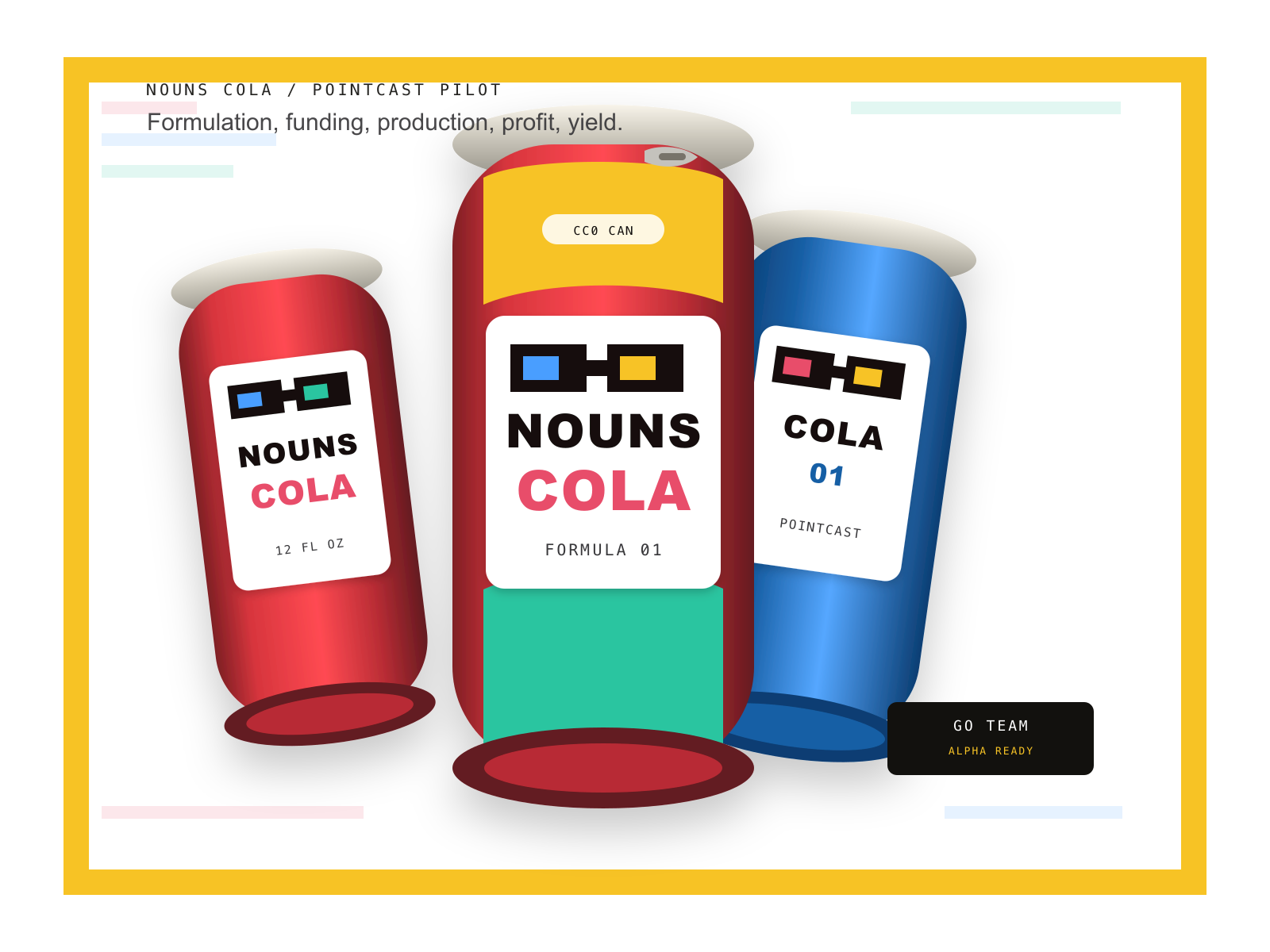
JOURNEY
From prompt to operating shape.
- 01 Prompt the can into existence
The process started as language before it became liquid: Nouns, cola, PointCast, go team. AI made it easy to sketch possibility faster than a normal packaging or campaign cycle would allow.
- 02 Turn prompts into surfaces
The project quickly stopped being a single image. It became a board, a game, a listening room, retailer concepts, mural systems, and campaign books. Each generated artifact changed what the beverage could plausibly become.
- 03 Separate image speed from product truth
AI was strongest at world-building, mood, sequencing, and visual options. It was weaker where the beverage had to become real: formulation, labeling, compliance, co-packer constraints, and claims discipline.
- 04 Use AI to compress the creative loop
Instead of waiting weeks between concepts, the project could test aesthetic territory in hours: arcade graphics, retailer assets, Vogue spreads, mural campaigns, and city-scale identity systems.
- 05 Earn the beverage after earning the world
The key lesson was not “AI can invent a drink.” It was that AI can rapidly build the narrative, commercial, and cultural scaffolding around a drink, which makes the next real-world decisions much sharper.
OUTPUT STACK
What AI actually produced around the beverage.
The point was not a single hero image. The point was the stack: each asset made the beverage more discussable, more testable, and more legible to collaborators.
KEY LESSONS
AI made the world quickly. Reality kept the edges honest.
WHAT WORKED
GUARDRAILS
- AI is best used here as a velocity engine for concepts, not as a substitute for beverage science.
- The generated world can make a future product feel legible before the product physically exists.
- A stronger artifact stack creates a more fundable story because the team can point at real surfaces instead of vague intention.
- The line has to stay bright: generated assets accelerate taste and campaign thinking, but regulated product claims still need qualified review.
Case study only. None of the generated visuals replace formulation, labeling, legal review, or product-testing work.
GO TEAM
The project got sharper because the artifacts got real.
- AI toolsaccelerated image, campaign, and world-building loops
- PointCastheld the board, archive, game, room, and case study in one system
- Humansstill owned the taste, legal, and production judgment calls
- Nouns Colamoved from vibe to operating concept
NEW POSTERS
Set 02 pushes the campaign one layer further.
A second ad set is now live as four individual AI-generated posters: hero, night, pop, and mural. Same beverage world, sharper single-image judgments.
