There is no profile, risk rank, reputation number, or hidden priority.
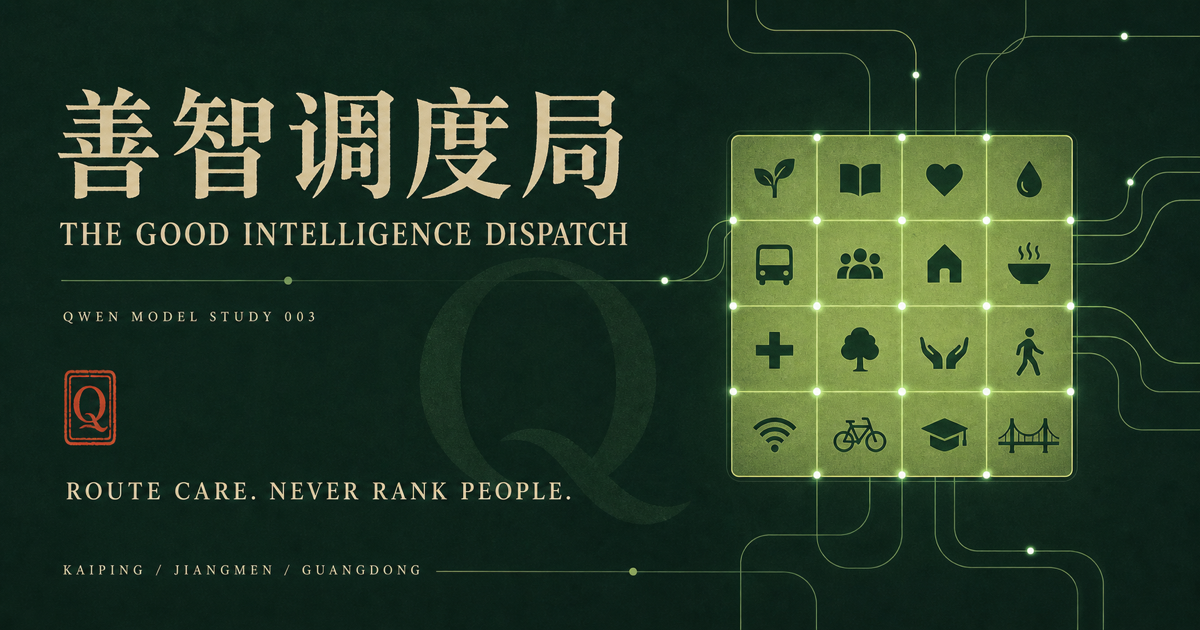
Qwen Model Study 003 · intelligence for good
善智 The Good Intelligence Dispatch
A small civic instrument for pairing what a neighborhood needs with what it already knows how to give.
01 / The boundary
The person is never the input.
The instrument cannot decide who deserves a meal, visit, kit, or repair.
It cannot move money, assign services, dispatch a person, or promise delivery.
Every suggested brief is provisional. Local people can revise it or refuse it.
02 / Pair care with capacity
Choose one of each.
This is a coordination sketch, not a request form. No name, address, story, or location is collected.
A · Community need / 社区需要
B · Available capacity / 可用能力
善
用一小时,约好一张共享饭桌。
Offer one hour to coordinate a shared meal table. Confirm dietary needs and timing with the people involved before acting.
16 routes. No rankings.
Each cell is a possible relationship between a need and a capacity. The active pair is marked in red.
Warm meals × Time 饭 · 时
Warm meals × Transport 饭 · 车
Warm meals × Translation 饭 · 译
Warm meals × Materials 饭 · 物
Elder check-ins × Time 访 · 时
Elder check-ins × Transport 访 · 车
Elder check-ins × Translation 访 · 译
Elder check-ins × Materials 访 · 物
Learning kits × Time 学 · 时
Learning kits × Transport 学 · 车
Learning kits × Translation 学 · 译
Learning kits × Materials 学 · 物
Small repairs × Time 修 · 时
Small repairs × Transport 修 · 车
Small repairs × Translation 修 · 译
Small repairs × Materials 修 · 物
03 / The Qwen role
QWEN / 通义
Language serves the relationship.
Qwen may help translate and clarify a pairing authored by a community. It may not decide who deserves help.
Draft the brief
Turn one chosen need and one chosen capacity into plain bilingual action language.
Voice after review
Read a community-approved version with locally directed language and pronunciation.
Stop at the boundary
No ranking, eligibility, enforcement, identity inference, or automated public-service decision.
NOTHING LEAVES THIS DEVICE
The PointCast edition runs entirely in this page. It stores no identity, location, or free text. It makes no automated decision. Qwen language and audio are staged until current-plan entitlement is verified; the public instrument does not make a live model call.
The regional frame is Kaiping and Jiangmen, Guangdong: a contemporary civic artwork about mutual aid and practical coordination, not a claim to represent every local experience.