DISPATCH · Nº 0566 · POINTCAST COLLEGE FOOTBALL
GEORGIA, GROUND ZERO
The machine, the town, and the Saturday it still has to deserve.
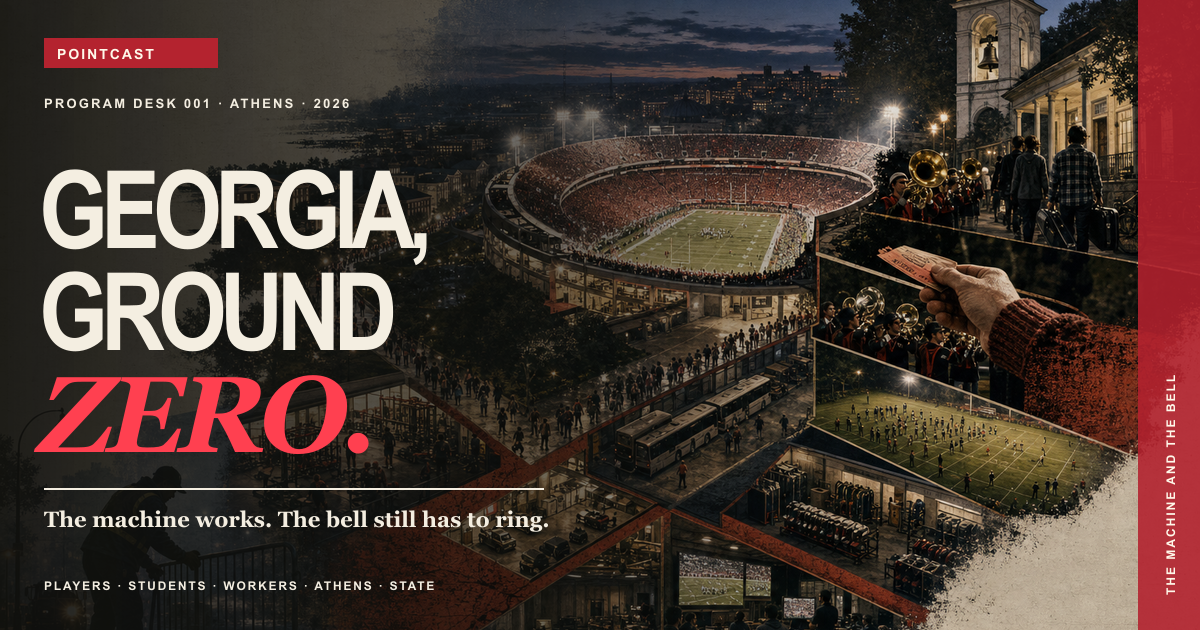
Nearly two hours before sunrise, before the red dresses and black polos, before the first television hit, UGA Police commanders install hydraulic traffic barricades around Sanford Stadium. Two miles away, bus drivers begin their first runs. Custodians, grounds crews, dining staff, medical teams, officers, drivers, and outside agencies turn a normal college town into a one-day city for more than 93,000 people.
That invisible operation is where Georgia, Ground Zero begins. Georgia may be the most complete operating system in college football: a state dense with players, immense recurring capital, a development model recruits can see, staff continuity, NFL proof, national-title expectation, and a stadium sewn into a college town. The feature asks the harder question: when the system becomes this capable, what keeps it from becoming only a professional operation wearing a university's old clothes?
Five inputs explain the machine. The Radius begins with NFL data: 143 players from Georgia high schools appeared on 2025 kickoff rosters, and 22 Georgia high-school alumni were selected in the 2025 draft. The Repetition is Kirby Smart's developmental thesis—grow the bottom of the roster toward the top, surround each position with trained eyes, and make hard practice the product. The People supply staff memory. The Capital includes University of Georgia Athletic Association reporting of $233.5 million in total athletics revenue and $149.3 million in football revenue for FY2025; these are EADA reporting categories, not a simple profit statement. The Proof is eight 2026 draft selections and Georgia Athletics' count of 82 NFL picks in ten Smart-era drafts.
The 2026 season is a clean audit. Georgia enters after consecutive SEC championships and a 12-2 season that ended with a 39-34 CFP quarterfinal loss to Ole Miss. Smart described the spring roster as having the fewest returning starters of his tenure, then opened August camp with roughly 125 to 127 players. If the Bulldogs are excellent again, the result will validate the institution's ability to teach its own standard. If the room wobbles, it will not be for lack of inputs.
The student section makes the cultural tension legible. A 2026 full home package costs $80 for seven games, a remarkable form of access. If demand exceeds supply, the priority system can assign three- or four-game partial packages. One unused ticket creates a strike; two strikes remove postseason eligibility. Tickets cannot transfer directly between students. Away tickets range from $140 for Florida to $265 for Alabama. Students generate the sound, youth, handmade dress, remembered friendship, and future alumni demand that make the product valuable—while being administered like scarce inventory.
Athens is the counterweight. Sanford sits inside a campus and near a town whose music history proves that a national signal can emerge from students, cheap rooms, local collaboration, and experiments no central office ordered. A good Saturday has two economies: the optimized system of tickets, transit, security, broadcast, and hospitality; and the porous system of side streets, breakfast shifts, houses, stages, shops, and people who return in February. The first makes the event work. The second makes it belong somewhere.
The feature closes with The Hedges Test: Can the student still get in? Are players people before they are inventory? Does Athens win on the other 358 days? Can a player arrive unfinished? Can another sport own the cathedral? Can the program survive being mortal? Does the Chapel Bell ring for something besides football?
Georgia does not need to become less serious about football. It needs to remain serious about everything football cannot manufacture. The machine works. The bell still has to ring.
