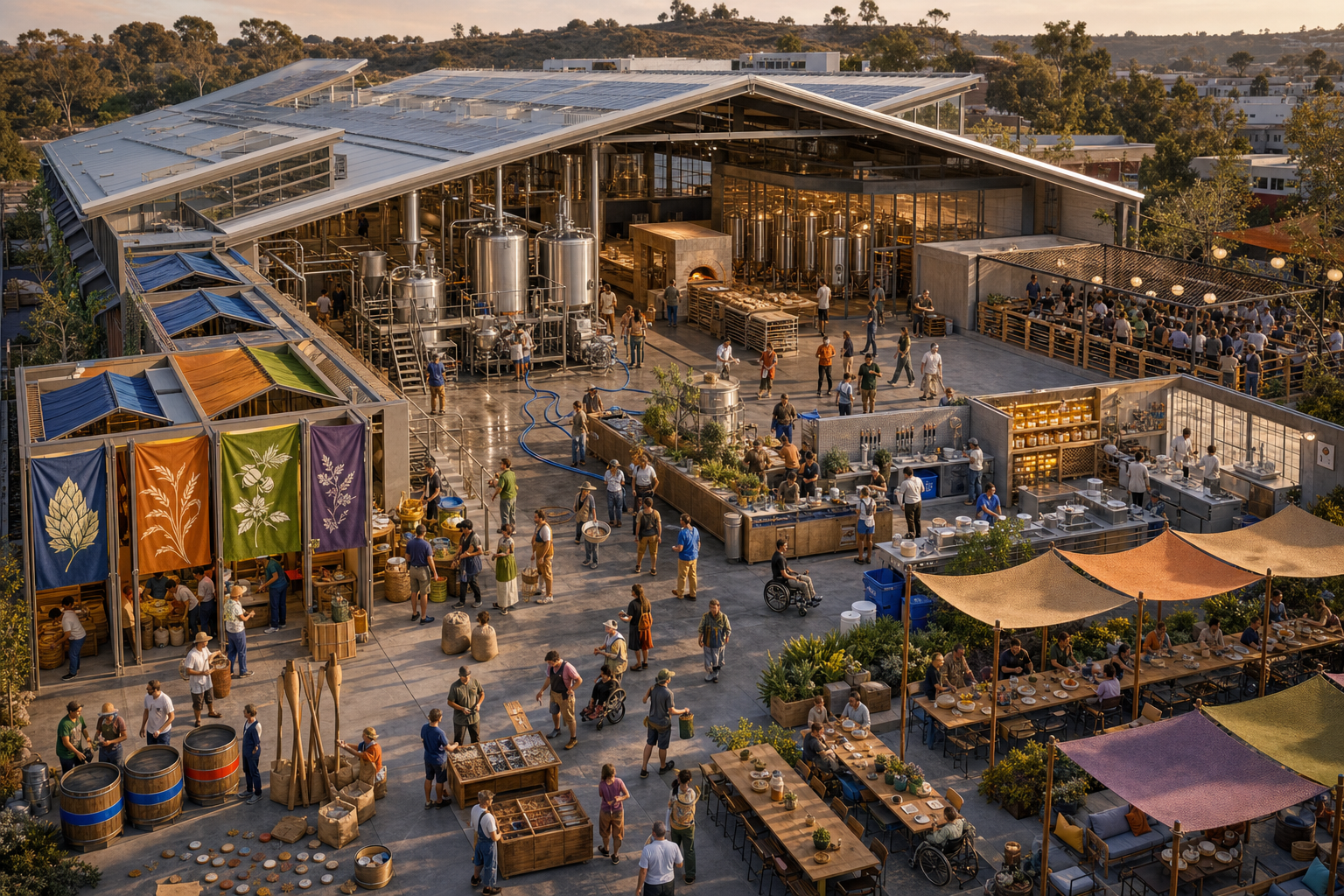
A large inland community fermentation campus combines stainless brewing equipment, bread ovens, honey worktables, four team bays, accessible paths, shade, and long communal tables.

PointCast Field Study 013 · Beach Commons

The Fermentation League

Four regions. One brewhouse. Nothing wins alone.

Brew inland. Play at the coast.

A speculative collaboration system for beer, bread, honey, public craft, regional style, and the games required to leave a gathering better than it began.

Meet the four teams ↓

A brewery can be shared civic equipment.

The interesting question is not whether twenty people can stand around a kettle. It is whether a community can distribute the real authorship: recipe, grain, hot work, cellar patience, laboratory checks, bread, honey, water, hospitality, accessibility, scorekeeping, cleanup, and return.

So four fictional place-teams—Coast, Basin, Valley, and Foothill—enter the same lawful brewhouse with different arguments about style. Beer is only one lane. Bread and honey get equal billing. The final test is whether the rivals can build one table together.

4Place-teams
3Festival lanes
100Possible points
0Alcohol at Dockweiler

The whole system, in order.

Open any plate for the full field view.

01 shared equipment / many forms of authorship

The Commons Brewhouse

A community brewery is not a big kettle. It is a legible chain of trust.

One qualified facility hosts four place-teams and makes milling, hot-side work, cellar care, laboratory checks, baking, honey provenance, hospitality, water, and cleanup equally visible.

Edge: Commercial or public beer production belongs inside a properly qualified and licensed operation. This plate is not a brewery plan, offer, club, producer, taproom, or event.
02 coast / basin / valley / foothill

The Four Waters Recipe Table

Place becomes interesting when it is an argument, not a costume.

Give every team the same equipment, disclosure rules, and judging frame; let water, grain, fermentation, aroma, bread structure, and hospitality express what each place values.

Edge: No geography mechanically determines flavor. Water is measured and adjusted lawfully; ocean water is never a brewing ingredient; local and floral-source claims require evidence.

03 all ages / equal billing

Bread + Honey Hall

The public festival begins where beer stops being the only serious craft.

Run bread crumb, crust, aroma, structure, grain, honey color, provenance, and pairing as full competitive lanes with water, tea, and alcohol-free malt drinks at the center.

Edge: Public food service needs the applicable permits and safe facilities. Allergens travel with every entry, perishable inclusions need qualified review, and honey is never served to infants under twelve months.

04 mill → mash → cellar → clean close

The Fermentation Relay

The baton is responsibility, not speed.

Pass one batch through named adult crews for grain, hot side, cold side, lab, bread, honey, water, hospitality, records, material return, and the final clean inspection.

Edge: Qualified supervision, sanitation, temperature control, mill-dust management, hot-liquid protection, records, fermentation time, and lawful packaging outrank spectacle or speed.

05 blind cup / complete systems

Coast v Basin v Valley v Foothill

The strongest glass can lose to the stronger commons.

Score flavor and intent beside bread and honey, provenance, hospitality, access, conservation, and clean close; publish the rubric before anyone writes a recipe.

Edge: Beer judging is controlled, anonymous, educational, small-pour, and adults-only. Public service, sale, fundraising, and homebrew competition rules depend on the actual operator and license.

06 brew inland / play at the coast

The Two-Site Festival Circuit

A constraint can become the most elegant part of the festival.

Keep production, cellar work, adult judging, and alcohol service at an authorized inland venue; carry flags, scorecards, bread, permitted honey service, and dry game props to an alcohol-free beach chapter.

Edge: LA County states that no alcohol permits are issued for Dockweiler State Beach. No alcohol, brewing vessel, glass, sale, drinking, or open container belongs in the beach chapter.

07 useful rivalry / all ages

The Local Games Field

Compete at the skills a good gathering actually needs.

Stage foam-barrel slalom, light sack carry, paddle precision, water accounting, canopy fold, accessible table assembly, aroma match, and leave-no-trace close.

Edge: Use cleaned lightweight props and bounded courses. No full kegs, drinking games, hot liquid, glass, thrown food, gambling, unsafe lifting, surf-edge play, blocked access, or habitat intrusion.

08 distributed awards / shared table

Nothing Wins Alone

A place can have a style. A commons needs every place.

End with one recipe archive, a shared bread display, distributed ceramic awards, returned tools, washed service ware, counted waste, sober departures, and a clean-close baton.

Edge: No winner-take-all podium, drinking contest, open-ended service, invented product launch, or claim that a club, brewery, nonprofit, festival, permit, or public program already exists.

Same building. Four arguments.

Style is not destiny or costume. It is a public statement about what a team chooses to make legible.

01

Coast

Brightness, dryness, aroma, open structure, and a clean finish. The coast team never uses seawater; it earns place through intention and restraint.

Beer
Hop-bright West Coast-style pilsener
Bread
Airy olive-oil slab
Honey
Citrus-blossom flight, only with traceable provenance
Game
Water-accounting relay
02

Basin

Light body, grain clarity, high collaboration, and the industrial intelligence of many systems sharing one floor.

Beer
Rice lager
Bread
Toasted-grain pull-apart loaf
Honey
Multifloral amber comparison
Game
Accessible table assembly
03

Valley

Fermentation can carry honey aroma without staying sweet. The team foregrounds source, timing, seeds, fruit-adjacent aroma, and patient change.

Beer
Dry honey saison
Bread
Seeded orchard miche
Honey
Single-source aroma spectrum
Game
Blind aroma match
04

Foothill

Spice, crust, texture, cool-cellar depth, shade, and durability. Weight comes from grain and care rather than strength for its own sake.

Beer
Rye beer
Bread
Dark seeded rye
Honey
Wildflower color-and-aroma flight
Game
Canopy fold and clean close

Twelve jobs. One baton.

The baton is responsibility. Every handoff has a named lead, a stop rule, a record, and a clean next station. Brewing stays under the responsible operator; public participation is designed around lawful, useful work rather than pretending everyone is suddenly a brewer.

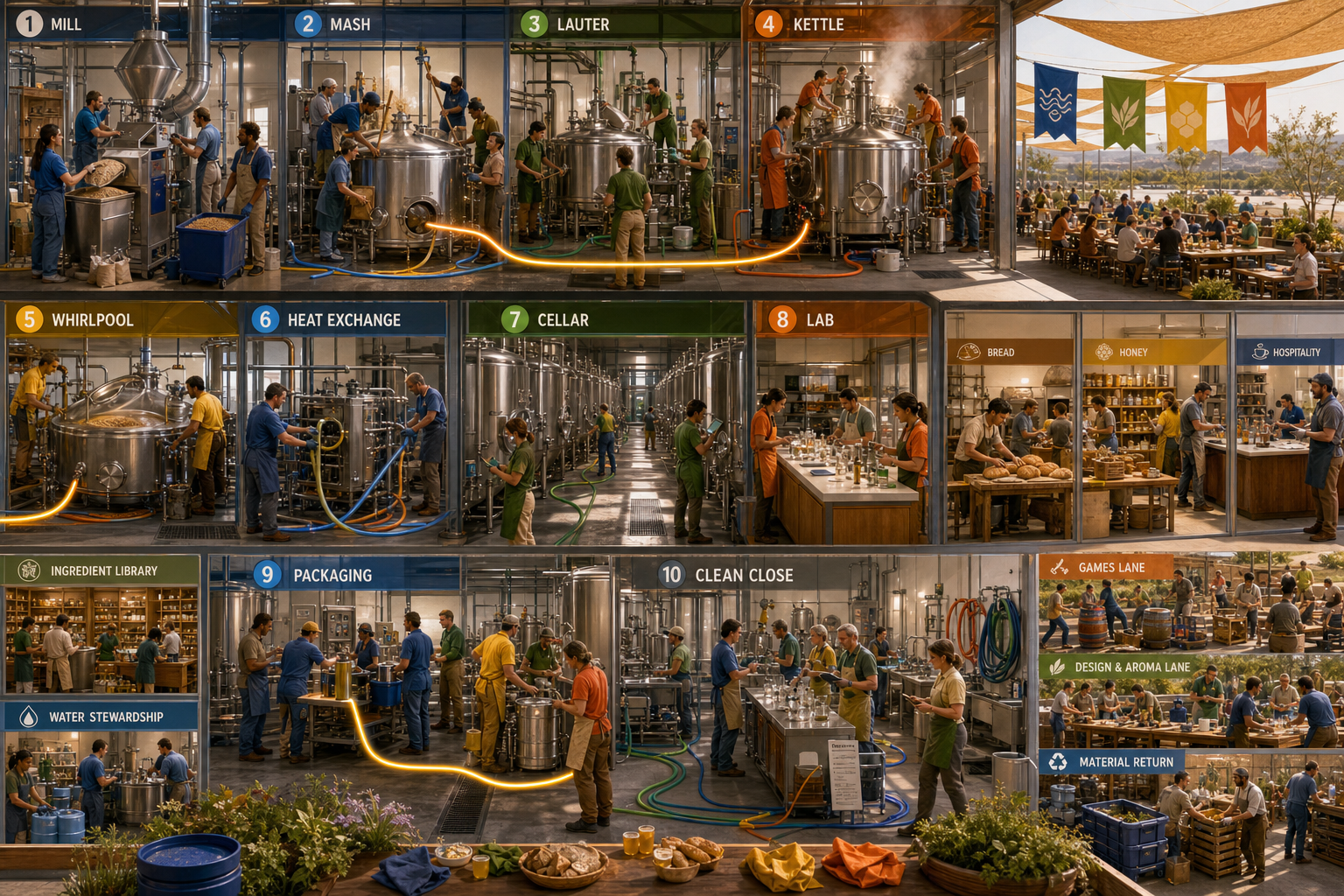
01mill02mash03cellar04lab05bread06honey07water08hospitality09access10score11material return12clean close
A cutaway brewery shows a glowing baton moving through milling, mashing, lautering, boiling, cooling, cellaring, laboratory work, packaging, hospitality, and cleanup.

Flavor is 25 points. The commons is 75.

No points for volume, strength, speed, exclusivity, spectacle, or drinking more.

Flavor + stated intent 25
Bread + honey craft 15
Ingredient traceability 15
Hospitality + access 15
Water + material care 15
Clean close + return 15

A technically excellent beer can lose. A generous, traceable, accessible, low-waste team can win.

Festival Draft Board

Pick one place-team and rehearse its complete slate. This does not create a recipe, registration, reservation, product, team, or real event.

Speculative team slate

Coast

Beer
Hop-bright West Coast-style pilsener
Bread
Airy olive-oil slab
Honey
Citrus-blossom flight, only with traceable provenance
Game
Water-accounting relay

Brightness, dryness, aroma, open structure, and a clean finish. The coast team never uses seawater; it earns place through intention and restraint.

Nothing is stored or sent.
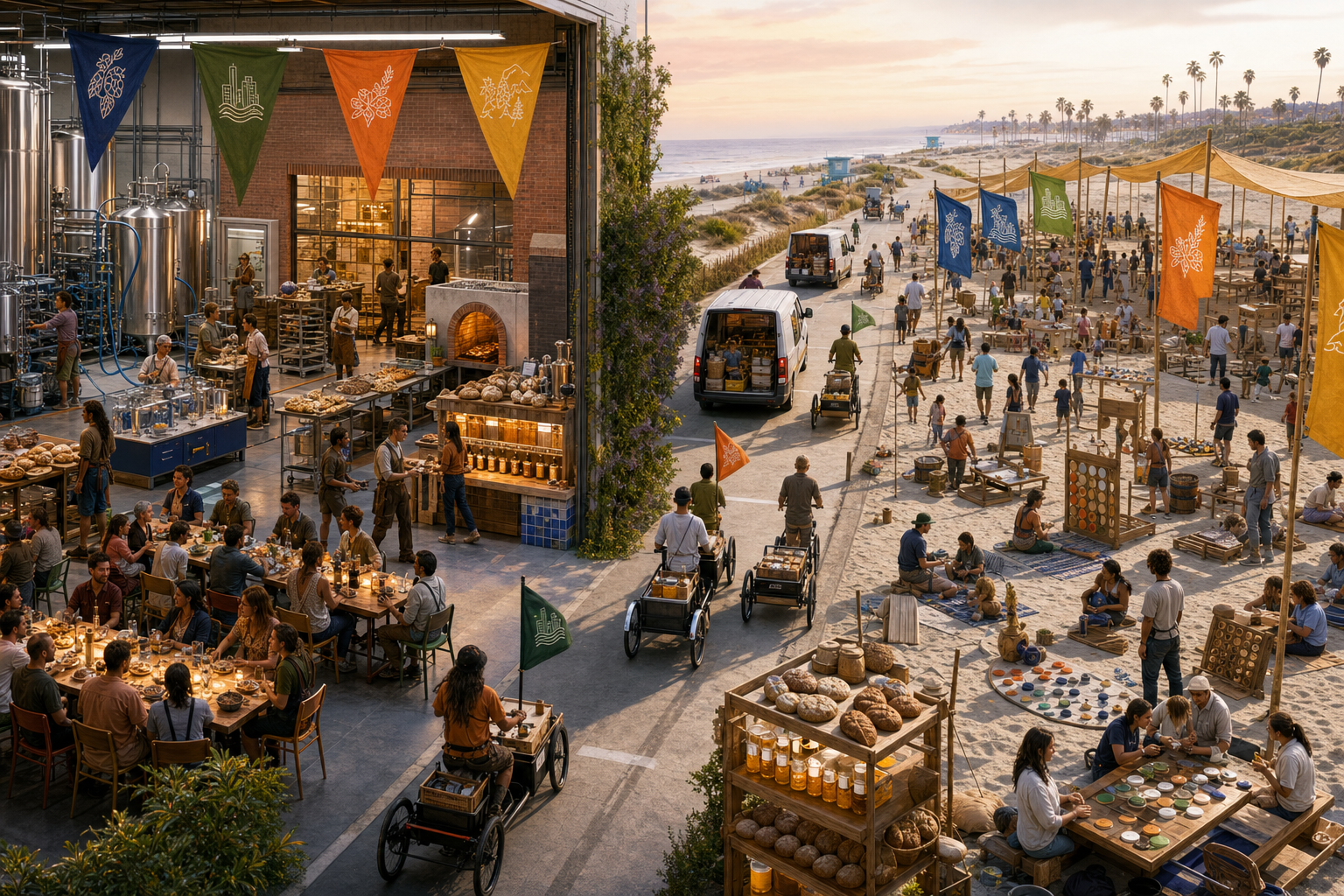
A split landscape connects a licensed inland brewhouse to an alcohol-free Dockweiler games and picnic chapter using cargo bikes, accessible cycles, and small electric vans.

One festival, two sites.

Inland / licensed

Make, cellar, judge, taste.

Production, adult beer judging, public alcohol service, bread ovens, honey archive, food, water, and the final long table stay with responsible operators at an authorized venue.

Dockweiler / alcohol-free

Play, picnic, return.

Lightweight games, abstract flags, ceramic score tokens, water, shade, and properly permitted food service become the coast chapter. Scorecards travel; open beverages do not.

LA County’s beach event materials state that no alcohol permits are issued for Dockweiler State Beach. V13 treats that as a design fact, not fine print.

Compete at useful things.

Every event uses dry, light, cleaned, purpose-built props and a bounded course.

  1. 01Foam-barrel slalom
  2. 02Light grain-sack carry
  3. 03Mash-paddle precision
  4. 04Water-accounting jug relay
  5. 05Canopy fold
  6. 06Accessible table assembly
  7. 07Blind aroma match
  8. 08Leave-no-trace close

No full kegs · no drinking games · no hot liquid · no glass · no food throwing · no gambling · no unsafe lifting · no surf-edge course

Start as a cup, or grow into a season.

The smallest credible version is one licensed partner, four invited teams, one all-ages hall, and one dry games day. A recurring league only follows after the close is audited.

01

Write the common rules

Publish the facility, team size, base constraints, judging rubric, evidence standard, alcohol-free lane, access plan, and stop rules before recipes begin.

02

Make through licensed partners

The responsible brewery owns production and records. Permitted bakers and food operators own their lanes. Team members contribute inside the operator’s lawful workflow.

03

Judge the complete system

Blind beer judging is one controlled adult room. Bread, honey, alcohol-free drinks, design, hospitality, conservation, and cleanup remain visible to everyone.

04

Carry only the games to the beach

A separately permitted, alcohol-free chapter uses lightweight props, sealed permitted food service, open access, shade, water, habitat buffers, and same-day pack-down.

05

Return to one table

Publish scores and lessons, distribute awards across roles, archive recipes with consent, return tools, count waste, close tabs, and decide whether a second season is warranted.

Imagine fully. Announce nothing.

The Fermentation League is an unofficial PointCast field study. It is not an operating brewery, homebrew club, nonprofit, producer, public tasting, recipe, batch, team, festival, competition, permit, fundraiser, product, sale, contribution drive, or invitation to gather.

Rules before recipes.

Sources establish boundaries and style context. They do not endorse this project or verify a future operator.

01 TTB — Beer FAQs

Federal brew-on-premises, collaboration, personal-use, competition, sale, and qualified-brewery boundaries.

Open source ↗
02 California ABC — License Types

Current beer manufacturer, small beer manufacturer, daily license, and event authorization summaries.

Open source ↗
03 California ABC — Daily Licenses

Qualified organization, owner authorization, outdoor diagram, timing, law-enforcement, and RBS requirements.

Open source ↗
04 LA County Beaches & Harbors — Special Event Permit Addendum

County form states that no alcohol permits are issued for Dockweiler State Beach.

Open source ↗
05 LA County Public Health — Community Events

Event organizer and temporary food facility permit context for public festivals that serve or give away food.

Open source ↗
06 Brewers Association — 2026 Beer Style Guidelines

Current style reference, including Rice Lager, Honey Beer, West Coast-style pilsener, and rye categories. Brewers Association 2026 Beer Style Guidelines published by the Brewers Association.

Open source ↗
07 AHA / BJCP — Sanctioned Competitions

Competition registration, standards, judging, and organizer resources.

Open source ↗
08 National Honey Board — Beer Research

Honey is highly fermentable; sweetness and aroma depend on beer, quantity, honey type, processing, and addition stage.

Open source ↗
09 California Department of Public Health — Cottage Food Operations

Approved-food, training, sanitation, labeling, and local registration or permit context.

Open source ↗
10 CDC — Honey before twelve months

Honey should not be given to children younger than twelve months because of botulism risk.

Open source ↗

Fermentation League plate

1 / 8