U
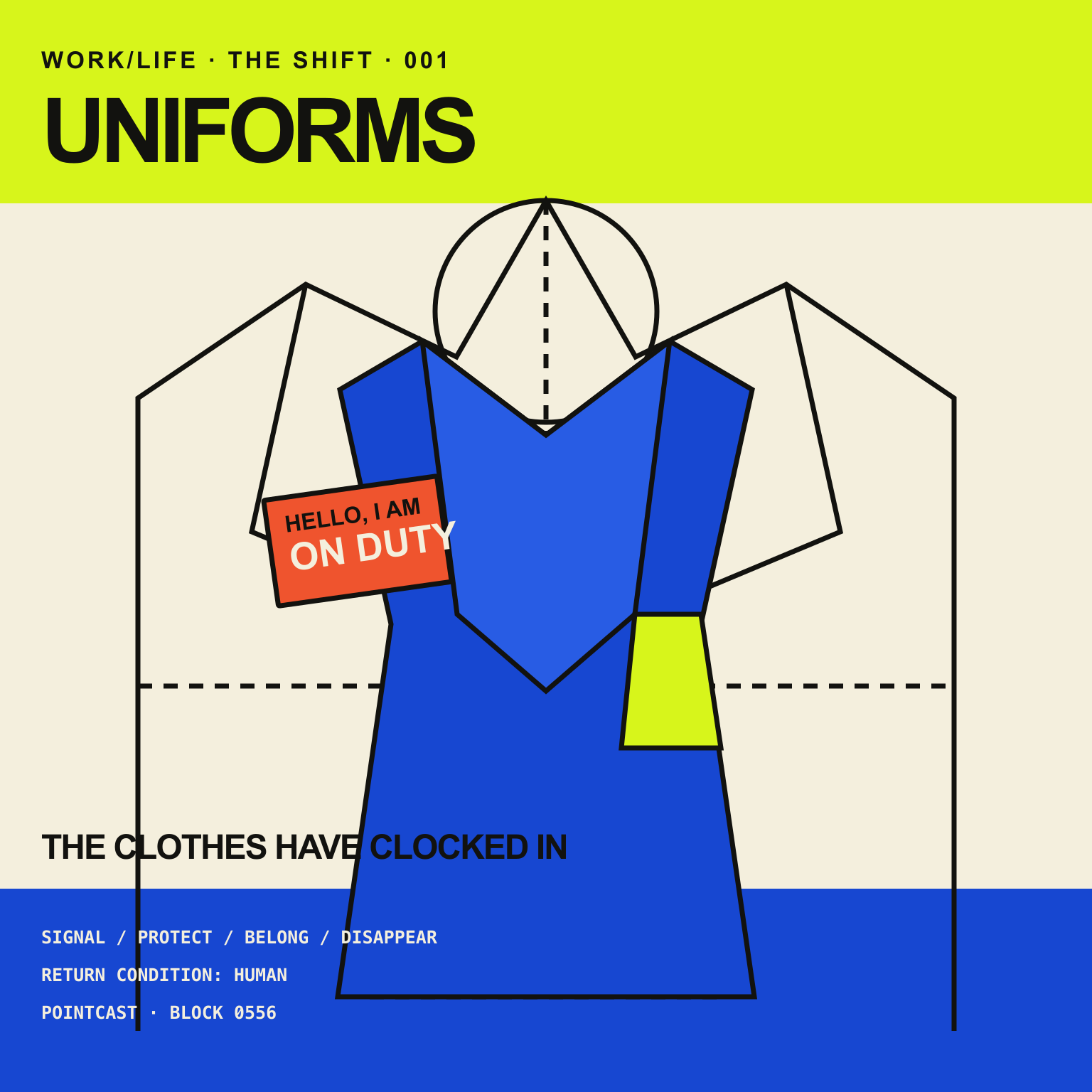
A uniform is an instruction written on a body. It can say trust me, ask me, do not cross this line, I belong here, or I am not the person in charge—sometimes all before the person wearing it has decided how they feel about the job.
We tend to treat uniforms as costumes for obvious occupations: the reflective vest, the scrubs, the apron, the blazer. But most workplaces have one. The black T-shirt, the neutral sneaker, the conference fleece, the camera strap, the permanent headphones: an anti-uniform becomes a uniform as soon as enough people recognize the code.
SIX GARMENTS / SIX INSTRUCTIONS
Read the role before the résumé.
- 01
HI-VIS VEST
BE SEEN / ABSORB RISKThe brightest person in the landscape is often the person asked to stand closest to danger.
- 02
SCRUBS
TRUST / HOLD A BOUNDARYCompetence becomes a color field. The garment makes care legible while keeping contamination in view.
- 03
BLACK TEE
REFUSE / QUIETLY CONFORMThe anti-uniform became a uniform the minute a whole industry agreed it meant no fuss, all focus.
- 04
APRON
SERVE / CARRY / STAINA front-facing tool belt that remembers the shift in flour, coffee, paint, grease, soil, and receipts.
- 05
BLAZER
BORROW AUTHORITYStructure at the shoulder can make an instruction sound as if it came from the building itself.
- 06
NAME BADGE
MAKE THE ROLE READABLEThe smallest uniform is a rectangle that lets strangers skip the introduction and begin with the request.
LOCAL FITTING ROOM / NO DATA LEAVES
What is the uniform doing?
A signal makes the role readable from across the room. It saves an introduction and starts an expectation.
THE PROMISE
A good uniform removes one decision and adds one protection.
It can make the wearer visible near traffic, keep private clothing clean, carry the tools of a shift, or let a frightened stranger locate help. It can turn a group into a team and make competence easier to find. At its best, the uniform takes on some of the work.
THE COST
A bad uniform asks the body to disappear inside the role.
It can advertise availability without offering authority, enforce an idea of gender or class, make discomfort look professional, or follow somebody home as smell, stain, posture, and mood. The clearer the role becomes, the easier it is to forget the person.
MIDJOURNEY ARCHIVE / AFTER SHIFT
The room keeps performing office.
These two studies came from Michael Hoydich’s May 2026 Midjourney archive. They are not documentary pictures of work. They are placed here because the emptiness makes a useful argument: screens, chairs, plants, art, and water coolers stay dressed for work after the worker has gone home.


Midjourney studies from the Michael Hoydich archive, May 2026
END OF SHIFT / CHECK THE LABEL
Who does the garment let you be—and who does it require you to stop being?
The useful question is not whether a workplace has uniforms. It is whether the worker gets any say in the fit, the signal, the care instructions, and when the clothes are finally allowed to clock out.