Progress you can touch
A loose piece becomes part of a larger picture. Small, visible finishes can make a long task feel inviting.
An editorial interpretation of the activity, not a measured promise about wellbeing.
POINTCAST PUZZLE WORLD · 2027 CONCEPT COLLECTION
A little attention. A table to gather around. An image you come to know with your hands.
Begin with jigsaws: why we return to them, what makes a good one, where to find one, and how we could make our own.
01 · THE PLEASURE OF A SMALL FINISH
A jigsaw gives attention somewhere to land. You can work alone, alongside someone, or leave it on the table and return tomorrow.
A loose piece becomes part of a larger picture. Small, visible finishes can make a long task feel inviting.
An editorial interpretation of the activity, not a measured promise about wellbeing.
People can build separate sections, trade observations and contribute without having to keep a conversation going.
Choose an image with several landmarks, and ask each person what a comfortable challenge looks like.
You study color, shape, orientation and texture in a way a quick glance never asks of you.
A 2018 randomized study found improved puzzle skill but no between-group improvement in overall visuospatial cognition after 30 days. It included healthy adults aged 50+ and was funded by a puzzle maker. Read the study ↗
Enjoyment is enough. Puzzles are recreation; this feature makes no claims about treating anxiety, preventing dementia or healing through sound.
02 · FIND YOUR KIND OF CHALLENGE
Image complexity, piece size, cut variety, contrast, eyesight, dexterity, table space and time all matter. A dark 500-piece image can be harder than a bright 1,000-piece scene.
A GENTLE START
Try distinct objects and strong color zones. Larger pieces may be easier to handle; compare physical dimensions, not just the count.
A TABLE FOR A WHILE
Enough room for texture and a longer session. Pick a subject you actually want to look at, and check the finished size before opening the box.
A LONGER PROJECT
More space and sorting. Dense architecture can offer landmarks; monochrome expanses or repeating patterns add challenge at any count.
Use even light with low glare, a contrasting mat, a large reference image and sorting trays within easy reach. Let people stand, sit, stop or ask for a hint. Offer large-piece alternatives and image landmarks that do not depend on color alone. These are design suggestions; test them with the people who will use the puzzle.
London engraver and map seller John Spilsbury is widely credited with early jigsaw puzzles. The National Portrait Gallery dates his puzzle to 1766. Dissected maps used pictures as teaching tools; today’s image puzzles turn that same idea into many kinds of leisure. National Portrait Gallery history ↗
Today’s world includes cardboard and laser-cut wood, irregular cuts, extra-large pieces, round images, shaped puzzles, mystery scenes and three-dimensional constructions. This first PointCast edition concentrates on two-dimensional image puzzles. Crosswords, logic, mechanical puzzles and other forms can become future rooms.
03 · TEN ORIGINAL WORLDS
A coast, a greenhouse, an impossible terminal. Ten different reasons to sit down and look closely.
These are original AI-generated concept images for a future-facing 2027 collection, with proposed piece plans. No factory samples, final dies or inventory exist. Web images are 1,536 × 1,024; they are concept previews, not production print masters.
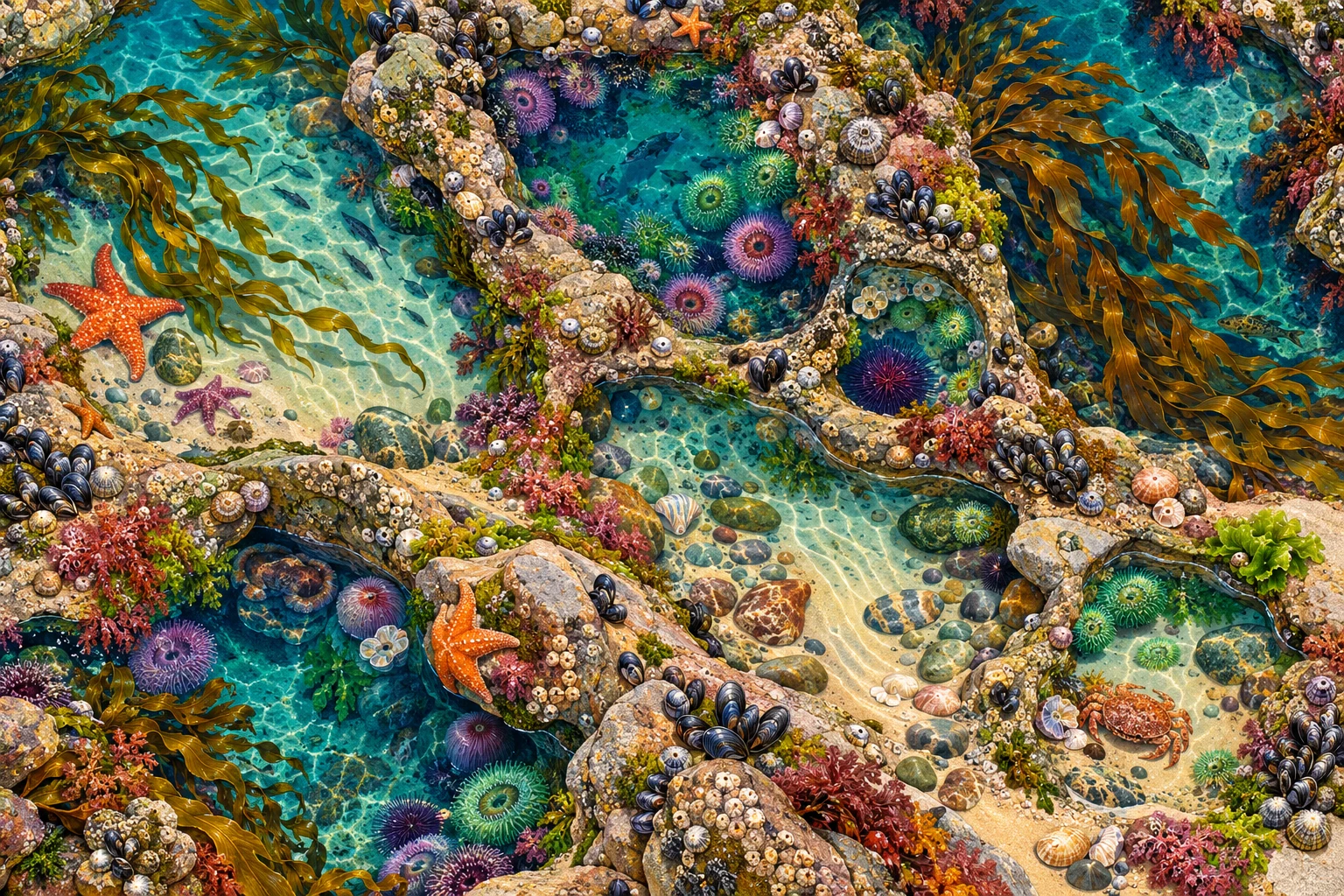
A whole coast in a few square feet. Follow the water between jewel pools, pebbles, algae and invented sea creatures.
Print: Preserve separation between turquoise water and dark rock. Check fine organisms at actual piece size, and keep key creatures away from trim.
First test: Strong first proof candidate: accessible scene with multiple footholds.
Design lesson: Zone maps and color proofing
Final crop, resolution, tolerances, piece dimensions and cut must follow the selected supplier’s specification and an approved physical proof.

The garden keeps its lights on. Warm windows, unusual foliage and quiet glass reflections make a little shelter after dark.
Print: Shadow detail is the risk. Soft-proof blues and greens, then check a matte physical sample under household lighting.
First test: Compare a 500-piece version with the proposed 750 before choosing.
Design lesson: Dark values and false fits
Final crop, resolution, tolerances, piece dimensions and cut must follow the selected supplier’s specification and an approved physical proof.

There is time before departure. An invented spaceport offers plants, small travelers, distant stars and a place to sit.
Print: Avoid turning subtle gradients into flat bands. A larger print master and clear differences across sky zones are required.
First test: A later release; test whether sky area makes 1,000 pieces too demanding.
Design lesson: Narrative landmarks and large quiet regions
Final crop, resolution, tolerances, piece dimensions and cut must follow the selected supplier’s specification and an approved physical proof.
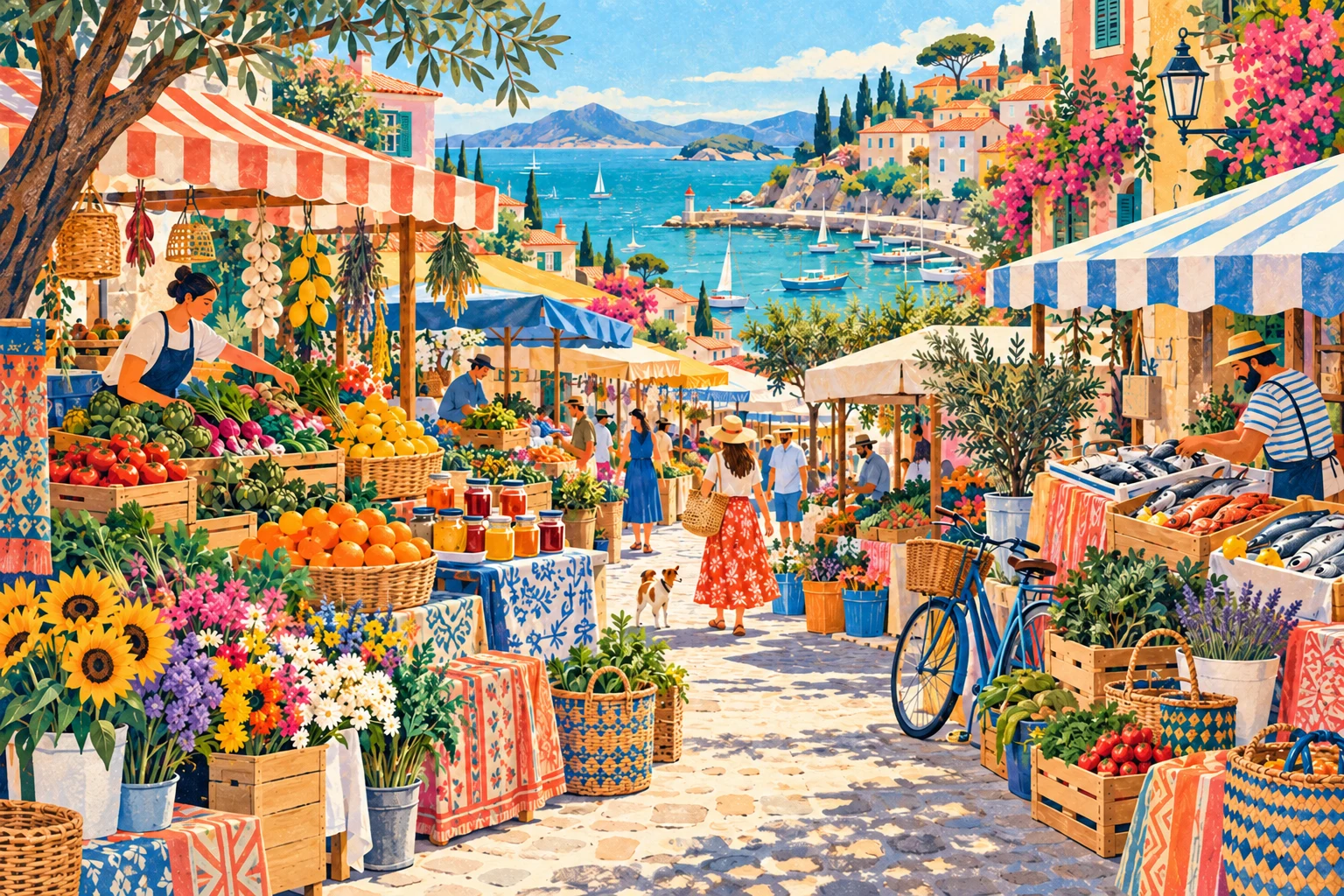
A small town is made by its market. Follow produce, baskets, bicycles and bright canopies through an invented Saturday morning.
Print: Keep produce clusters readable and simulated print texture subtle. Small marks must not become muddy at final size.
First test: Pair with The long table for a community collection.
Design lesson: Collaborative composition
Final crop, resolution, tolerances, piece dimensions and cut must follow the selected supplier’s specification and an approved physical proof.
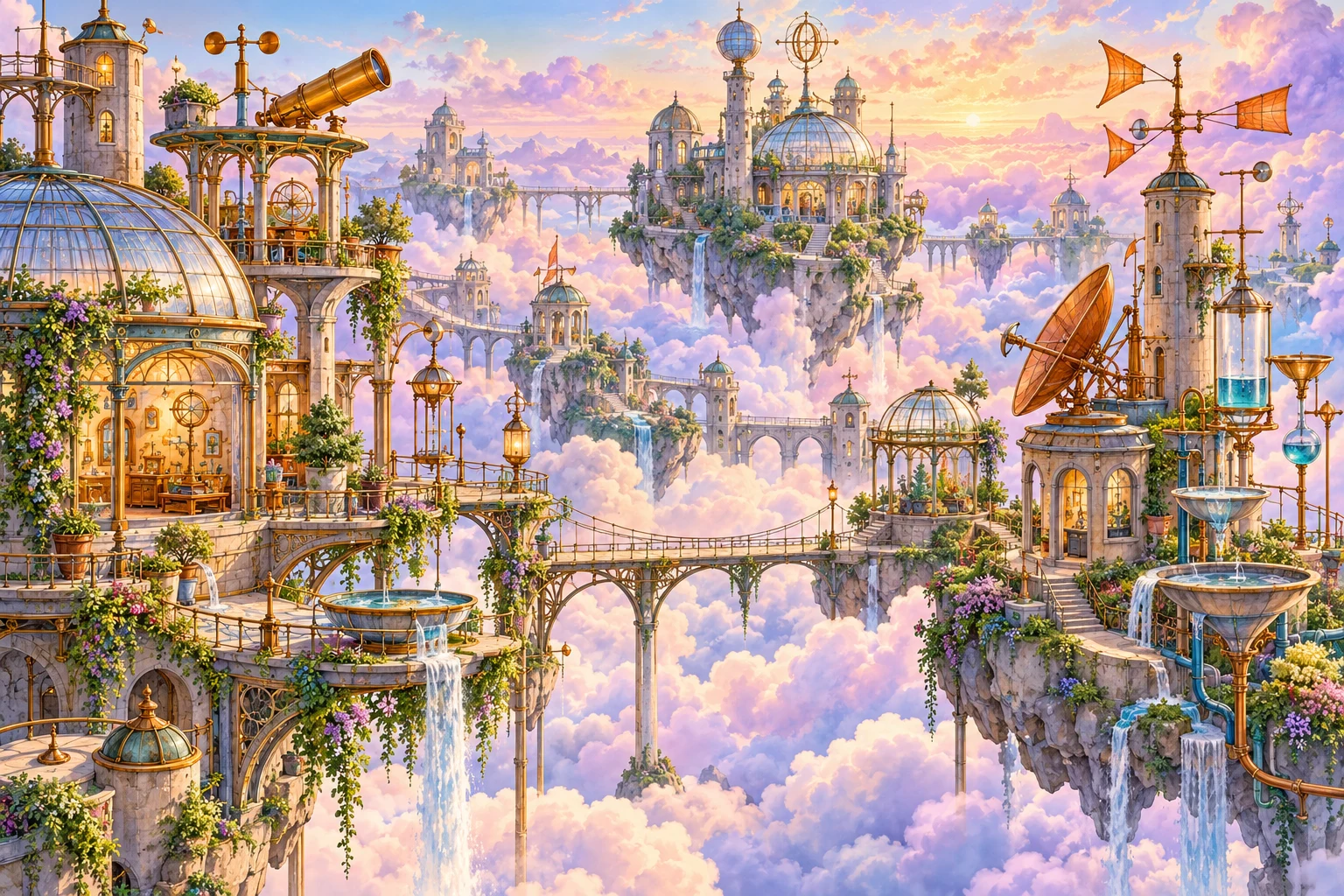
Somewhere above the weather, people measure clouds with improbable orange instruments. An impossible place with a welcoming map.
Print: Pale tones can disappear on uncoated stock. Require a physical proof; refine cloud boundaries and minimum feature scale.
First test: First large-piece study; size and handling need real user testing.
Design lesson: Lower piece counts without losing imagination
Final crop, resolution, tolerances, piece dimensions and cut must follow the selected supplier’s specification and an approved physical proof.
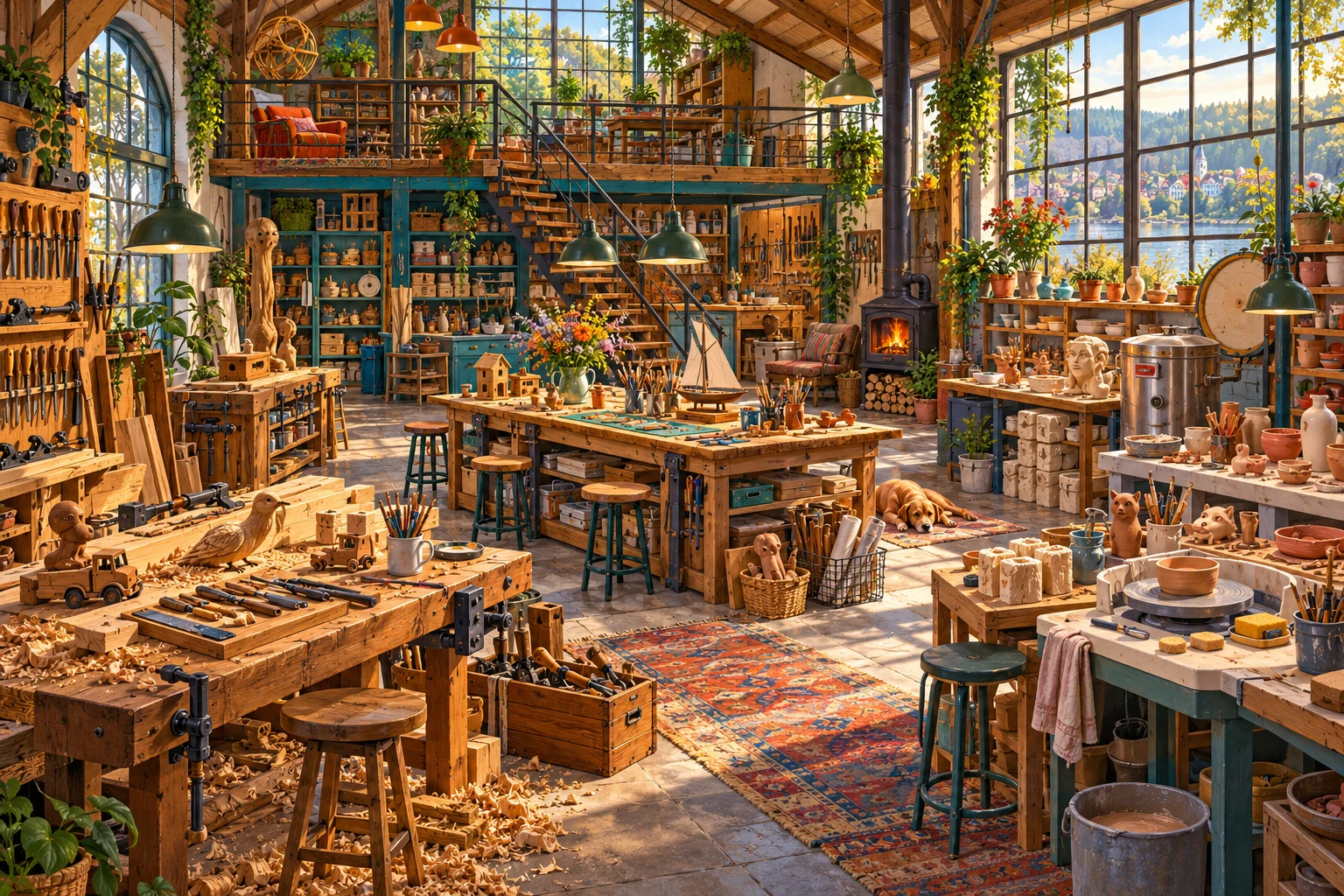
A cutaway workshop turns raw material into possibility. Benches, tools, molds and scraps form an invented community of making.
Print: Keep the scene illustrative, not a machinery instruction. Test tool-scale detail and eliminate accidental tiny marks in the print master.
First test: Complement to Buildworks: a puzzle about making, not a competing small-object catalog.
Design lesson: Design for assembly; design for manufacture
Final crop, resolution, tolerances, piece dimensions and cut must follow the selected supplier’s specification and an approved physical proof.

Sunlight becomes a paper mosaic. Ochre, cobalt, peach and mint make a rhythm you can assemble one small interval at a time.
Print: Check saturated color clipping and repeated shape ambiguity. Consider 500 pieces if playtesting exposes too many false fits.
First test: A specialist concept; do not assume every customer wants 1,000 pieces.
Design lesson: Repeat, variation and difficulty
Final crop, resolution, tolerances, piece dimensions and cut must follow the selected supplier’s specification and an approved physical proof.

An overhead feast of vegetables, bowls, linens and hands. There is a place for another person at the table.
Print: Inspect generated hands and utensils, correct any anatomy or merged details in a final master, and proof food tones without oversaturation.
First test: Test tactile piece handling and contrast with voluntary adult participants.
Design lesson: Still life and inclusive participation
Final crop, resolution, tolerances, piece dimensions and cut must follow the selected supplier’s specification and an approved physical proof.
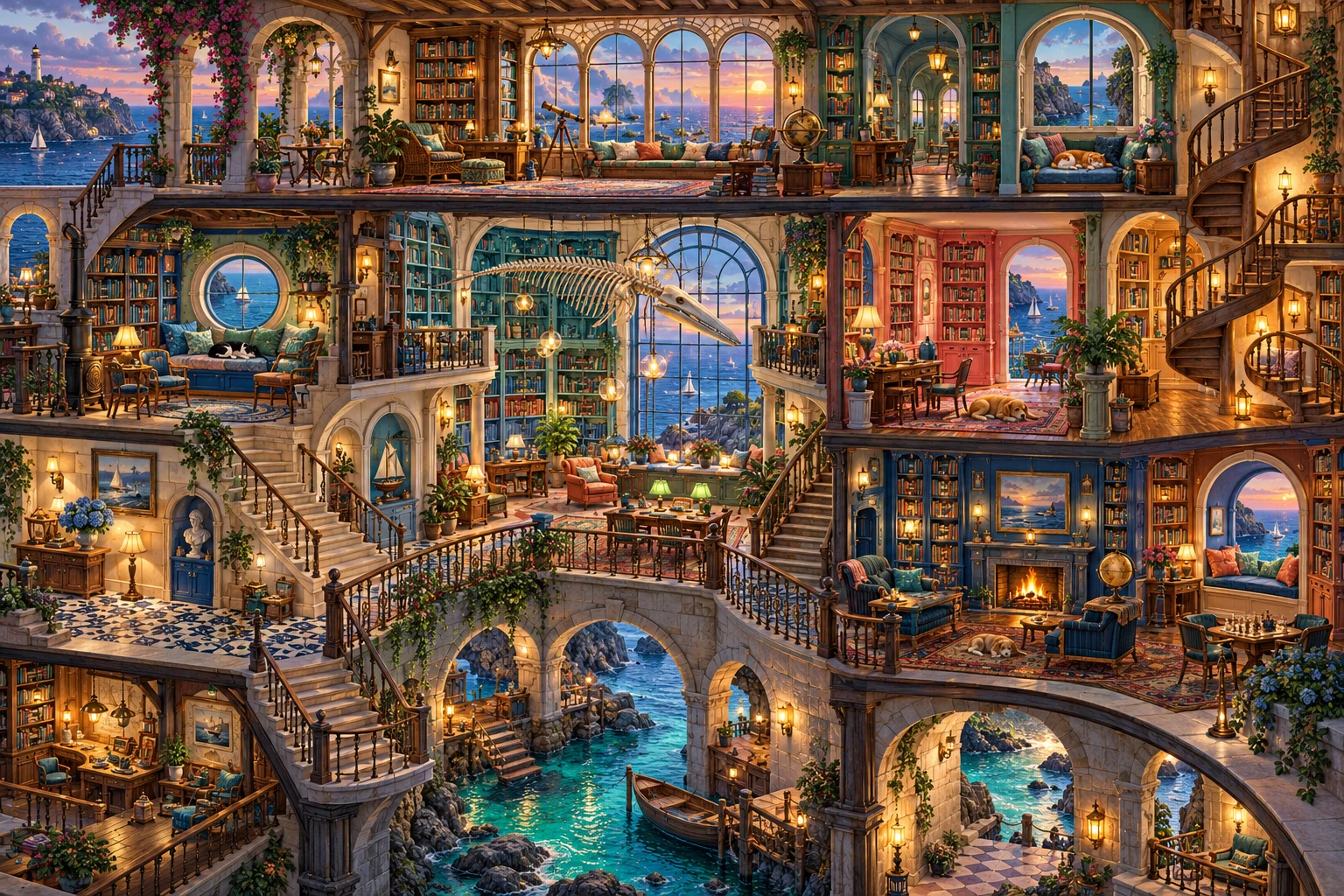
The library faces the sea. Shelves, stairs and little lamps hold a thousand imagined stories while the tide turns outside.
Print: 1,500 is a proposal, not a validated die. Require a much larger master, detail cleanup and an actual-size proof before sampling.
First test: An advanced edition after demand and print detail have been tested.
Design lesson: Scale, repetition and visual hierarchy
Final crop, resolution, tolerances, piece dimensions and cut must follow the selected supplier’s specification and an approved physical proof.

The street shines after a coastal shower. Reflections, bicycles and warm windows turn an ordinary invented neighborhood into a small event.
Print: Proof dark pavement carefully. Lift blocked shadows without flattening the evening atmosphere; check edges at the intended crop.
First test: A 500-piece visual balance candidate after shadow proofing.
Design lesson: Reflection, contrast and crop
Final crop, resolution, tolerances, piece dimensions and cut must follow the selected supplier’s specification and an approved physical proof.
04 · A SMALL PRACTICE TABLE
A 12-piece picture assembly demo using our original art. These digital pieces have straight cuts; physical jigsaws will need tested interlocking dies. There is no timer or score to chase.
Enable JavaScript to play this picture assembly demo.
Select a piece below, then choose a board space. Use Tab to move between buttons, Enter or Space to select. Wrong placements give a hint and keep your piece selected.
05 · OPTIONAL SOUNDTRACK
Mike’s playlist: veridis quo surfer dreams.
The official Spotify page identifies this playlist and creator mhoydich. We have not listened to or reviewed the audio; music is optional.
Open the playlist on Spotify ↗Opens the official service. No audio, lyrics or cover art are hosted here. No claims are made about healing frequencies.
06 · THE NEXT THREE ROOMS
A useful world includes the pleasure of the object and the reality of making it. Follow the path that interests you.
Official publisher links, choosing guidance and no invented stock or checkout.
Art, print, mounting, cut, proof, packaging, rights and safety. The process behind the table.
Five routes to market, realistic cost assumptions and an interactive contribution calculator.
07 · SOURCE NOTES & LIMITS
Sources checked October 3, 2026. Prices, policies and catalogs can change. Manufacturer claims are labeled as such. Original illustrations depict invented places and people; they do not document an actual project.
AI generation does not establish exclusive copyright or guarantee freedom from third-party claims. Before a commercial launch: preserve prompts and source history, document human edits, inspect artwork, secure needed permissions and review the production master. Read the rights workflow.