Skip to content
POINTCAST PUZZLESPointCast Store ↗

UNIVERSITY OF EL SEGUNDO · OPEN DESIGN & BUSINESS CASE

Design
the solve.

The picture is one design problem. The piece, the table, the box and the business are four more.

Six self-directed modules connect visual practice to manufacturing and business. Work privately, at your pace. There is no application, grade submission or purchase required.

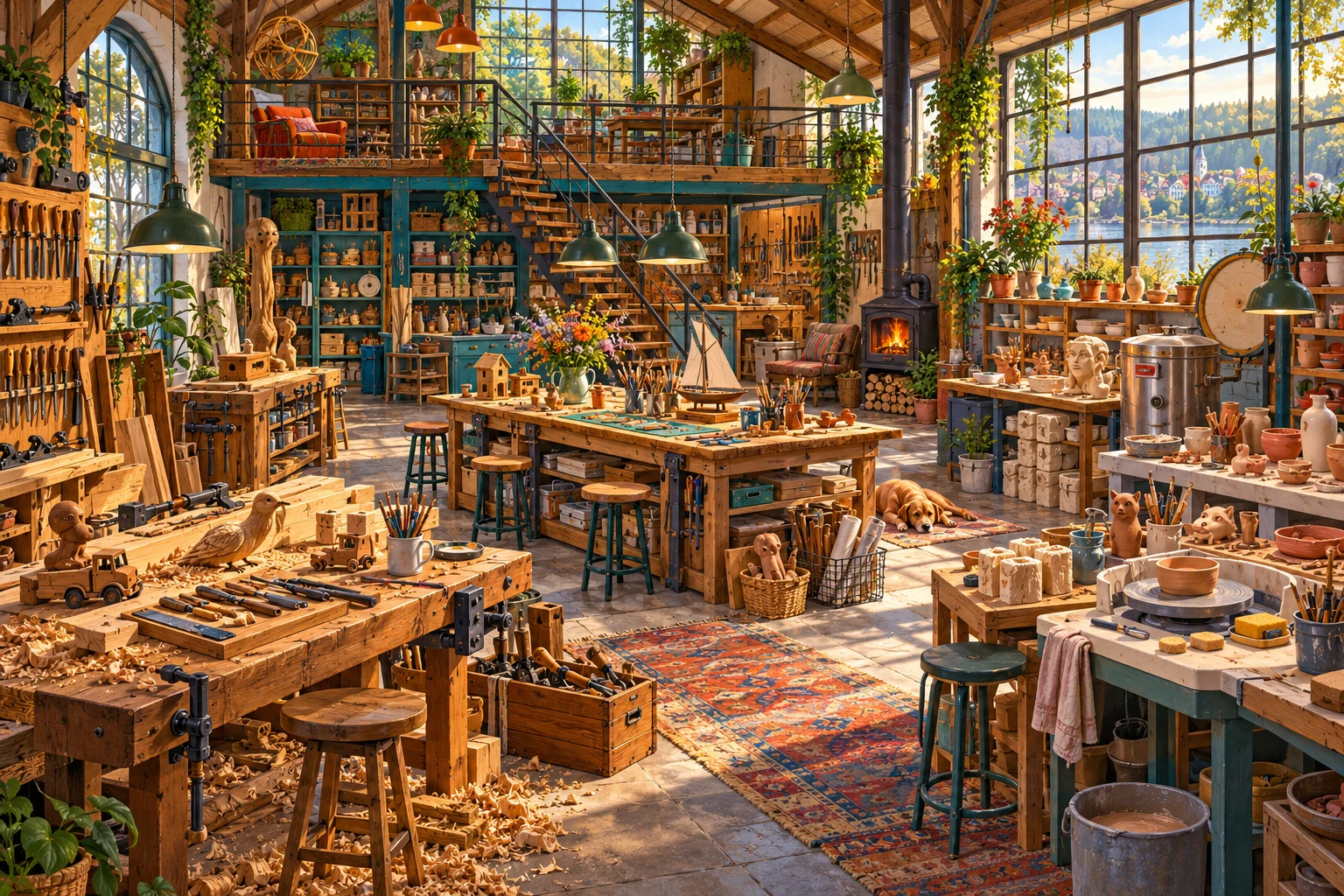
Original detailed imagined community workshop with benches, hand tools, materials and small fabrication stations.
06 / Workshop of small wonders · Original artwork study · Proposed puzzle
Independent, unaccredited educational project. A proposed puzzle case, with no claim of enrolled students, completed cohorts or commercial partnerships.

01 · SIX MODULES

Observe.
Make. Test. Cost.

Each module leaves a keepable artifact. A concept brief can be completed using this site and public sources; manufacturing and user testing remain optional future work.

Read the table

Choose one audience, one occasion and one comfortable challenge. Compare three physical puzzles for piece size, contrast, grip and reference readability. A desk study can use specifications; label what has not been physically examined.

Deliver: A one-page audience brief with three access hypotheses.

Critique: How do you know this is a need rather than your preference?

Compose a solve

Mark obvious anchors, edge clues, texture regions and deliberate hard areas. Make a grayscale check so landmarks do not depend only on hue. Try three crops and explain which gives the most useful clues.

Deliver: A color-and-shape zone map plus three annotated crops.

Critique: Does each part of the image give someone a place to begin?

Turn art into an object

Select a tentative piece count and print size. Calculate effective pixels per inch, inspect details at actual piece scale and follow one supplier template. Draw the box, insert and opening sequence.

Deliver: A supplier-specific specification, piece-scale proof sheet and packaging sketch.

Critique: What must be proven physically rather than assumed from the screen?

Test with care

Plan a voluntary adult playtest with consent, varied experience and optional hints. Ask about comfort, landmarks, false fits and reference use. Do not collect diagnoses or publish names. Do not invent completed findings.

Deliver: An unrun test protocol, or an anonymous observation report if a real test happens.

Critique: Can someone contribute without racing, seeing every color or handling tiny pieces?

Cost the promise

Use the business lab to compare a pilot, direct retail and wholesale. Replace assumptions with dated quotes where available. Track packaging, labor, postage, replacements and acquisition.

Deliver: A contribution worksheet, cash-timing diagram and three stress cases.

Critique: Can the product survive higher costs or half the expected demand?

Make a responsible brief

Write an honest pitch: picture, audience, specification, proof evidence, rights, costs and unresolved questions. Distinguish proposed work from tested results. Prepare an IndustryNext-style case narrative with clear sources.

Deliver: A five-page launch dossier and a pass, revise or stop decision.

Critique: Which claim would you remove because the evidence is not yet there?

02 · TEN BRIEFS, TEN DIFFERENT QUESTIONS

Choose your
first study.

The gallery’s proposed counts are starting hypotheses. Change the plan if composition, print tests or user observations give a reason.

BRIEF 01 · 500 PROPOSED PIECES

Tidepool atlas

Study: Zone maps and color proofing.

Color islands and recognizable organisms give several easy starting points; water reflections add a gentle final stretch.

Physical test: Preserve separation between turquoise water and dark rock. Check fine organisms at actual piece size, and keep key creatures away from trim.

Business decision: Strong first proof candidate: accessible scene with multiple footholds.

Return to the artwork →

BRIEF 02 · 750 PROPOSED PIECES

Night greenhouse

Study: Dark values and false fits.

Architectural lines help establish the frame; foliage texture increases the challenge inside.

Physical test: Shadow detail is the risk. Soft-proof blues and greens, then check a matte physical sample under household lighting.

Business decision: Compare a 500-piece version with the proposed 750 before choosing.

Return to the artwork →

BRIEF 03 · 1,000 PROPOSED PIECES

The quiet terminal

Study: Narrative landmarks and large quiet regions.

Big window geometry creates structure; quiet sky regions make this the slowest part of the journey.

Physical test: Avoid turning subtle gradients into flat bands. A larger print master and clear differences across sky zones are required.

Business decision: A later release; test whether sky area makes 1,000 pieces too demanding.

Return to the artwork →

BRIEF 04 · 500 PROPOSED PIECES

Saturday market

Study: Collaborative composition.

Distinct stalls give several people independent sections to work on, then a shared finish.

Physical test: Keep produce clusters readable and simulated print texture subtle. Small marks must not become muddy at final size.

Business decision: Pair with The long table for a community collection.

Return to the artwork →

BRIEF 05 · 300 PROPOSED PIECES

Cloud observatory

Study: Lower piece counts without losing imagination.

Pastel shapes, architecture and warm landmarks support a lower piece count. Similar clouds still need deliberate contrast.

Physical test: Pale tones can disappear on uncoated stock. Require a physical proof; refine cloud boundaries and minimum feature scale.

Business decision: First large-piece study; size and handling need real user testing.

Return to the artwork →

BRIEF 06 · 750 PROPOSED PIECES

Workshop of small wonders

Study: Design for assembly; design for manufacture.

Different workstations form separate puzzle zones; many small details reward repeat looking.

Physical test: Keep the scene illustrative, not a machinery instruction. Test tool-scale detail and eliminate accidental tiny marks in the print master.

Business decision: Complement to Buildworks: a puzzle about making, not a competing small-object catalog.

Return to the artwork →

BRIEF 07 · 1,000 PROPOSED PIECES

A thousand little suns

Study: Repeat, variation and difficulty.

Repeating motifs are intentionally harder. Different sizes and texture bands should prevent every piece looking alike.

Physical test: Check saturated color clipping and repeated shape ambiguity. Consider 500 pieces if playtesting exposes too many false fits.

Business decision: A specialist concept; do not assume every customer wants 1,000 pieces.

Return to the artwork →

BRIEF 08 · 300 PROPOSED PIECES

The long table

Study: Still life and inclusive participation.

Bowls and food provide obvious anchors. The cloth adds a modest quieter section without dominating the image.

Physical test: Inspect generated hands and utensils, correct any anatomy or merged details in a final master, and proof food tones without oversaturation.

Business decision: Test tactile piece handling and contrast with voluntary adult participants.

Return to the artwork →

BRIEF 09 · 1,500 PROPOSED PIECES

Library of tides

Study: Scale, repetition and visual hierarchy.

Dense architecture supports extended solving, though repeated shelves require deliberate local variation.

Physical test: 1,500 is a proposal, not a validated die. Require a much larger master, detail cleanup and an actual-size proof before sampling.

Business decision: An advanced edition after demand and print detail have been tested.

Return to the artwork →

BRIEF 10 · 500 PROPOSED PIECES

After the rain

Study: Reflection, contrast and crop.

Reflections connect upper and lower sections; garden textures and windows keep the dark pavement from becoming one uniform field.

Physical test: Proof dark pavement carefully. Lift blocked shadows without flattening the evening atmosphere; check edges at the intended crop.

Business decision: A 500-piece visual balance candidate after shadow proofing.

Return to the artwork →
03 · A PRIVATE DESIGN BRIEF

Keep the
questions together.

Write locally in this page and download your own text file. Notes are not transmitted or saved automatically. Navigating away can lose them.

No notes are saved automatically.

04 · THE CONNECTIONS

A studio within
a wider school.

Use existing UES resources and the Industry Next Communications Lab as educational companions. These links describe editorial connections, not institutional partnerships.

Public Image Office

UES’s existing image-making studio provides a related home for visual language, public claims, attribution and image responsibility.

Open UES-203 →

Common Table

UES’s existing community studio asks what a welcoming shared setting needs. Apply that lens to puzzle tables, references and participation.

Open UES-206 →

El Segundo School archive

Study the existing art archive as a visual resource. An archive link does not grant commercial reproduction rights to its artworks; follow each work’s rights record.

Explore the archive →

Buildworks complement

The companion Buildworks studio focuses on small crafted objects. This case focuses on puzzles. Compare material use, packaging and rights across formats without assuming a bundle will sell.

Study the workshop puzzle →

A useful critique asks for evidence: Is the image readable? Does the actual cut work? Can different people participate? Are rights and sources clear? Do the numbers withstand stress? What remains unknown?