DISPATCH · Nº 0506 · POINTCAST FIELD STUDY
Dockweiler Beach Commons — Hardpoint + Softkit
A storm-tough mineral center and a kit of rooms that ten people can carry, repair, rearrange, and share.
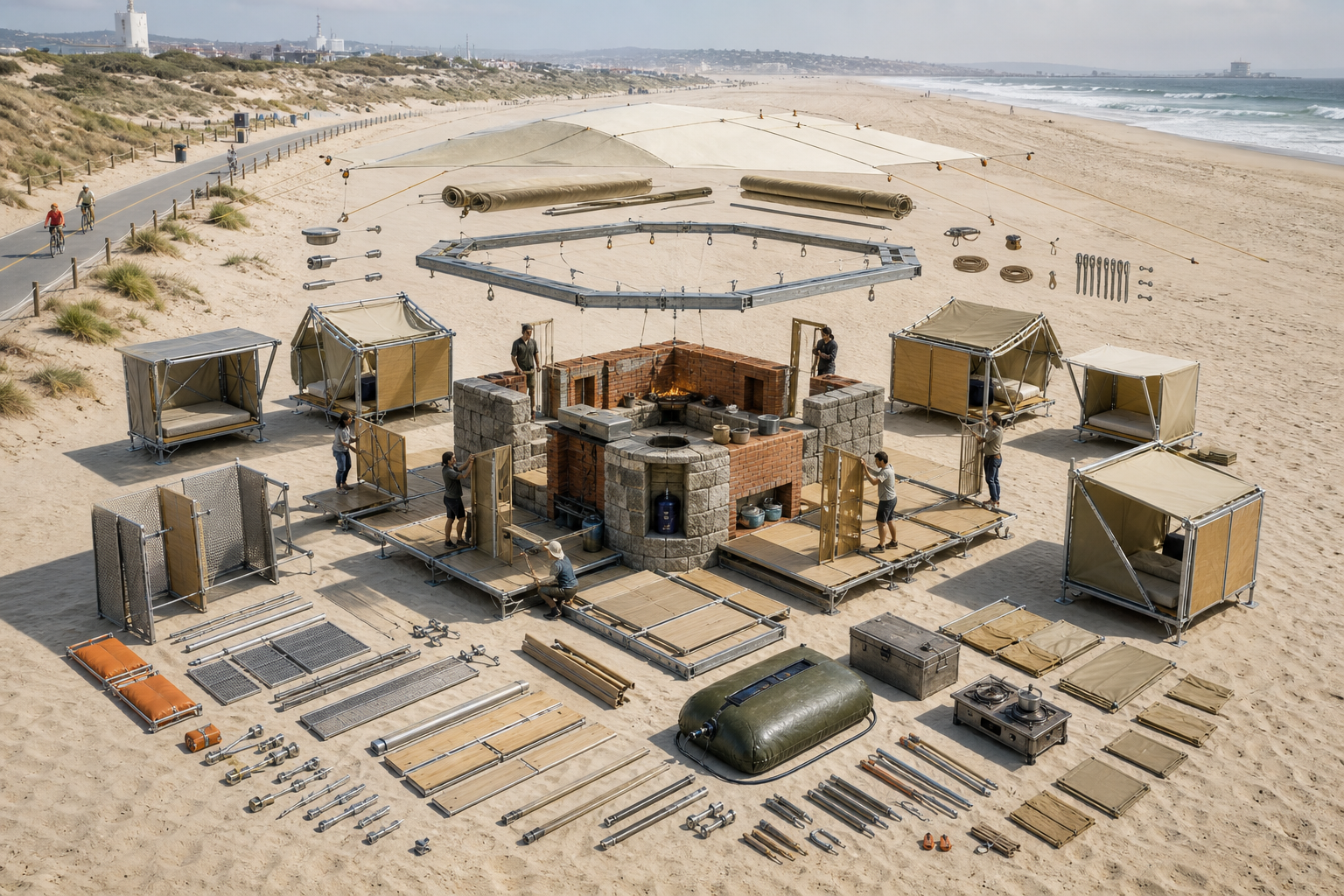
The sturdy brick-and-stone service buildings along Dockweiler suggest a useful split: make one small center heavy enough to protect water, washing, cooking, first aid, storage, thermal mass, and the social hearth; make every room around it light enough for people to carry, repair, turn, open, and remove.
The six-image field study calls that split Hardpoint + Softkit. Ten people begin with a shared courtyard instead of ten private tents. They can reconfigure the same parts into quiet sleeping thresholds, a two-level nest, a long table, a shadow-theater wall, or a repair shop. Solar stays small and boring—light, water, radio, tools—while communication happens through voice, bells, lanterns, paper, rhythm, and presence.
Two experiments approach the water without pretending to own it. The Tide Room is a removable listening and observation room with public passage kept clear. Wave Foundry sends slow wave motion through lines and pulleys to a loom, ceramic chimes, a sand-drawing arm, and one low-voltage light. Its first output is culture rather than an electricity claim.
The stone is literal only in a permanent civic version. A one-day exploration should imitate mineral logic—mass, calm, a shared center—using brought-in modular ballast rather than pretending masonry can appear safely in an afternoon. Any seasonal or permanent version would need real engineering, accessibility, habitat review, public-access protection, permits, and removal plans.
This is speculative architecture: six images and a set of social rules, not a construction document, active beach camp, permitted installation, or invitation to build on the public beach.
