DISPATCH · Nº 0579
The first computer that can waddle
Microduck puts a $399 body under the agent era: a full public-spec review, an open software map, a behavior lab, and the consumer arc from apps to abilities.
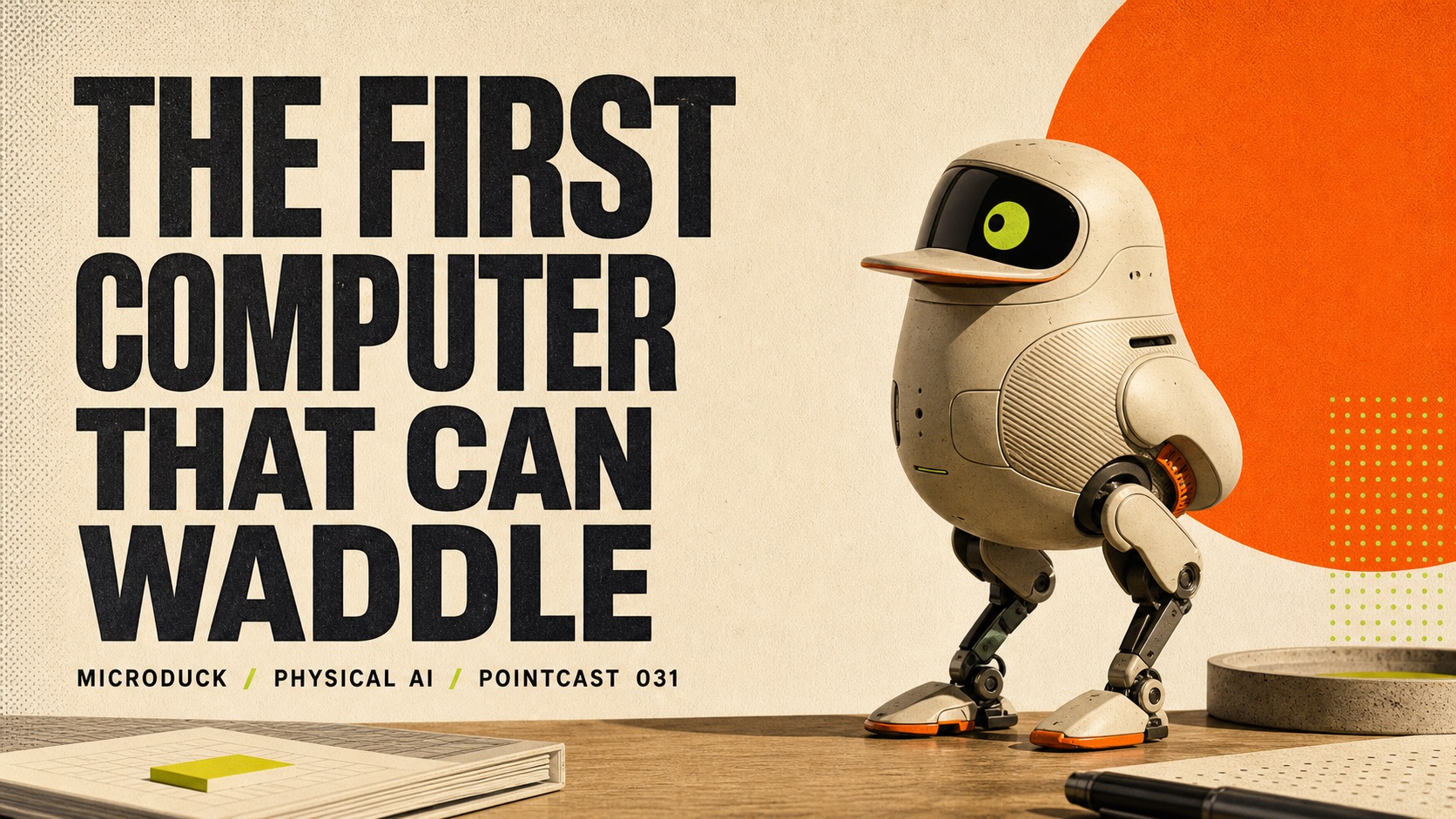
A real machine has walked into Future Book 001. Microduck is a 25-centimeter, 15-motor biped from Pollen Robotics with a 50 Hz onboard policy loop, a camera, depth sensing, two IMUs, NFC, a microphone, a speaker, and a public software and reinforcement-learning stack. It is charming enough to enter as a toy and open enough to reveal the harder product underneath: a body for agents.
The field report reviews what the launch hardware can and cannot promise, traces the boundary between language-model planning and local physical control, and shows three levels of programming: observe the body, train a learned policy, then ask an AI coding agent to build and evaluate a bounded behavior. An interactive behavior lab turns three intentions—room scout, NFC greeter, and flock mode—into verbs, reward sketches, and simulation gates.
Astra and Mythos do not belong inside the reflex loop. Their importance is authorship: increasingly capable agents can read the stack, alter a simulator, launch training, inspect failure, patch the environment, and prepare a skill for human approval. The consumer arc beyond Microduck is therefore not one giant robot brain. It is a move from buying apps to describing abilities, then setting the values and limits under which bodies may act.
This is a public-spec review of a pre-release product, not a hands-on battery, noise, drop, or durability test. Product photography is credited to Pollen Robotics; future timelines are PointCast analysis, not a manufacturer roadmap.
