Lighthouse: follow the light
Simon as a lighthouse lens at night. Four lamps in Atari 800XL or Commodore 64 colors play a growing sequence of light and tone; you play it back. A free-play mode turns the lens into a four-note instrument.
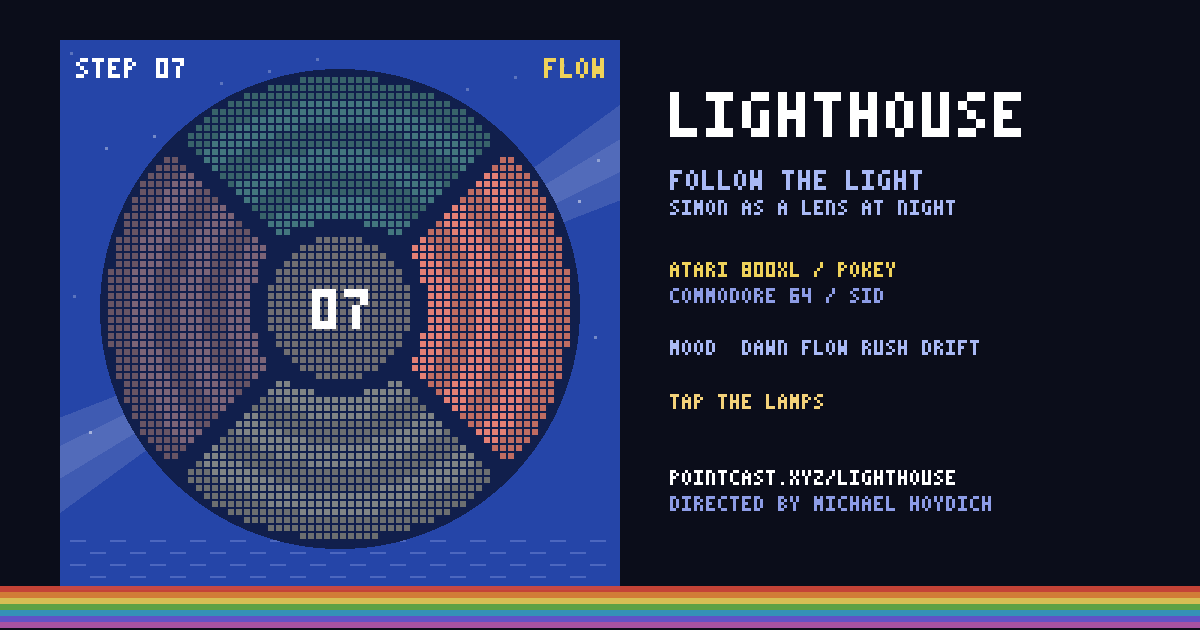
Lighthouse is Simon, the 1978 Milton Bradley memory game designed by Ralph Baer and Howard Morrison, drawn as the lens of a lighthouse at night. Four lamps sit at the compass points: green to the north, red to the east, yellow to the south and orange to the west, in the colors each machine gives Breakwater's bricks. Each has its own tone, and together they sound an A major chord, after Simon's four bugle-like notes. The light plays a sequence. You play it back with taps, the arrow keys or 1 to 4. Each round the light adds one lamp and plays it all again, and as on Simon the playback speeds up after the fifth, ninth and thirteenth step. A wrong lamp, or waiting too long, sounds a low buzz and blinks the lamp that was due. Between rounds a beam sweeps the field. The game keeps a mood with you. Each lamp you get right raises its energy, each sequence you finish raises it more, and every eighth step reached lifts both; a miss lowers its calm. DRIFT, after a miss, slows the playback and waits longer for your answer. RUSH speeds the playback and lets the lamps go dark between flashes. On the CALM dial a miss replays the same sequence and there is no game over. Your best is the longest sequence you repeated. FREE turns the lens into a four-note instrument: hold a lamp to sound it, slide between lamps to play a run. It is built for a phone held upright and for a desktop in full screen, and it lights its cabinet on Cabinet Row. [Play Lighthouse](/lighthouse). [Read the machine edition](/lighthouse.json). [Walk Cabinet Row](/cabinet-row).
