Hoydich Enterprises / 2030 design study / El Segundo
Beyond the car. Built around the person.
Three personal-transit concepts, a local manufacturing thesis, and the evidence gates between imagination and a real program.
Independent design fiction. Architectural illustrations are not construction instructions or flight-certified blueprints. Hoydich Enterprises' El Segundo factory is an aspiration, not an existing facility. No flight performance, certification, partners or funding are claimed.
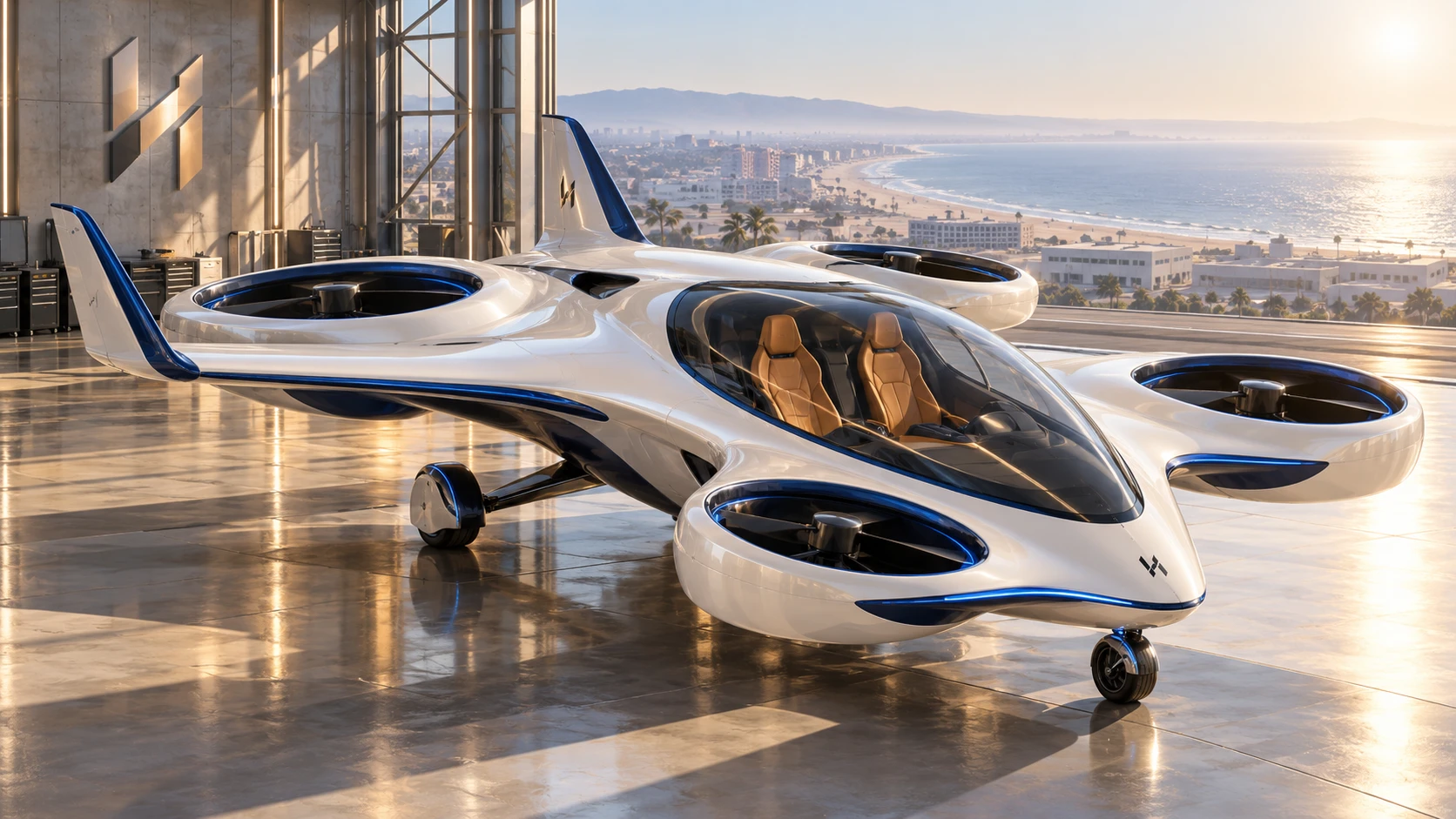
STRATUS / 2030 design study. Original generated concept art. Neither performance nor certification is established. The depicted coastal hangar is fictional.
01 / The design space
A cabin. A craft. A cocoon.
A small personal cabin moves through a city that gives people more time. Ground transit does the ordinary work; a separately engineered aerial system is a question to investigate, never an assumed capability. The images propose shapes and experiences; they do not resolve mechanics, occupant protection or aircraft classification.
2030 design study
Tidemark
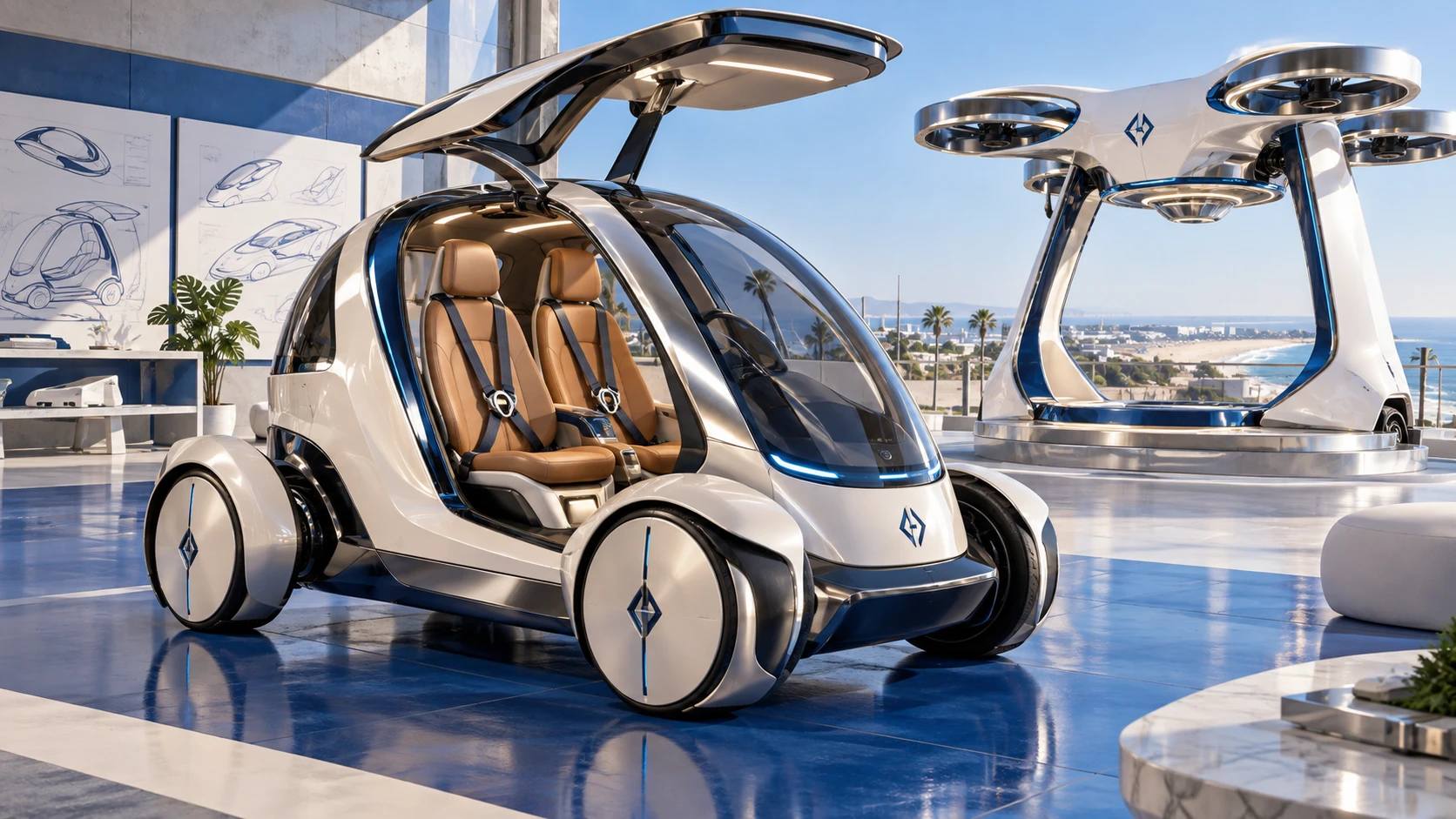
Ground-first modular personal pod
2030 design study. Neither road nor flight approval is claimed. Aerial docking and failure handling remain unresolved.
A quiet two-person cabin imagined on a low-speed ground platform. Explore accessible boarding, luggage, serviceability and an understandable interface before any aerial vehicle exists.
Open question: Seats, dimensions and road approval require engineering; this is a visual proposition.
2030 design study
Stratus
Two-seat aerial form study
2030 design study. Flight performance and aircraft classification have not been established; illustrated shrouds are not validated protection.
A speculative personal aircraft silhouette with distributed propulsion. Study aircraft category, energy, noise and emergency landing needs as open questions with qualified engineers.
Open question: No verified lift, range, speed, autonomy or airworthiness.
2030 design study
Nimbus
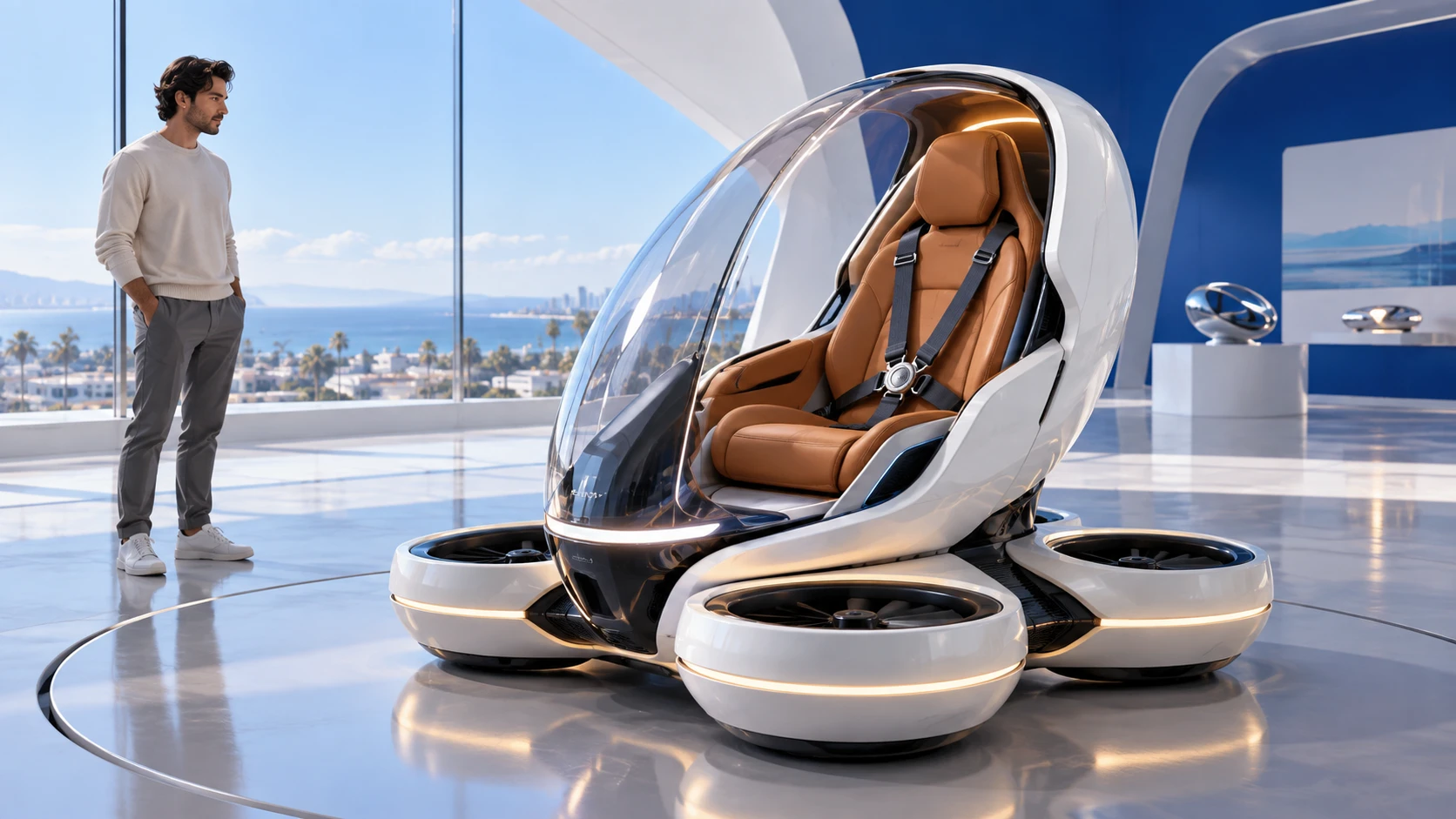
Far-horizon personal cocoon
2030 design study. Neither occupant protection nor flight capability has been validated.
What if a journey felt more like a protected chair than a car? A provocative single-seat form study, not the first manufacturing program. Human factors, noise, downwash, energy and failure tolerance remain unanswered.
Open question: A speculative form, not a buildable or validated flight system.
Design rule / Start with a person
Useful before airborne.
First learn whether the ground cabin improves a real journey: boarding, storage, service and understandable controls. A separable aerial carrier is an unresolved hypothesis, not a commercial dependency.
Accessibility, maintenance and community acceptance belong in the first drawing. A beautiful canopy or shroud in a render is not evidence of safety.
No range, speed, lift, payload, autonomy, noise or production-price claim is made.
02 / Conceptual architecture
Give every interface an owner.
01 / Human need↓ Cabin & interface study↓ Ground base case↳ Aviation option: separately gatedAssurance record connects every decision
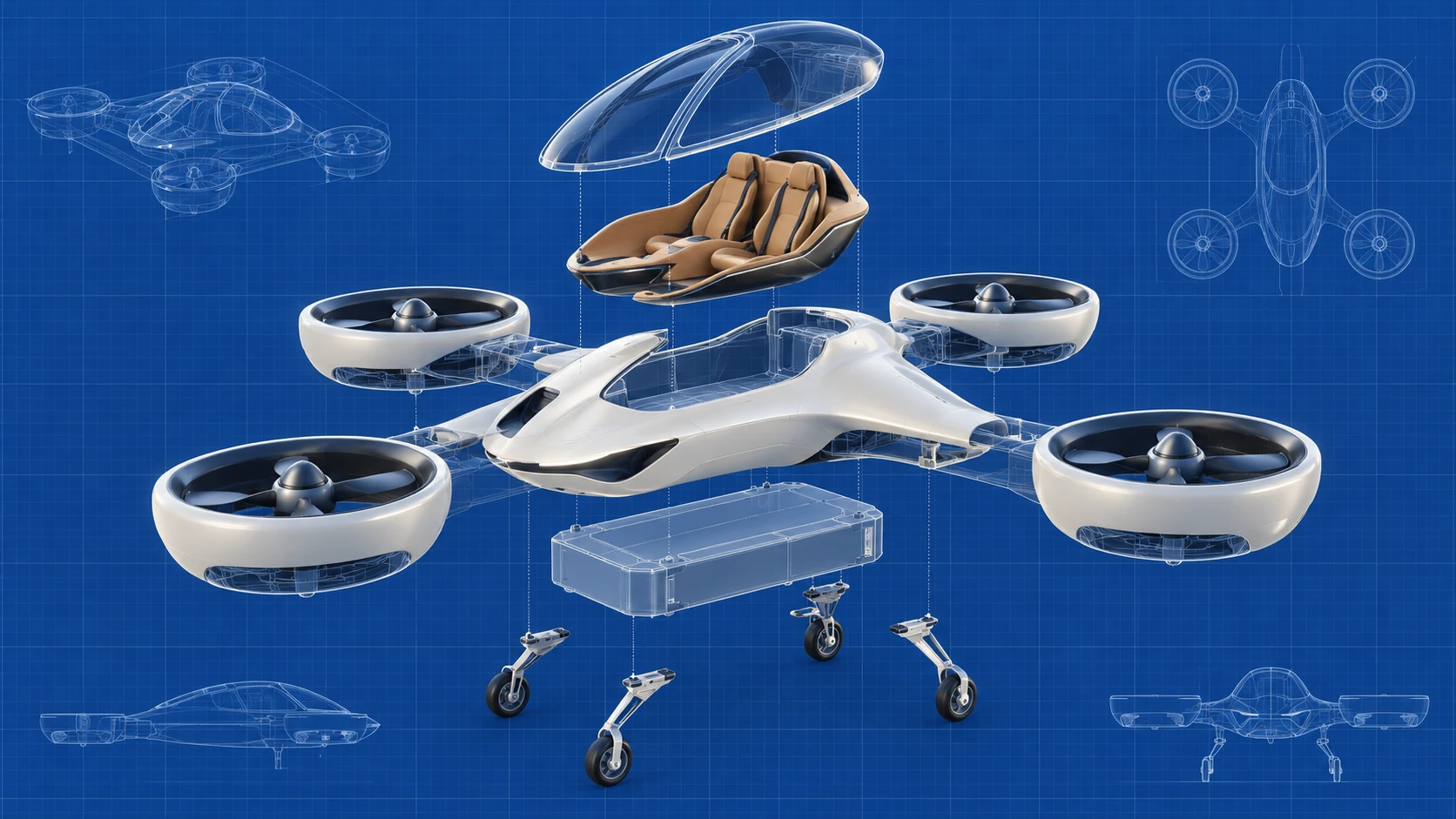
BP.01 / Functional boundaries only. Read the system cards below for the accessible text equivalent. No dimensions, wiring, controls or assembly instructions.BP.02 / Non-dimensional concept illustration. Separated forms are functional groups, not a parts list, assembly sequence or validated load path.
SYS.01
Human cabin
Boarding, restraints, accessibility, luggage and legible status.
Interface to resolve
Occupant needs → cabin geometry → ground and aircraft requirements.
Evidence before advancing
Accessibility studies and ergonomic mockups with human review.
SYS.02
Structure & attachment
Separate ground and aerial structural requirements; inspectable interfaces.
Interface to resolve
Loads, fatigue and crashworthiness requirements owned by qualified engineering teams.
Evidence before advancing
Analysis plans, materials records and independent structural review.
SYS.03
Energy & thermal
Investigate energy storage, thermal management and isolation.
Interface to resolve
Vehicle demands ↔ thermal system ↔ charging and fire response.
Evidence before advancing
Bench-only characterization and hazard assessment before vehicle integration.
SYS.04
Propulsion research
Compare plausible aircraft configurations without choosing performance numbers.
Interface to resolve
Propulsion ↔ structure ↔ energy ↔ acoustic impact.
Evidence before advancing
Simulation review and contained ground test plans; no flight instructions.
SYS.05
Safety & assurance
Identify hazards, responsibilities, failure responses and evidence gaps.
Interface to resolve
All systems ↔ engineering review ↔ regulator-agreed compliance evidence.
Evidence before advancing
Requirements traceability, independent review and a documented go/no-go process.
SYS.06
Human interface
Clear state, manual operational responsibility and accessible explanations.
Interface to resolve
Human operator ↔ vehicle state ↔ service desk.
Evidence before advancing
Usability studies; no autonomy or aircraft-control software is supplied.
SYS.07
Ground operations
Maintenance, charging, inspection, dispatch and community impact.
Interface to resolve
Vehicle ↔ trained service team ↔ permitted infrastructure.
Evidence before advancing
Tabletop exercises, service procedures and a noise/community research plan.
SYS.08
Digital record
Trace parts, requirements, changes and evidence across the lifecycle.
Interface to resolve
Supplier documentation ↔ quality records ↔ human approval.
Evidence before advancing
Auditable records, limited access and security review; no flight-control connection.
Shared ground and aviation hardware is a hypothesis. Road compliance does not qualify a part for flight. Ground propulsion and braking, aviation propulsion, flight controls and navigation, module retention, production quality, training and service each need their own reviewed requirements.
03 / El Segundo manufacturing vision
A studio that can become a factory.
A proposed El Segundo design, integration and service center, supported by qualified regional suppliers. There is no acquired facility, capacity commitment or approved supply chain. Each production step depends on evidence and actual site permissions.
CELL.01
Design office
Requirements, industrial design, community research and digital configuration control.
CELL.02
Supplier interface
Specify capabilities and qualification needs. Public directory entries are leads, not partners.
CELL.03
Ground demonstrator cell
Accessible mockups and non-flying integration studies with qualified supervision.
CELL.04
Inspection studio
Incoming inspection, traceability, calibrated measurement and documented nonconformances.
CELL.05
Service school
Design for repair; rehearse maintenance, emergency response and human handoffs.
CELL.06
Certification branch
An independently gated aviation program with regulator engagement before aircraft design commitments.
A public capability is a lead for qualification. It is not a supplier commitment, aerospace approval or an endorsement.
04 / Research & capital architecture
Fund the next question.
2030 is a decision horizon. Dates below are illustrative planning hypotheses; each gate can delay, redirect or stop the program. Financing ideas describe R&D planning only.
2026 / Define
Choose a problem before a vehicle
Deliverable
User research, ground-first use case, category assessment and initial hazard register.
Go / no-go gate
Qualified engineering and regulatory review of the intended use.
Planning assumption
Illustrative exploration envelope: $100k–$300k
Possible research support
Founder-supported research or appropriately scoped research grants; eligibility unverified.
2027 / Demonstrate
Make the experience tangible
Deliverable
Full-scale non-flying cabin mockup, ground experience studies, supplier RFQs and a traceability prototype.
Go / no-go gate
Human factors, accessibility, safety and cost review before powered integration.
Planning assumption
Illustrative ground-study envelope: $500k–$2m
Possible research support
Research collaborations, grants where eligible and negotiated development services; no partnerships assumed.
2028 / Decide
Earn the next branch
Deliverable
Independent trade study: ground product, aviation research or stop. Develop a regulator-engagement and compliance plan if aviation is selected.
Go / no-go gate
Credible safety, community, financing and certification path; a stop decision is valid.
Planning assumption
Illustrative definition envelope: $2m–$8m
Possible research support
Private strategic financing only after professional legal and financial review; no offer is made here.
2029 / Qualify
Build evidence, not a launch date
Deliverable
Qualified supplier program, reviewed ground integration and documented verification methods. Flight activity requires separate approved programs.
Go / no-go gate
Independent safety assurance and applicable approvals before any aircraft test.
Planning assumption
Aviation program cost is not estimated here; it may greatly exceed prior exploration budgets.
Possible research support
Milestone financing conditioned on evidence, realistic capital needs and applicable law.
2030 / Possible horizon
The year is a question
Deliverable
Publish what was learned and decide whether any permitted ground product or separately certified aviation product is viable.
Go / no-go gate
Certification, operational permission and production readiness are prerequisites, not calendar promises.
Planning assumption
Production capital requires a new bottom-up estimate.
Possible research support
No funds are solicited, securities offered or prototype flight organized by this page.
Numbers are fictional planning assumptions in 2026 USD, not quotes, forecasts, investment terms or a total aircraft-program budget. They exclude land, full aircraft certification, production tooling, insurance and operating infrastructure. Replace them with qualified bottom-up estimates before decisions.
This is an informational research roadmap. No investment terms, returns, funds collection or investment invitation are provided. Any actual capital-raising plan needs qualified securities counsel and a lawful offering route before public terms or solicitation. SEC general-solicitation guidance.
05 / The approvals are separate
A form is not an aircraft category.
Ground-first modular mobility
Controlled ground demonstrator with a documented road-compliance plan
Vehicle classification and applicable FMVSS
Manufacturer compliance certification
California registration and road-use requirements
Local facility and safety requirements
Research judgment: Lowest of these three; still material. No eligibility is established for the rendered designs.
Eligible two-seat powered-lift can have a light-sport special-airworthiness route under Part 22 / §21.190. A special-class type-certification route is a separate branch. Neither is assumed for these shapes.
The July 2026 acceptance of ASTM F3840-26 covered powered-lift only at that time, despite its title including multicopters. A generic wingless multicopter must not be treated as automatically eligible.
Light-sport aircraft certification does not create powered-lift sport-pilot privileges or general paid-passenger authority. The framework addressed here assumes onboard pilots; autonomous passenger service is not established.
SFAR 120 / Part 194 covers pilot training and operations separately. Experimental authorization does not grant routine commercial passenger permission; two occupants do not qualify as a Part 103 single-occupant ultralight.
Aircraft approval does not approve a landing site. LAX airspace, FAA review, Caltrans heliport permits, local land use, environmental review and emergency access need site-specific work. No speculative flight corridor or rooftop is approved here.
Electric imagery does not resolve noise, downwash, fire response or community acceptance. The proposed factory also requires parcel-level review.
Does a ground-only cabin solve the actual problem?
Who benefits, and who bears noise, cost and access burdens?
What aircraft category and operating model would apply?
What energy and emergency-response constraints rule out the concept?
Which supplier capabilities can be qualified and independently inspected?
What evidence would make us stop?
Next useful work: define one civil ground-use case, commission qualified classification and safety review, and gather scoped nonflight prototype quotes. An independent review should be able to conclude that the aviation branch should stop.
07 / Research record
Sources & limits.
Primary-source research checked 2026-10-02. The architecture and roadmap are an original planning synthesis, not agency forecasts or legal advice. Direct eCFR retrieval and the final powered-lift safety-continuum policy were not independently verified in this research; no quantitative safety targets are claimed.