
◊ VISIT STAMP · 07.28 · 07:19 PT
TIDE CABINET — Beach Commons V10
An empty field museum for shell-and-stone attention, a walking net that never catches, and a restoration relay from Dockweiler to the habitats where the work belongs
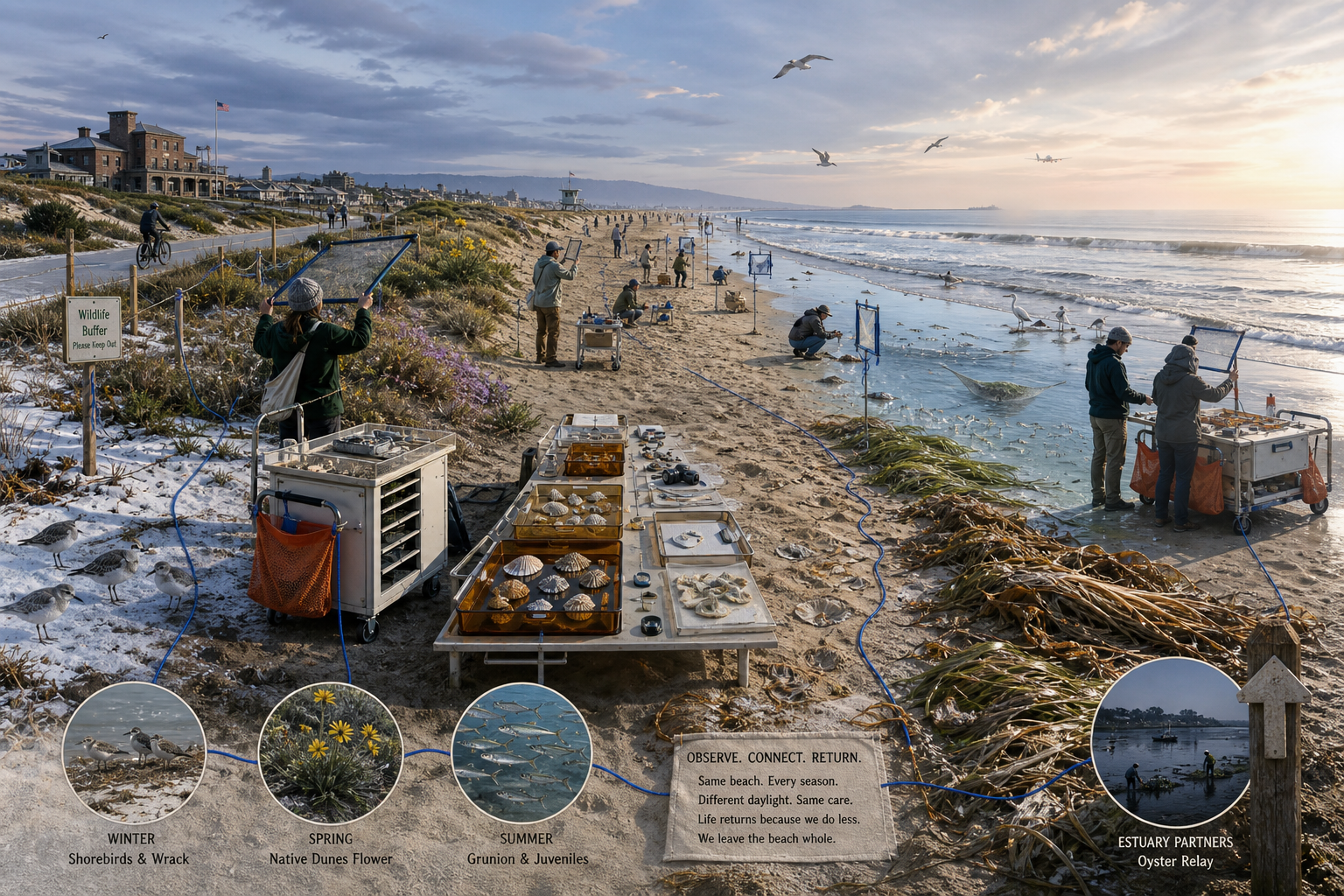
TIDE CABINET is an eight-part field museum that opens with no collection and closes the same way. Shells, stones, wrack, feathers, driftwood, and animal remains stay part of the beach. The permanent collection is attention: exact-location cards, descriptions, scale drawings, photographs, textures, uncertainties, and the completed act of return. The walking net catches only perspective. Soft cord is stretched across a light frame and carried above dry sand as a viewfinder, lifted as a shadow grid, laid on a table as a map, or used to carry clearly human-made litter. It is never swept, dragged, seined, trapped, dipped, chased, or used to catch wildlife. Ocean take remains governed by current species, season, place, license, and gear rules; this is not fishing gear or instruction. The sequence moves from the Tide Cabinet and Shell + Stone Borrowing Library through a Net Walk and Wrack Line Reading Room, then into a no-take Grunion Moon Watch and a dry-land Eelgrass Window. A final Oyster Relay makes the essential location change: Olympia oyster restoration belongs in sheltered bays and estuaries with qualified partners, prepared material, monitoring, and permits—not as a do-it-yourself release into exposed Dockweiler surf. Dockweiler already participates in real living-shoreline work: dune restoration and an offshore eelgrass pilot. The most credible public experiment is to make those living systems legible, protect wrack and wildlife space, remove only anthropogenic litter, and ask the existing teams what community help is genuinely useful. The human edition includes eight original 1536×1024 concept plates, an exact-return borrowing loop, eight contributor roles, three honest paths toward a real experiment, current official ecology and regulation sources, and a six-voice Shoreline Score generated live in the browser. No sample, recording, account, or autoplay is used. No event is announced.
