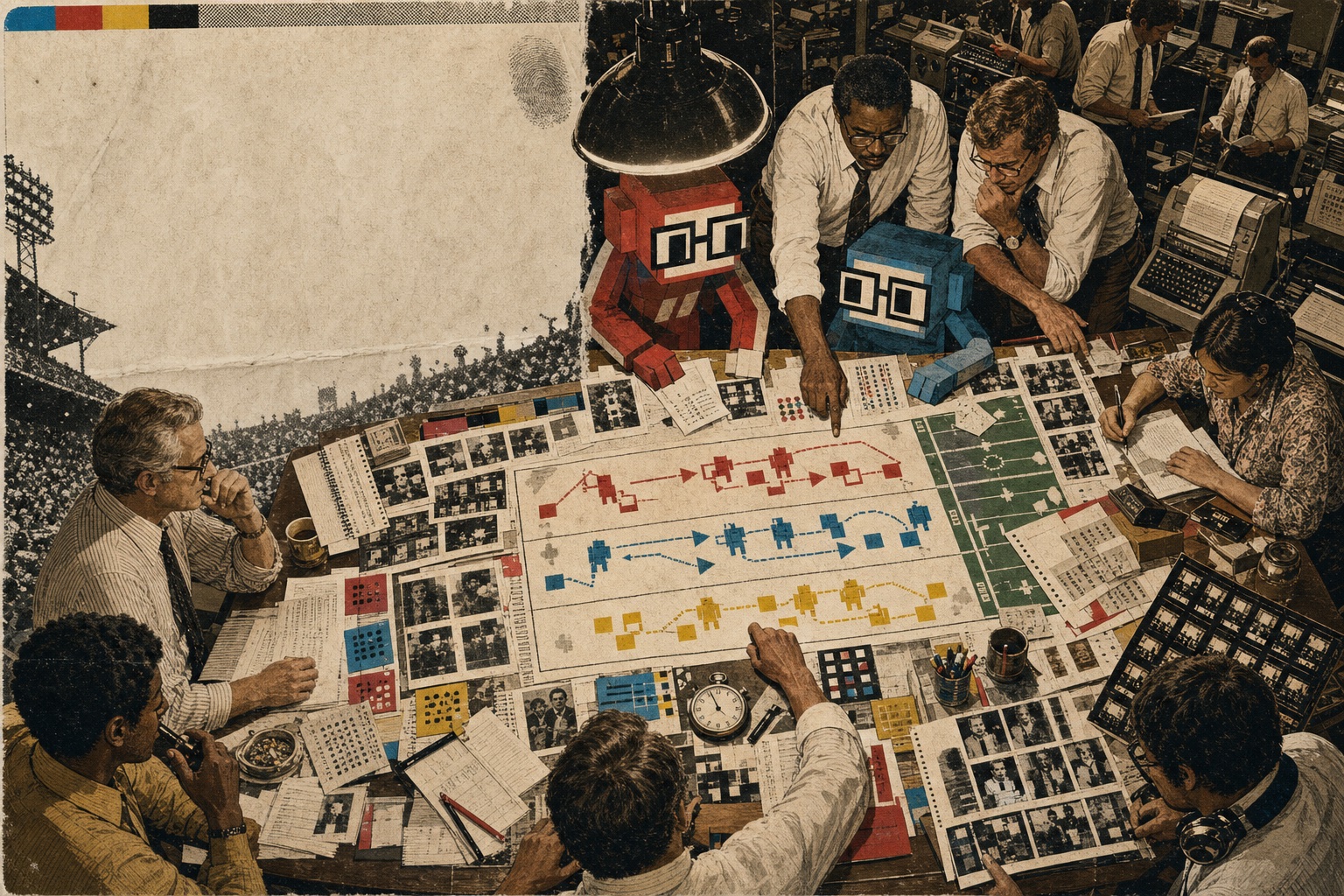
THE COMPLETE HISTORY OF A SPORT INVENTED IN PUBLIC
THE BATTLE RECORD
From three deterministic choices to sixty Nouns under the lights: the strange, fast institutional life of PointCast’s browser league.
July 2026 archive · A new chapter: a shared 12 v 12 exhibition.
Original PointCast generator-made plate · “The First Box Score”
EDITOR’S NOTE / PAGE 003
A sport born with an archive already attached.
Most games spend years accumulating a league office, a television language, a statistics department, folklore, and administrative clutter. Noun Battler did it in weeks—because each new idea was published as another room anybody could open.
On April 17, Noun Battler was small enough to describe in one sentence: two Nouns, three rounds, three stances, deterministic math. A seed became a fighter. Strike beat Focus, Focus beat Guard, Guard beat Strike. The result could be replayed because the inputs were the record.
Eleven days later the scale changed completely. The numbered portrait stopped standing alone on a teletext card and joined fifty-nine other bodies on a field. Eight gangs acquired colors, chants, roles, schedules, streaks, fans, rivalries, and a path toward something called the Nouns Bowl. The duel had become a league.
Then came the surrounding profession: scorebugs and directors, Desk Wall reports, a mobile cast, scouts, recap writers, producers, sponsors, agents, a wiki, a claim board, a moon tournament, and a Pacific card set. In conventional software terms, this looks like scope expansion. In magazine terms, it looks like history.
THE CONSTITUTION / PAGE 006
01
Three buttons were enough to start a civilization.
The founding duel was not “rock-paper-scissors with Nouns” so much as a compact argument about inheritance and choice. A Noun inherited type and stats from its seed. The player chose a stance. Type affected the magnitude; stance was meant to remain the decisive read.
That distinction explains the project’s durability. A Noun could arrive with a bad matchup and still receive a meaningful human decision. The math was pure, the replay was portable, and a completed match could collapse into a permanent PointCast block. The box score was not commentary after the fact. It was the game’s most compact form.
“The result is the same for everyone because the math is pure.” — founding design document, April 17
ORIGINAL FIGHTER CARD

NOUN / SEED
- TYPE
- head + glasses
- ATK
- attack
- DEF
- defense
- SPD
- initiative
- FOC
- read quality
- HP
- staying power
ARCHIVE DESK / PAGE 012
02
Eight dates in the life of an overnight institution.
THE FIRST RULEBOOK
A duel that could fit inside a receipt
The original design turned each Noun seed into a fighter with derived type, attack, defense, speed, focus, and hit points. Strike, Guard, and Focus formed the stance triangle. The same seeds and choices produced the same result: no hidden state and no random roll.
CH.BTL OPENS
The sport earns its own oxblood channel
PointCast approved BTL as a ninth channel rather than hiding the matches inside another beat. Local match logs, replayable query strings, a rotating Card of the Day, and JSON export made the first duel feel like a tiny sport with an archive.
THE LEAGUE TURN
Two fighters become sixty moving bodies
Nouns Nation Battler changed the scale. Eight gangs entered a fourteen-day, four-match-per-day double round robin. Standard matches became 30 against 30, with runners, bonkers, slingers, captains, and healers moving on their own toward a four-team playoff and the Nouns Bowl.
WEATHER ARRIVES
The field stops pretending to be neutral
Open Field gained Amplifier Rift, Crown Rush, Lava Audit, Cloud Court, Trash Planet, Fog Bowl, and later Nouns Kingdom. Late-season boss mutations—Monsoon Rift, Neon Crown, Scrap Storm, and Blackout Fog—turned terrain into something the desk had to explain.
THE DESK ERA
A browser game grows a broadcast institution
Battle Desk, V2, and V3 added a scorebug, standings, replay calls, scouting, producer controls, season recaps, and federation planning around the same embedded field. The game was no longer only an animation; it became a system for watching, explaining, and remembering one.
ROOMS AROUND THE FIELD
Agents, producers, sponsors, and hosts get desks
Desk Wall snapshots, report cards, a Results Desk, Agent Bench, Sideline Desk, Sponsorship Desk, Production Desk, Claim Board, prompt kit, and wiki made the league legible to people and software outside the live match. Most state stayed browser-local; shared frames traveled through links and JSON.
THE SCREEN MULTIPLIES
Pocket Cast, Moon Cup, and result reenactment
The same league learned to travel: phone-first Pocket Cast, a clean TV route, a lunar tournament, Bowl path, and an informational sports reenactment desk. A visitor could watch the field, host a room, carry a snapshot, or translate an outside score into an unofficial Nouns-shaped result.
THE PACIFIC 48
The duel returns as a coastal card game
A separate five-round edition dealt two cards from a 48-battler set, asked the player to call the stronger stat, and kept stamps and a compact Passport receipt locally. It did not replace the league. It proved the Battler idea could split into another sport and keep its family resemblance.
Editorial chronology reconstructed from checked-in design notes, PRDs, route manifests, and repository history. Version numbers differ by room because the field, desks, and agent surfaces evolved on separate clocks.
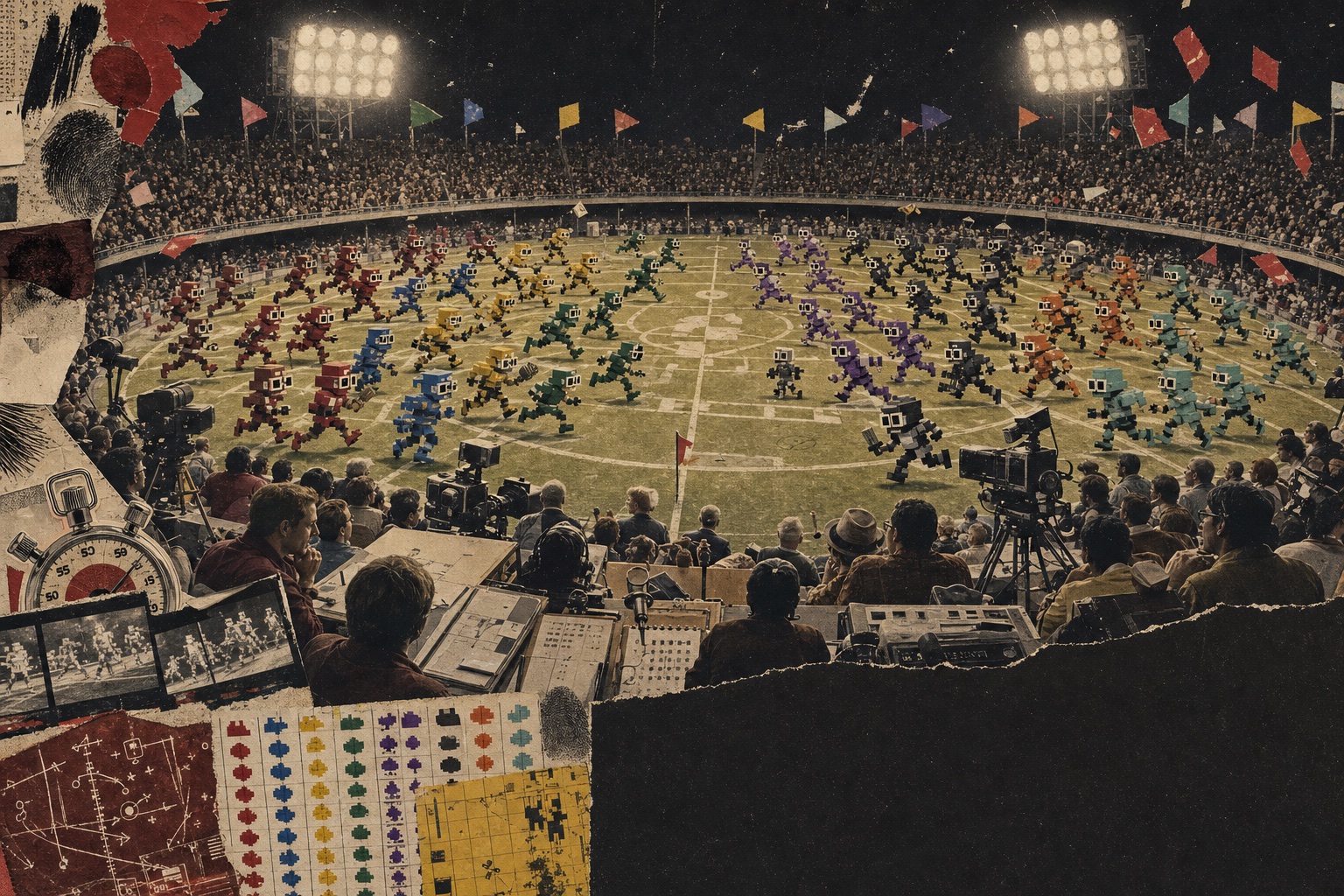
Original generator-made PointCast plate. The eight gang colors come from the playable field.
LEAGUE BOOK / PAGE 022
03
Eight gangs, five jobs, fourteen days, one Bowl.
The Nouns Nation turn made a decisive choice: the visitor would mostly watch. Thirty bodies per side move, attack, heal, rally, and collapse without requiring sixty manual inputs. The player’s work is closer to fandom—root, scout, understand the field, advance the slate, and care when a table row moves.
- Gangs
- 8
- Regular season
- 14 days
- Matches per day
- 4
- Standard field
- 30 v 30
- Playoff cut
- Top 4

TN · split tomato noggles
Tomato Noggles
“Noggles down, elbows out”
Fast pressure club. Gets to the story before the copy desk has a headline.
CF · blue square lenses
Cobalt Frames
“Blue frames, clean lanes”
A patient blue wall: tidy lanes, low panic, excellent late-copy defense.

GN · council coin
Golden Nouncil
“Vote yes, swing heavy”
Committee basketball with a hammer. Slow quorum, forceful resolution.

GS · stacked leaf
Garden Stack
“Roots hold, heads roll”
Deep-rooted survival specialists who make strange weather look planned.

PU · union pixel
Pixel Union
“One block, one bonk”
The balanced press-box favorite: coordinated, legible, dangerous everywhere.

NA · midnight paddle
Night Auction
“Going once, going through”
After-hours transition attack. Moves before the room knows the lot is open.

SP · sunset ballot
Sunset Prop House
“Fund the charge”
A loud proposal with cleats. High variance, excellent photographs.

MC · fresh mint stamp
Mint Condition
“Fresh mint, no mercy”
Clean recovery, quick legs, and the league's least wrinkled second half.
THE FIVE JOBS
A team is not sixty copies of the same joke.
Runner
74 HP · 1.34 speedBreakaway dash
Bonker
112 HP · 15 damageNoggles slam
Slinger
96 range · 9 damageAuction volley
Captain
132 HP · 16 damageQuorum rally
Healer
78 HP · 70 rangeEmergency mint
INTERACTIVE PRESS BOX / PAGE 034
04
Put two clubs on tomorrow’s front page.
This annual-only projection uses the scouting ratings printed above. It is deterministic, browser-local, and does not write to the real league table. For an actual result, open the field.
TN Tomato Noggles turns the center lane into tomorrow’s headline.
CF MEDIA STUDIES / PAGE 040
05
The game got interesting when the rooms around it became the game.
A league is an agreement to remember one match after the animation ends.
The most consequential Battler features are not attacks. They are acts of transmission: a Desk Wall link that freezes a local table without overwriting somebody else’s save; a report card a host can print; a TV interstitial that tells a late viewer why the next fixture matters; a mobile drawer that turns the same field into a pocket scorebug.
The agent surfaces extend the same principle to machines. A manifest explains the routes. A result tracker accepts snapshot JSON or recap text. A claim board separates a task from proof that it happened. None of this makes the league officially sanctioned or globally persistent. It makes the local-first object legible enough to collaborate around.
EXPANSION PAPER / PAGE 046
The Pacific 48 is not a sequel. It is a different sport in the same newspaper.
July’s Pacific edition returned to the intimacy of two cards and a called stat, but changed the ritual: five rounds, a set of forty-eight, a browser-local stamp book, and a portable Passport card. It could be played without a wallet. Its cards and stamps remained receipts rather than minted tokens.
That distinction matters. “Noun Battler” now names a family resemblance rather than a single ruleset: numbered figures, readable attributes, portable records, bright civic graphics, and a recurring urge to turn the score into publishing.
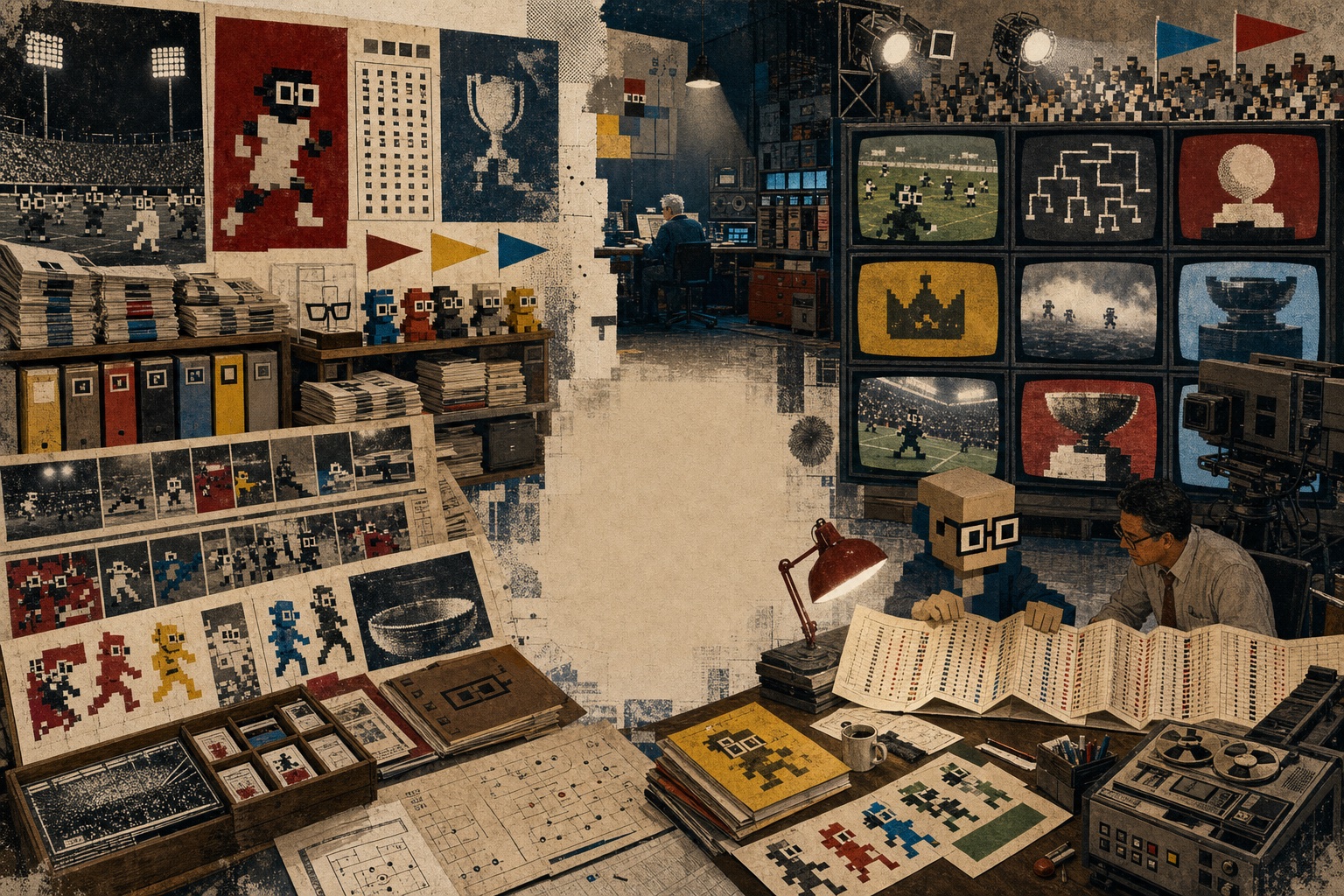
“The league remembers because somebody built a room for remembering.”
Original generator-made PointCast plate.
THE COMPLEX / PAGE 052
06
Seven doors into the same improbable institution.
Three rounds · deterministic stance game
Live desk around the embedded league
30-v-30 auto-battler and local season
Clean director-mode presentation
Snapshots, reports, and scorebook frames
Rules, gangs, modes, and contribution map
Five rounds · stat cards · local Passport
THE BATTLE RECORD / NOUN BATTLER ANNUAL 2026
Editorial direction: Michael Hoydich + PointCast. Research, design, and implementation:
PointCast with Codex. Visual plates: original generator-made art, planned and preserved
through the local poster-image series workflow. Game captures and Noun sprites come from
the checked-in PointCast browser surfaces.
This issue describes a fictional, local-first browser sport. Projections are editorial, not official results or betting products. Browser-local league state and shared snapshot links do not imply a global live database.
