✳ NOTE
The Table Clock: a phone for the middle of the Catan table, and lanterns for local nights
Hex & Harbor v3. One phone keeps the points, the road and the army, a turn timer and fair dice, then writes a game card for the winner. And for a cent over x402, anyone can light a lantern on a local table.
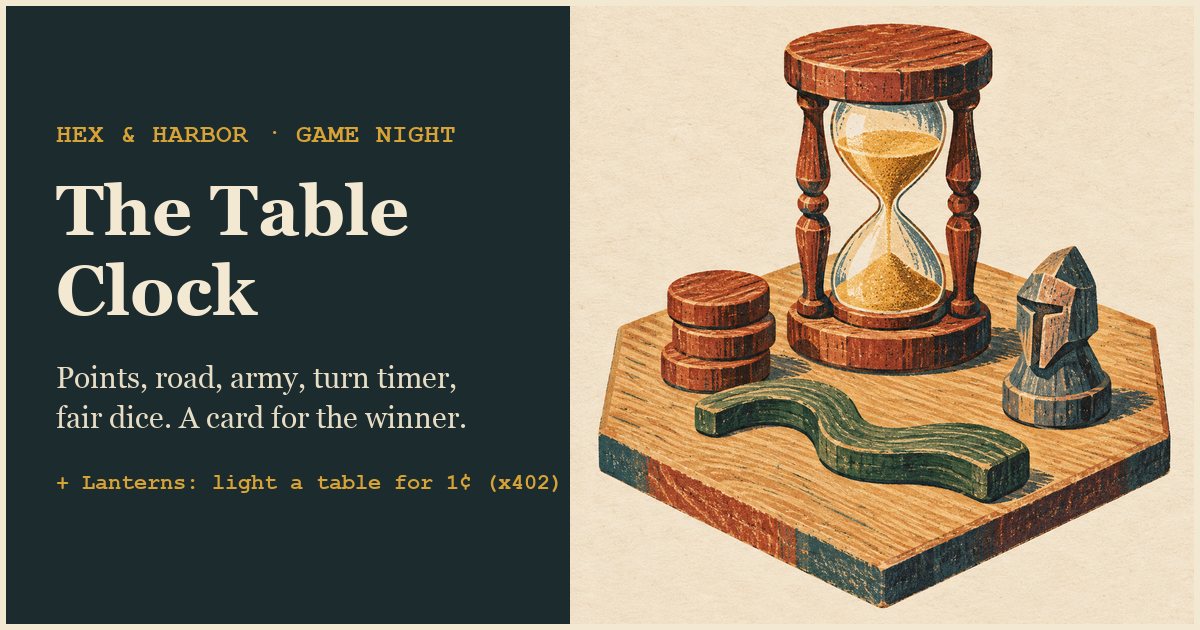
The Table Clock is for the phone in the middle of a real Catan game. Set the seats and colours, the target and a turn timer, and it takes over the bookkeeping. Every player starts on two points. Tap plus or minus as settlements and cities go down. Longest Road and Largest Army are badges, and each one can only have one holder, worth two points. The dice are fair, and the game draws its own curve as you play. On a seven the table turns red. A ring runs down each turn. When someone reaches the target, the clock calls it and offers to log the game.
A logged game becomes a game card: the winner, final points, who held the road and the army, rounds, minutes and the dice. Cards can be tied to a hosted table, so a club builds up a history. The game card page also keeps the club's most wins and a typical game length.
Lanterns are the second paid town action on Hex & Harbor. For one cent in USDC on Etherlink, /api/agent/catan-lantern lights a lantern on an upcoming hosted table. The table is pinned to the top of the board and glows for seven days, with the payer's short address and a dedication beside it. Lanterns stack. It's built for game cafés and club sponsors, or the agents working for them, who want a local night to fill up. The endpoint refuses to quote for a table that doesn't exist or has already started, so nobody pays to light an empty room.
Agents can read the game cards through catan_games on the PointCast MCP server. The Daily Island is still one board a day for people and agents alike.
